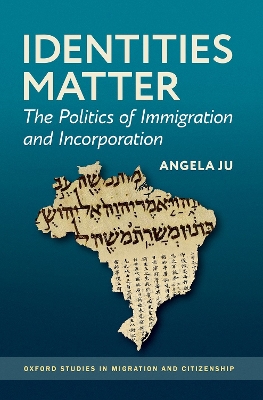
Higher-status immigrant communities in the Global South with ties to more developed countries might form identities and political strategies that reinforce an association with their heritage country rather than seek to completely integrate into their host country. Identities Matter: The Politics of Immigration and Incorporation investigates the politically and socially beneficial reasons for this. The case studies illustrating these phenomena are Japanese Brazilians and Jewish Brazilians.
Grandchildren of immigrants belonging to groups that have achieved high socioeconomic status choose which identities to leverage in the host country's political arena. The scholarship about political incorporation often assumes that immigrant groups and their descendants find it in their best interest to pursue mainstream political incorporation. Those immigrants who belong to ethnic minority groups might choose to engage politically in a number of ways, depending on their racial or economic status; Identities Matter: The Politics of Immigration and Incorporation looks at how descendants of minoritized groups who have achieved, generally speaking, high socioeconomic status choose to identify politically in their adopted nations. Contrary to many expectations about political and social incorporation of immigrants, it finds that assimilation is not necessarily advantageous for groups who are from or associated with countries that are more economically developed than their host country. When this is the case, these immigrant communities may choose to strategically associate themselves with the heritage country over the one in which they reside.
The book draws on original research among third-generation Japanese and Jewish Brazilians to determine the seemingly paradoxical ways in which the descendants of immigrants choose which identities to emphasize in the political arena. It shows that immigrant communities' strategies of political incorporation and social integration are framed within where they fall in existing ethno-racial and socioeconomic hierarchies, and that perceptions of discrimination drive third-generation descendants to vote in line with their ethnic interests. One particularly interesting finding is that in Brazil, a country that suffers from high levels of political corruption, Japanese Brazilian politicians are often incentivized to emphasize their Japanese-ness over their Brazilian-ness to convey to voters that they are more honest as political candidates than their "more Brazilian" opponents. Finally, ethnic community-based organizations allow these groups to leverage their identities transnationally.
List of Figures List of Tables Preface Acknowledgments 1: Identities of
Japanese Brazilians and Jewish Brazilians 2: Conceptualizing Japanese
Brazilian and Jewish Brazilian Identities 3: The Racial or Color Identity
Determinants of Japanese Brazilians and Jewish Brazilians 4: Leveraging
Identities in Brazil 5: Leveraging Identities with Associated Countries:
Ethnic Community-Based Organizations 6: Conclusion: The Changing Diversity of
Brazil Appendices Bibliography Index
Angela Ju received four Bachelor of Arts degrees in Political Science, Spanish, Latin American Studies, and European Studies from the University of Washington, Seattle and her MA and PhD. in Political Science from the University of California, Los Angeles in 2015. After completing her PhD, she worked in international development consulting before returning to academia. Since 2019, she has been Assistant Professor of Global Studies & Political Science at St. Edward's University in Austin, TX. She uses mixed-methods approaches to study race/ethnicity, gender, international migration, and social determinants of health in North America, Latin America, Europe, and East Asia.

 Lisainfo e-raamatute kohta