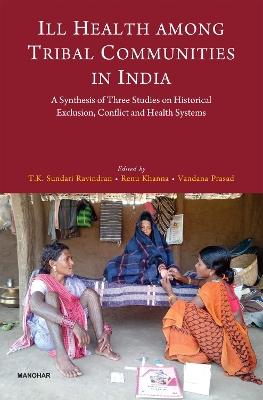
This book brings together the findings from three studies across four sites: Assam, Chhattisgarh, Jharkhand, and Kerala. It aims to understand and explain the diverse nature of health inequities along with processes and historical contexts which create, configure, and sustain health inequities among tribal populations in India. The book reveals that beneath the oft-repeated storyline of the poor health of tribal communities lies a more nuanced reality of varied experiences across different tribal communities; and within-group differentials among the same community.
The book also forcefully brings home the inadequacy of commonly used health indicators such as morbidity and mortality to describe the multiple dimensions of lack of well-being experienced by the tribal communities. With the help of thick qualitative descriptions, the book captures the everyday violence of loss of livelihoods, displacement, insecurity, poverty, and hunger, not to mention the overt violence of ethnic conflicts. It argues that these consequences to people's well-being can hardly be captured in terms of disease and death alone.
The book delineates the pathways through which health inequities experienced by the tribal communities have come about and have persisted. It highlights, among other factors, the failure of the public health system to reach out to the tribal communities and, worse still, the public health system's systematic marginalisation of tribal communities owing to the 'equity-blindness' of its very design, structure, and organisation. The book ends with reflections on the implications of the studies for policies, programmes, and research.
List of Tables, Figures and Boxes 6
Acknowledgements 9
Foreword
T.K. Sundari Ravindran, Renu Khanna and Vandana Prasad 11
1. Health Inequities and the Health of Tribal Communities in India
T.K. Sundari Ravindran, Ganapathy Murugan, Antony Stanley, Hisham Moosan,
Rama Baru and Aditi Hegde 15
2. Study Methodologies Renu Khanna, Jennifer Liang, Sulakshana Nandi, Antony
Stanley, Hisham Moosan and N. Nakkeeran 55
3. Findings Jennifer Liang, Vandana Prasad, Sulakshana Nandi, Renu Khanna, N.
Nakkeeran and Rama Baru 87
4. Discussion and Recommendations T.K. Sundari Ravindran, Renu Khanna,
Vandana Prasad, N. Nakkeran, Jennifer Liang, Sulakshana
Nandi and Rama Baru 155
Bibliography 181
Index 193
List of Contributors 201
T.K. Sundari Ravindran has more than four decades of experience as an academic and an activist working on gender and social inequities in health. Renu Khanna has over 40 years experience as a feminist development practitioner, trainer and evaluator. Vandana Prasad is a community pediatrician and public health professional with specific experience of working with tribal communities. She is technical advisor Public Health Resource Society (PHRS).

 Lisainfo e-raamatute kohta