Key Features
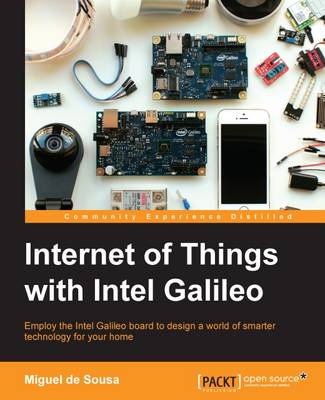
Book DescriptionThis book employs an incremental, step-by-step approach to get you familiarized with everything from the basic terms, board components, and development environments to developing real projects. Each project will demonstrate how to use specific board components and tools. Both Galileo and Galileo Gen 2 are covered in this book.What you will learn
Understand the concept of the Internet of Things Wire and power a Galileo board safely Develop code using the Arduino IDE, Intel IoT Dev Kit, and Intel XDK environments Build and start a Galileo board from a bootable image Use the Internet to feed, control, and gather data from sensors Create connected modules Combine multiple sensors to build complex projects
Who this book is forThis book employs an incremental, step-by-step approach to get you familiarized with everything from the basic terms, board components, and development environments to developing real projects. Each project will demonstrate how to use specific board components and tools. Both Galileo and Galileo Gen 2 are covered in this book.
Table of Contents
Introducing Intel Galileo
Rediscovering the Arduino IDE
Reading the Board Temperature
Create a Motion Sensing Light
Using the IoT Dev kit Image
Meteorological Station
Christmas Lights
Intel XDK IoT edition
IoT Quiz Game
Integrating with an IoT Cloud
Miguel de Sousa is a core engineer and full-stack developer at Muzzley. He holds an MSc in computing and telecommunications engineering from ISCTE-IUL Lisbon University Institute, Portugal. He has worked in backend networking, protocols implementation, and systems integration. As a maker, over the last 2 years, he has been developing several projects using Raspberry Pi, Arduino, and Intel Galileo/Edison boards in the field of Internet of Things.

 Lisainfo e-raamatute kohta