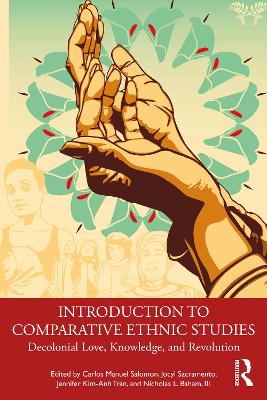
This book guides instructors and students through an intersectional and comparative approach to understanding key theories, concepts, practices, and movements in Ethnic Studies.
Written for introductory courses and for those new to Ethnic Studies, the book explores the decolonial legacies and origins of Ethnic Studies before delving into a broad array of vital and vivid topics including music and performance, U.S. militarism and migration, racial capitalism, gender and sexuality, environmental activism, and liberation through education, amongst others. Each chapter introduces the decolonial process of Love, Knowledge, and Revolution rooted in the theoretical and activist lineages of Ethnic Studies as an academic discipline.
Key features include:
- A focus on providing a range of diverse perspectives to help students develop critical self-awareness that nurtures a love for self and community
- A comparative approach that interweaves exemplary historical figures and preeminent scholars to empower students to view themselves within a continuum of an ongoing struggle for freedom
- Textboxes across the volume that highlight case studies and provide historical context to enhance student understanding
- Discussion questions in each chapter aid engagement with the ideas presented and develop the reader’s critical thinking skills
- A glossary of key terms
This book will be essential reading for students and teachers of courses in Ethnic Studies, and those interested in learning about the complex processes of race making and power through the lens of multiracial lived experiences in the United States.
This book guides instructors and students through an intersectional and comparative approach to understanding key theories, concepts, practices, and movements in Ethnic Studies.
Introduction
Part A: Love
Love: The First Step Toward Liberation
1. Learning Comparative Ethnic Studies: Critical Pedagogies of Decolonial
Love
2. Decolonization: Movement, Theory, Practice, and Transformation
3. Immigration: Inclusions, Exclusions, and Mobilizations
4. Class, Labor, and Racial Capitalism
5. Women of Color Feminist Theorizing and Praxis
6. Taking Ethnic Studies Back: Maintaining Liberatory Education even through
Institutionalization
Part B: Knowledge
Knowledge: Unveiling the Structures, Honoring the Stories
7. Militarism and Migration
8. Race, Space, and the City
9. Burn Hollywood, Burn!: Race and Racism in American Film
10. Activism through Music, Dance, and Performance
11. Culinary Resilience: Food Sovereignty, Ancestral Knowledge, and
Indigenous Lands
12. Gender and Sexuality
Part C: Revolution
Revolution: The Praxis of Love and Knowledge in Motion
13. Social Movements: Decolonialism, Civil Rights, and Self-Determination
14. Artivism for the Love of Art and Community
15. Spiritual Activism
16. Abolition Democracy and Prison Protest
17. Decolonizing Our Futures, Healing Our Minds: Vision Quests of
Afrofuturism to Indigenous and Queer Futures
Carlos Manuel Salomon is Professor of Ethnic Studies at California State University, East Bay. Dr. Salomon is the editor of The Routledge History of Latin American Culture (2019) and the author of Pio Pico: The Last Governor of Mexican California (2010).
Jocyl Sacramento is Associate Professor of Ethnic Studies at California State University, East Bay.
Jennifer Kim-Anh Tran is Assistant Professor of Ethnic Studies at California State University, East Bay. As an Oakland organizer, Dr. Tran leads inclusive community development initiatives that center the needs and expertise of immigrants and people of color in her hometown.
Nicholas L. Baham, III is Professor of Ethnic Studies at California State University, East Bay. He teaches Black Studies and Genders and Sexualities in Communities of Color. Dr. Bahams books include The Coltrane Church: Apostles of Sound, Agents of Social Justice (2015) and The People's Detective (2024).

 Lisainfo e-raamatute kohta