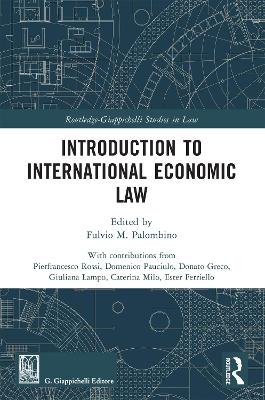
International Economic Law (IEL) refers to the rules governing economic relations at the international level and involving States, international organizations and private entities. This textbook explores IEL within the broader context of public international law, providing all the foundational principles essential for the study of IEL.
International Economic Law (IEL) refers to the rules governing economic relations at the international level and involving States, international organizations and private entities. This textbook explores IEL within the broader context of public international law from the ground up, providing all the foundational principles of international law essential for the study of IEL. The first part of the book is devoted to the analysis of actors and sources of IEL while the second part focuses on the three main sectors of IEL: international investment law, the law of international trade, as developed through the work of the World Trade Organization (WTO), and international financial and monetary law. Through references to conventional rules, landmark cases and decisions of international organizations, Introduction to International Economic Law provides a clear and concise primer on the main issues in current IEL. It will be an ideal textbook for students taking introductory courses in IEL, as well as a useful guide for anyone wishing to learn about the subject and understand the dynamics behind it.
1. Introduction
2. The Subjects, Actors and Sources of International
Economic Law
3. International Investment Law
4. The Law of the World Trade
Organization
5. International Financial Law
Fulvio M. Palombino, Ph.D., is Full Professor of International Law at the University of Rome Tor Vergata and Adjunct Professor of International Law and Interna- tional Economic Law at Luiss University.
Pierfrancesco Rossi, Ph.D., is Assistant Professor of International Law at the University of Teramo, Adjunct Professor of International Law at Luiss University and Adjunct Professor of International Trade Law at the University of International Studies of Rome.
Domenico Pauciulo, Ph.D., is Assistant Professor of International Law at the University of Trieste and Adjunct Professor of International Trade Law at Luiss University.
Donato Greco, Ph.D., is Assistant Professor of International Law at the University of Naples Federico II and Adjunct Professor of International Organizations and Human Rights at Luiss University.
Giuliana Lampo, Ph.D., is Postdoctoral Research Fellow in International Law and Adjunct Professor of International and EU Economic Law at Luiss University.
Caterina Milo, Ph.D., is Postdoctoral Research Fellow in International Law at the University of Trento and Adjunct Professor of International and EU Economic Law at Luiss University.
Ester Ferriello, Ph.D. Candidate in International Law at the University of Naples Federico II.

 Lisainfo e-raamatute kohta