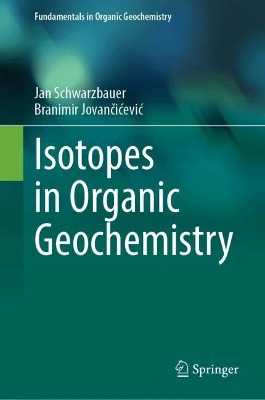
This volume of the series Fundamentals of Organic Geochemistry provides an overview of isotope analysis in organic geochemistry and related fields of applied sciences. It dives deep into the basics of isotopes and isotopic fractioning processes with applications e.g. in environmental biodegradation or correlations of fossil matter. This textbook helps students understanding the geoscientific, analytical, and chemical isotope aspects in complex natural systems. Students learn the importance of isotope organic geochemistry and its relationship to fundamental processes in the geosphere and biosphere, which include e.g. photosynthesis, evaporation/precipitation within the global water cycle, biotic degradation, and biosynthesis.
The book is intended for chemistry and geoscience students at BSc, MSc, and PhD levels.
Chapter 1: Introductory aspects.
Chapter 2: Isotope fractionation processes.
Chapter 3: Analytical methods.
Chapter 4: Aspects of compound-specific isotope analysis apart from geosciences.
Chapter 5: Fossil matter correlation.
Chapter 6: Biogenic vs thermogenic gas emissions.
Chapter 7: Paleoenvironmental conditions.
Chapter 8: Isotope analysis in environmental sciences.
Prof. Dr. Jan Schwarzbauer
Current research topics:
Sources, transport and fate of organic contaminants in water and sediments of surface water systems Impact of anthropogenic xenibiotics on riverine systems Structure elucidation of still unknown organic contaminants Analytical investigations on pollution sources of surface and ground water (industrial emissions, municipal effluents, waste deposit seepage water, mining effluents etc.) Organic-geochemical characterization of bound residues in riverine particulate matter Compound specific isotpe anaylsis of organic pollutants Geochronology of organic contamination in riverine sediment archives and generation of correlated pollution histories Detection and quantification of synthetic polymers in river water, municipal effluents, sewage slugde and soil
CV: 1993: Degree in Chemistry (diploma) University of Hamburg 1997: Dr. rer. nat. degree, University of Hamburg 2004: Habilitation, RWTH Aachen University 2004 2009: Assoc. Prof. (Privatdozent), RWTH Aachen since 2009: Full Professor
Prof. Branimir Jovanievi
Education and qualifications:
1985: Bachelor of science studies Chemistry / Prirodno-matematiki fakultet (Belgrade, Serbia) 1988: Master of science studies Chemistry / Prirodno-matematiki fakultet (Belgrade, Serbia) 1994: Doctoral academic (PhD) studies Chemistry / University of Belgrade Faculty of Chemistry (Belgrade, Serbia) Scientific interest: Organic geochemistry, environmental chemistry.

 Lisainfo e-raamatute kohta