Muutke küpsiste eelistusi

E-raamat: Italian Renaissance: A Cultural History

(University of Cambridge)
  • Formaat: PDF+DRM
  • Ilmumisaeg: 15-Jan-2026
  • Kirjastus: Cambridge University Press
  • Keel: eng
  • ISBN-13: 9781009474238
  • Formaat - PDF+DRM
  • Hind: 33,34 €*
  • * hind on lõplik, st. muud allahindlused enam ei rakendu
  • Lisa ostukorvi
  • Lisa soovinimekirja
  • See e-raamat on mõeldud ainult isiklikuks kasutamiseks. E-raamatuid ei saa tagastada.

DRM piirangud

  • Kopeerimine (copy/paste):

    ei ole lubatud

  • Printimine:

    ei ole lubatud

  • Kasutamine:

    Digitaalõiguste kaitse (DRM)
    Kirjastus on väljastanud selle e-raamatu krüpteeritud kujul, mis tähendab, et selle lugemiseks peate installeerima spetsiaalse tarkvara. Samuti peate looma endale  Adobe ID Rohkem infot siin. E-raamatut saab lugeda 1 kasutaja ning alla laadida kuni 6'de seadmesse (kõik autoriseeritud sama Adobe ID-ga).

    Vajalik tarkvara
    Mobiilsetes seadmetes (telefon või tahvelarvuti) lugemiseks peate installeerima selle tasuta rakenduse: PocketBook Reader (iOS / Android)

    PC või Mac seadmes lugemiseks peate installima Adobe Digital Editionsi (Seeon tasuta rakendus spetsiaalselt e-raamatute lugemiseks. Seda ei tohi segamini ajada Adober Reader'iga, mis tõenäoliselt on juba teie arvutisse installeeritud )

    Seda e-raamatut ei saa lugeda Amazon Kindle's. 

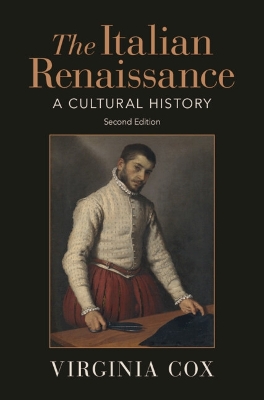
The extraordinary creative energy of Renaissance Italy lies at the root of modern Western culture. In this magisterial study, Virginia Cox offers a fresh vision of this iconic moment in cultural history. Her lucid and absorbing book explores key artistic, literary and intellectual developments, as well as histories of food and fashion, map-making, exploration and anatomy. Alongside towering figures from Petrarch and Boccaccio to Leonardo, Machiavelli, and Isabella d'Este, Cox unveils lesser-known Renaissance protagonists including printers, travel writers, actresses, courtesans, explorers-even celebrity chefs. This extensively revised and expanded edition includes an incisive overview of Italy's relationship with the European and non-European worlds, embracing ethnic and religious diversity within Italy, the global dissemination and hybridization of Italian Renaissance culture, and Italian global encounters, including Jesuit missions to Asia. Pulling together the latest scholarship with original research and insight, Cox's book speaks both to general readers and specialists in the field.

Arvustused

Praise for the first edition: 'Virginia Cox makes the text and its contents comprehensible and well-befitting the required reading list of nascent students of the period . Her prose is particularly well suited to those with little or no familiarity with the topic. However, her outstanding overall examination of the Italian Renaissance will also spark the interest of seasoned enthusiasts and fellow scholars.' Italian Culture '[ This] is an essential book for anyone interested in this topic. This work would be a great resource for the university classroom, serving as a general textbook for undergraduate- and graduate-level courses from which the instructor can supplement with the primary and secondary sources Cox mentions. For the general reader, this book provides a strong foundation in the people, places, art, and literature of the period that will spur further reading of more specialized scholarship.' Sixteenth Century Journal 'Virginia Cox's short history of the Italian Renaissance is an exemplary introduction - concise, lucid, elegant, balanced, perceptive and accessible. It summarizes traditional views of the Renaissance, especially Jacob Burckhardt's, criticizes them, and offers a revised interpretation of the movement. Cox's Renaissance is, in her own words, 'broader and deeper' than its predecessors. She places more emphasis than usual on the coexistence and conflict between different ideas and styles. She re-interprets Burckhardt's idea of Renaissance 'individualism' with the aid of recent work on social psychology. Her book includes discussions of the applied arts, notably fashion, as well as a chapter on 'the Renaissance woman,' based on the author's own research. Students will be grateful for this book, general readers will enjoy it, and fellow-scholars will be appreciative of the knowledge and thought underlying its apparently effortless production.' Peter Burke, FBA, Emeritus Professor of Cultural History, University of Cambridge, author of The Italian Renaissance 'This is a short and pithy book by an outstanding scholar at the top of her game. Prioritizing literature, it uses newly-discovered or unfamiliar writings to re-describe social classes, as well as topics like individualism and gender. Its innovative chapters on 'Renaissance Man' and - especially - 'Renaissance Woman' help to reset the agenda for understanding the Italian Renaissance, making this book an invaluable twenty-first-century guide, not only for students but for the rest of us as well.' Alison Brown, Emerita Professor of Italian Renaissance History, Royal Holloway, University of London, author of The Renaissance 'Virginia Cox's rich, thought-provoking and elegantly written introduction to the Italian Renaissance conceives the cultural movement widely and inclusively, and encourages us to see it in new ways. Cox shows how it was rooted in an emulative and endlessly inventive dialogue with the models of ancient Rome and Greece that responded to, and was made more urgent by, the new needs of expanding cities and commerce. The cultural production that she considers includes of course literature, fine art, music and thought, but also material culture (including cooking and fashion), geography and science. Cox argues convincingly that the Renaissance in Italy should be seen as lasting until as late as the start of the seventeenth century, and as multipolar, with important developments emerging as much from princely courts as from the republics of Florence and Venice.' Brian Richardson, University of Leeds, author of Manuscript Culture in Renaissance Italy 'Virginia Cox's creative, original, and well-argued study of the Italian Renaissance should be on the bookshelf of every reader interested in the period. Cox gives attention not only to classical scholarship and those who practised it, but also to those who used it in their everyday lives. She presents short, judiciously chosen case studies that illuminate Renaissance art-making and collecting. And she writes with an expert hand about what it was like to live as a man or woman in the Renaissance, again by limiting her focus to exemplary cases that illuminate much larger realities. This short volume should be a go-to book for scholars teaching courses in the Renaissance as well as for general readers who want an introduction to the period that wears its considerable scholarship lightly. The writing throughout is crisp and elegant, with not a wasted word in sight.' Christopher S. Celenza, Charles Homer Haskins Professor of Classics and German and Romance Languages and Literatures, Johns Hopkins University, author of Machiavelli: A Portrait and The Lost Italian Renaissance: Humanists, Historians, and Latin's Legacy

Muu info

Wide-ranging overview of the dazzling cultural novelties of the Italian Renaissance, incorporating fresh perspectives and current research.
List of Illustrations; Preface and Acknowledgements page; Introduction;
1. What? When? Where? Whose?; 1.1 Rebirth; 1.2 Cultural Geography; 1.3 When
Was the Renaissance?; 1.4 Whose Was the Renaissance?;
2. The Renaissance and
the Ancient; 2.1 The Birth of Humanism; 2.2 Humanism and Scholasticism; 2.3
The Material Renaissance; 2.4 The Artistic Renaissance; 2.5 Humanism and
Christianity; 2.6 Strategies of Conciliation: Allegory and Syncretism; 2.7
Strategies of Conciliation: Double Truth; 2.8 Pandora's Jar: The Dangers of
'Ancient Things'; 2.9 Conclusion;
3. The Renaissance and the Modern; 3.1 The
Past Reinvented; 3.2 A Changing World; 3.3 The 'Discovery of the World and of
Man'; 3.4 Mapping the World: Geography and Cartography; 3.5 Mapping Man:
Dissection and Anatomy; 3.6 Vasari and the Progress of Art; 3.7 Culture and
Technology: The Impact of Print;
4. Identity and the Self; 4.1 Renaissance
Individualism Revisited; 4.2 (Self ) Portrait of a Lady: Isabella d'Este; 4.3
Identity and Performance; 4.4 The Social Dynamics of Individualism; 4.5
Self-Fashioning beyond the Elites;
5. Renaissance Man; 5.1 Renaissance Man /
Renaissance Men; 5.2 Renaissance Men: The Merchant; 5.3 Renaissance Men: The
Courtier; 5.4 Renaissance Men: The Artist; 5.5 The Other Artists: The
Virtuosi of the Courts; 5.6 Crafts and Craftsmen: Renaissance Man at Work;
6.
Renaissance Woman; 6.1 Gender and Society in Renaissance Italy; 6.2
Rethinking Woman; 6.3 Depicting the New Woman; 6.4 Beyond the Courts; 6.5 The
Courtesan as Renaissance Woman; 6.6 Renaissance Women and the Arts; 6.7
Depicting the Virtuosa; 6.8 The Renaissance in the Cloisters; 6.9 Women
Rethinking Women; 6.10 Conclusion: The Female Renaissance;
7. The Italian
Renaissance beyond Italy; 7.1 The World in Italy / Italy in the World; 7.2
The Renaissance beyond Italy; 7.3 The Renaissance beyond Europe; 7.4
'Renaissance Men'? The Jesuits in Asia; 7.5 The Renaissance Travelling 'I';
7.6 Conclusion: Adventures in Persian;
8. Conclusion: Reintegrating the
Renaissance; Bibliography; Index.
Virginia Cox is Senior Research Fellow at Trinity College, Cambridge and Honorary Professor of Early Modern Italian Literature and Culture. A fellow of the British Academy, she is a three-time recipient of the Renaissance Society of America's William Nelson Prize. Her five monographs include The Renaissance Dialogue  and Women's Writing in Italy, 1400 1650.