Muutke küpsiste eelistusi

E-raamat: Late Medieval Liturgies Enacted: The Experience of Worship in Cathedral and Parish Church

Edited by (Bangor University, Wales), Edited by , Edited by (University of Oxford, UK)
  • Formaat - EPUB+DRM
  • Hind: 59,79 €*
  • * hind on lõplik, st. muud allahindlused enam ei rakendu
  • Lisa ostukorvi
  • Lisa soovinimekirja
  • See e-raamat on mõeldud ainult isiklikuks kasutamiseks. E-raamatuid ei saa tagastada.

DRM piirangud

  • Kopeerimine (copy/paste):

    ei ole lubatud

  • Printimine:

    ei ole lubatud

  • Kasutamine:

    Digitaalõiguste kaitse (DRM)
    Kirjastus on väljastanud selle e-raamatu krüpteeritud kujul, mis tähendab, et selle lugemiseks peate installeerima spetsiaalse tarkvara. Samuti peate looma endale  Adobe ID Rohkem infot siin. E-raamatut saab lugeda 1 kasutaja ning alla laadida kuni 6'de seadmesse (kõik autoriseeritud sama Adobe ID-ga).

    Vajalik tarkvara
    Mobiilsetes seadmetes (telefon või tahvelarvuti) lugemiseks peate installeerima selle tasuta rakenduse: PocketBook Reader (iOS / Android)

    PC või Mac seadmes lugemiseks peate installima Adobe Digital Editionsi (Seeon tasuta rakendus spetsiaalselt e-raamatute lugemiseks. Seda ei tohi segamini ajada Adober Reader'iga, mis tõenäoliselt on juba teie arvutisse installeeritud )

    Seda e-raamatut ei saa lugeda Amazon Kindle's. 

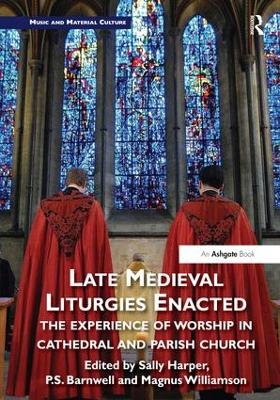
This book critically explores ways in which our understanding of late medieval liturgy can be enhanced through present-day enactment. It is a direct outcome of a practice-led research project, led by Professor John Harper and undertaken at Bangor University between 2010 and 2013 in partnership with Salisbury Cathedral and St Fagans National History Museum, near Cardiff. The book seeks to address the complex of ritual, devotional, musical, physical and architectural elements that constitute medieval Latin liturgy, whose interaction can be so difficult to recover other than through practice. In contrast with previous studies of reconstructed liturgies, enactment was not the exclusive end-goal of the project; rather it has created a new set of data for interpretation and further enquiry. Though based on a foundation of historical, musicological, textual, architectural and archaeological research, new methods of investigation and interpretation are explored, tested and validated throughout. There is emphasis on practice-led investigation and making; the need for imagination and creativity; and the fact that enactment participants can only be of the present day. Discussion of the processes of preparation, analysis and interpretation of the enactments is complemented by contextual studies, with particular emphasis on the provision of music. A distinctive feature of the work is that it seeks to understand the experiences of different groups within the medieval church - the clergy, their assistants, the singers, and the laity - as they participated in different kinds of rituals in both a large cathedral and a small parish church. Some of the conclusions challenge interpretations of these experiences, which have been current since the Reformation. In addition, some consideration is given to the implications of understanding past liturgy for present-day worship.

Arvustused

"a valuable overview of the logistics of medieval worship and of the ways that it may have been experienced by participants, both clergy and laity". Madeleine Gray, University of South Wales, in Archaeologia Cambrensis.

"This book is as strong in describing the research methods used as in the detailed information that it presents. (...) This volume is highly specialised, but can be recommended to anyone interested in music and liturgy and the world of the late medieval Church in England and Wales." - Robert Manning, The Consort Early Music Journal, vol.73, Summer 2017

"This substantial book is beautifully produced with numerous colour and black-and-white photographs and is very comprehensive. It fills a large gap in our knowledge." - Peter Freeman, Anglo-Catholic History Society

List of Figures and Music Examples
ix
List of Plates
xi
List of Tables
xiii
Notes on Contributors xv
Preface xix
List of Abbreviations
xxi
Lists of Enactments of Late Medieval and Other Liturgies 2008--13
xxv
Introduction 1(12)
John Harper
PART I INVESTIGATING THE EXPERIENCE OF LATE MEDIEVAL WORSHIP IN MEDIEVAL CHURCH BUILDINGS
1 Investigating the Experience of Late Medieval Worship
13(18)
John Harper
2 Enacting Late Medieval Worship: Locations, Processes and Outcomes
31(22)
John Harper
PART II PAST EVIDENCE AND PRESENT REALISATION
Material Culture Re-created
3 The Church of St Teilo, Llandeilo Tal-y-bont -- A Moving Story
53(10)
Gerallt D. Nash
4 Clothing the Space: Making and Using the Artefacts and Vestments
63(16)
Sally Harper
5 A New Pre-Reformation Organ for the Church of St Teilo
79(14)
Dominic Gwynn
The Written and the Performed
6 Establishing a Liturgical `Text': Text for Performance, Performance as Text
93(14)
Matthew Cheung Salisbury
7 How Did They Do Liturgy? Preparing Late Medieval Text for Modern Enactment
107(18)
Sally Harper
John Harper
8 Quadring Cows: Resourcing Music in the Pre-Reformation Parish
125(32)
Magnus Williamson
PART III HISTORICAL FOUNDATIONS -THREE CASE STUDIES
9 The Reform of the Choir of Salisbury Cathedral, c.1450--1549
157(20)
Roger Bowers
10 The Musical Knowledge and Practice of Expert Tudor Descanters
177(14)
Jane Flynn
11 The Holy Name of Jesus: A Literate Cult?
191(16)
Judith Aveling
PART IV MEDIEVAL LITURGY AND MODERN ENACTMENT
12 The Nature of Late Medieval Worship: The Mass
207(12)
P.S. Barnwell
13 The Celebrant Reflects: Theological and Spiritual Priorities Expressed through Sarum Use
219(6)
Jeremy Davies
14 Enabling the Ritual: Aspects of the Experience of Assisting Clergy, Servers, Singers and Organ-Player
225(10)
John Harper
15 How to Do Without Rubrics: Experiments in Reconstructing Medieval Lay Experience
235(20)
P.S. Barnwell
16 Reflections on the Enactments: Voices from the Nave
255(18)
Keith Beasley
Judith Aveling
John Francis Moss
PART V REFLECTING ON PRESENT EXPERIENCE OF PAST RITUALS
17 Reconciling the Historical and the Contemporary in Liturgical Enactment
273(12)
Nils Holger Petersen
18 The Ritual Enactments: Historical Validity, Measurable Outcomes, Experience and Engagement
285(18)
John Harper
19 Enactment and the Study of Late Medieval Liturgy
303(13)
John Harper
Appendix 1 Summary Narrative of Mass of the Day in Choir 316(2)
Appendix 2 Summary Narrative of Simple Sung Mass with Priest, Server and Singers 318(1)
Appendix 3 Plan of Salisbury Cathedral 319(1)
Appendix 4 Plan of St Teilo's Church 320(1)
Select Bibliography 321(20)
Index 341
Sally Harper is senior lecturer in the School of Music at Bangor University, Wales, and an associate chaplain of Bangor Cathedral. She has written widely on music and culture in medieval and early modern Wales, and on medieval liturgy.


P.S. Barnwell is Fellow in the Historic Environment at Kellogg College, University of Oxford, UK. His research interests include the relationships between theology, liturgy, lay devotion, and the evolution of the form of the English medieval parochial church.


Magnus Williamson is senior lecturer at Newcastle University. His research focuses on the sources and contexts of Tudor polyphony, organs, improvisation, and critical editing. He is currently General Editor of the British Academy series Early English Church Music.


John Harper, though not one of the editors, is the principal author, and has been the fons et origo of the practice-led research project from which this book flows and which exemplifies his career as a liturgical musician, scholar, teacher and administrator. Through honorary association with the University of Birmingham, UK, and emeritus associations with Bangor University and The Royal School of Church Music, he continues his work in sacred music studies and liturgy. He is perhaps most widely known for his useful guide The Forms and Orders of Western Liturgy from the Tenth to the Eighteenth Century.