Muutke küpsiste eelistusi

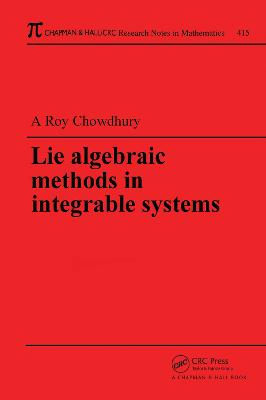
E-raamat: Lie Algebraic Methods in Integrable Systems

(University of California, Riverside, USA)
Teised raamatud teemal:
  • Formaat - PDF+DRM
  • Hind: 221,00 €*
  • * hind on lõplik, st. muud allahindlused enam ei rakendu
  • Lisa ostukorvi
  • Lisa soovinimekirja
  • See e-raamat on mõeldud ainult isiklikuks kasutamiseks. E-raamatuid ei saa tagastada.
Teised raamatud teemal:

DRM piirangud

  • Kopeerimine (copy/paste):

    ei ole lubatud

  • Printimine:

    ei ole lubatud

  • Kasutamine:

    Digitaalõiguste kaitse (DRM)
    Kirjastus on väljastanud selle e-raamatu krüpteeritud kujul, mis tähendab, et selle lugemiseks peate installeerima spetsiaalse tarkvara. Samuti peate looma endale  Adobe ID Rohkem infot siin. E-raamatut saab lugeda 1 kasutaja ning alla laadida kuni 6'de seadmesse (kõik autoriseeritud sama Adobe ID-ga).

    Vajalik tarkvara
    Mobiilsetes seadmetes (telefon või tahvelarvuti) lugemiseks peate installeerima selle tasuta rakenduse: PocketBook Reader (iOS / Android)

    PC või Mac seadmes lugemiseks peate installima Adobe Digital Editionsi (Seeon tasuta rakendus spetsiaalselt e-raamatute lugemiseks. Seda ei tohi segamini ajada Adober Reader'iga, mis tõenäoliselt on juba teie arvutisse installeeritud )

    Seda e-raamatut ei saa lugeda Amazon Kindle's. 

Over the last thirty years, the subject of nonlinear integrable systems has grown into a full-fledged research topic. In the last decade, Lie algebraic methods have grown in importance to various fields of theoretical research and worked to establish close relations between apparently unrelated systems.

The various ideas associated with Lie algebra and Lie groups can be used to form a particularly elegant approach to the properties of nonlinear systems. In this volume, the author exposes the basic techniques of using Lie algebraic concepts to explore the domain of nonlinear integrable systems. His emphasis is not on developing a rigorous mathematical basis, but on using Lie algebraic methods as an effective tool.

The book begins by establishing a practical basis in Lie algebra, including discussions of structure Lie, loop, and Virasor groups, quantum tori and Kac-Moody algebras, and gradation. It then offers a detailed discussion of prolongation structure and its representation theory, the orbit approach-for both finite and infinite dimension Lie algebra. The author also presents the modern approach to symmetries of integrable systems, including important new ideas in symmetry analysis, such as gauge transformations, and the "soldering" approach. He then moves to Hamiltonian structure, where he presents the Drinfeld-Sokolov approach, the Lie algebraic approach, Kupershmidt's approach, Hamiltonian reductions and the Gelfand Dikii formula. He concludes his treatment of Lie algebraic methods with a discussion of the classical r-matrix, its use, and its relations to double Lie algebra and the KP equation.

Arvustused

"Lie theory and algebraic geometry have played a unifying role in integrable theory since its early rebirth some 30 years ago. They have transformed a mosaic of old examples, due to the masters like Hamilton, Jacobi and Kowalewski, and new examples into general methods and statements. The book under review addresses a number of these topics contains a variety of interesting topics: some are expained in a user-friendly and elementary way, and others are taken directly from research papers." -Pierre Van Moerbeke, in The London Mathematical Society

Preface
Introduction
1(12)
Lax Equation and IST
3(4)
Conserved Densities and Hamiltonian Structure
7(3)
Symmetry Aspects
10(1)
Observations
11(2)
Lie Algebra
13(62)
Introduction
13(2)
Structure Constants and Basis of Lie Algebra
15(3)
Special Linear Lie Algebra
16(2)
Lie Groups and Lie Algebra
18(2)
Representation of a Lie Algebra
20(4)
Cartan-Killing Form
24(2)
Root Space Decomposition
26(4)
Lie Groups: Finite and Infinite Dimensional
30(2)
Loop Groups
32(5)
The Virasoro Group
37(5)
Quantum Tori Algebra
42(6)
Kac-Moody Algebra
48(3)
Serre's Approach to Kac Moody Algebra
51(3)
Gradation
54(3)
Other Infinite Dimensional Lie Algebras
57(18)
Prolongation Theory
75(64)
Introduction
75(2)
Sectioning of Forms
77(3)
The KdV Problem
80(4)
The Method of the Hall Structure
84(5)
Prolongation in (2+1) Dimension
89(8)
Method of Pseudopotentials
97(7)
Prolongation Structure and the Backlund Transformation
104(5)
Constant Coefficient Ideal
109(2)
Connections
111(3)
Morphisms and Prolongation
114(5)
Principal Prolongation Structure
119(8)
Prolongations and Isovectors
127(5)
Vessiot's Approach
132(4)
Observations
136(3)
Co-adjoint Orbits
139(54)
Introduction
139(2)
The Kac-Moody Algebra
141(3)
Integrability Theorem: Adler, Kostant, Symes
144(5)
Superingegrable Systems
149(4)
Non-Linear Partial Differential Equation
153(8)
Extended AKS Theorem
161(3)
Space-Dependent Integrable Equation
164(4)
The Moment Map
168(7)
Moment Map in Relation to Integrable Non-Linear Equation
175(12)
Co-Adjoint Orbit of the Volterra Group
187(6)
Symmetries of Integrable Systems
193(62)
Introduction
193(1)
Lie Point and Lie Backlund Symmetry
193(4)
Lie Backlund Transformation
197(4)
Some New Ideas in Symmetry Analysis
201(45)
Gauge Transformation (Polyakov Approach)
202(8)
Algebra of Lax Operator
210(5)
Method of Fourier Analysis and Small Amplitude Expansion
215(9)
Hidden Symmetries
224(6)
Approximate Symmetries
230(10)
Kac-Moody Symmetry
240(6)
Non-Local Symmetries
246(6)
Observations
252(3)
Hamiltonian Structure
255(56)
Introduction
255(1)
Drinfeld Sokolov Approach
255(6)
The Lie Algebraic Approach
261(4)
Example of Hamiltonian Structure and Reduction
265(3)
Hamiltonian Reduction in (2+1) Dimension
268(7)
Hamiltonian Reduction of Drinfeld and Sokolov
275(6)
Krupershmidt's Approach
281(8)
Gelfand Dikii Formula
289(5)
Trace Identity and Hamiltonian Structure
294(12)
Symmetry and Hamiltonian Structure
306(5)
Classical r-matrix
311(36)
Introduction
311(2)
Double Lie Algebra
313(6)
Classical r-matrix
319(5)
The Use of r-matrix
324(10)
The r-matrix and KP Equation
334(13)
Index 347
Amit K. Roy-Chowdhury (University of California, Riverside, USA) (Author)