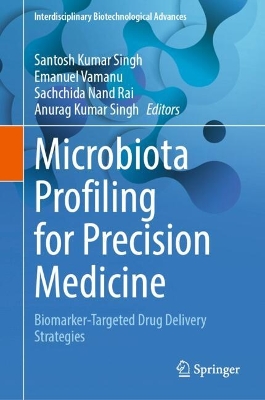
This book provides an in-depth exploration of microbiota profiling and precision medicine, including the underlying mechanisms, delivery methods, treatment strategies, and the impact of biomarker-targeted drug delivery. It incorporates the latest research findings, such as biomarker-targeted drug delivery, clinical assessment and diagnosis, and therapeutic approaches. The book offers a comprehensive overview of the latest developments in biomarker-targeted drug delivery strategies. It addresses the challenges faced by healthcare professionals, offering actionable strategies for effective multidisciplinary care, along with patient and family perspectives, coping mechanisms, and ways to improve quality of life. By combining scientific knowledge, clinical expertise, and patient insights, the book enhances understanding, diagnosis, and treatment options for these complex conditions. These qualities distinguish it from existing publications and make it a valuable resource for readers seeking a thorough and engaging overview of this subject.
The chapters cover a broad range of topics, including recent advances in microbiota profiling techniques, microbiota's role in drug metabolism and toxicity, and its immunomodulatory effects. Special focus is given to the involvement of microbiota in neurodegenerative diseases such as Alzheimer's and Parkinson's, emphasizing the therapeutic potential of microbiome-targeted strategies. The authors provide expert analysis on integrating microbiota-derived data with innovative tools like nanotechnology and machine learning to improve drug delivery systems. Readers will also gain practical insights from case studies on microbiota-informed therapies for cancer, autoimmune conditions, and gastrointestinal disorders. This book is essential for researchers, clinicians, academicians, and students working in microbiome science, pharmacology, biotechnology, and precision medicine. It addresses key questions such as biomarker validation, data integration, and the ethical considerations necessary for the clinical use of microbiome-based therapies.
Chapter
1. Introduction about Precision Medicine, Personalized Therapies
in Health and Diseases.
Chapter
2. Microbiota profiling techniques: Recent
advancement.
Chapter
3. Microbiota Drug Interaction and Its Influence on
Drug Metabolism and Toxicity.
Chapter
4. Immunomodulatory Effects of
Microbiome Derived Therapies.
Chapter
5. Alzheimer's Disease and Gut
Microbiota.
Chapter
6. Parkinsons Disease and Gut Microbiota.
Chapter
7.
Biomarker Role in Drug Delivery: Microbiota Implications and Nanotechnology
for Personalized Therapeutics.
Chapter
8. Advancing Precision Therapeutics
Integrating Microbiota Biomarkers and Nanotechnology for Targeted Drug
Delivery - Insights from Case Studies.
Chapter
9. Strategies for Biomarker
Identification and Validation in Precision Medicine: Microbial Predictors,
Data Integration, Machine Learning, and Clinical Trial Insights.
Chapter
10.
Microbiota-Driven Precision Therapies: Applications in Autoimmune Disorders,
Optimizing Cancer Therapy, and Advancements in Gastrointestinal Disease
Treatment.
Chapter
11. Exploring Clinical Applications: Precision Medicine
in Gastrointestinal Disorders, Microbiota-Driven Cancer Therapies and
Innovative Interventions for Neurological Disorders-Insights from Case
Studies.
Chapter
12. The Next Frontier in Microbiome-Based Therapeutics:
Advanced Clinical.
Chapter
13. Navigating the Landscape: Regulatory
Frameworks and Ethical Considerations in Microbiota-Based Precision
Medicine.
Chapter
14. Challenges and Future Perspectives in Microbiota-Based
Precision Medicine: Standardization of Profiling Methods, Ethical
Considerations and the Potential for Preemptive Healthcare.
Dr. Santosh Kumar Singh is a Senior Scientist at the Centre of Experimental Medicine & Surgery, Institute of Medical Sciences, Banaras Hindu University (BHU), Varanasi. He completed his Ph.D. at Banaras Hindu University in 1998 and pursued postdoctoral research at the same institution. He also served as a Visiting Scientist at the Department of Photosynthesis, Institute of Physical Biology, University of South Bohemia, Czech Republic. Dr. Singh has presented his scientific work internationally, including in the United States and other countries. With more than 25 years of professional experience, Dr. Singh has supervised over 12 Ph.D. scholars, 3 postdoctoral fellows, and more than 10 MD/MS/DM/M.Ch. theses. He has published over 120 research/review articles in internationally reputed journals and has edited more than five books. Dr. Singh also serves on the editorial boards of various scientific journals. He has led numerous research projects funded by esteemed agencies such as the Department of Science and Technology (DST), the Department of Biotechnology (DBT), and the Science and Engineering Research Board (SERB). His contributions to science earned him membership in the National Academy of Sciences, India (NASI), Prayagraj. Dr. Singh is a recipient of the National Award for Science and Technology Communication, presented by the Ministry of Science & Technology, Government of India, in recognition of his exceptional contributions to the field.
Emanuel Vamanu is a Romanian professor at the Faculty of Biotechnologies at USAMV Bucharest, where he has taught and led research in pharmaceutical biotechnology, cellular pathology, microbial bioremediation, and industrial biotechnology since March 2022. He was a researcher at the Applied Biochemistry and Biotechnology Center BIOTEHNOL from 2002 to 2012. He has completed numerous advanced training courses across Europe in gene manipulation, lipid metabolism, animal science, and EU structural funds.
Dr. Sachchida Nand Rai is a Research Associate (ICMR-RA) at the Centre of Experimental Medicine and Surgery, Institute of Medical Sciences, Banaras Hindu University (BHU), Varanasi. He earned his Ph.D. in the Department of Biochemistry from Banaras Hindu University in 2018 and completed a 3-year postdoc at the University of Allahabad. He has impressive publications in several reputed journals. Dr. Rai serves as Academic Editor for the journals Mediators of Inflammation, International Journal of Inflammation, BMC Research Notes, and Associate Editor for 3-Biotech, Molecular Neurobiology, Oxidative Medicine and Cellular Longevity along with Journal of Inflammation Research and Degenerative Neurological and Neuromuscular Disease. He has published two books with the renowned publishers. His current Google Scholar citation is 2701 with 29 h-indexes. He is investigating the neuroprotective activity of common Indian medicinal plants in a toxin-induced Parkinsonian mouse model. He is also a member of the Indian Academy of Neurosciences (India).
Dr. Anurag Kumar Singh is a Research Associate (ICMR-RA) at the Department of Pharmaceutical Engineering and Technology, Indian Institute of Technology (Banaras Hindu University), Varanasi. He has previously worked as a Postdoctoral Researcher in Cancer Biology at Alabama State University, USA, and in Nanotechnology at Bar-Ilan University, Israel. He brings over 3 years of postdoctoral research experience to his current role. Dr. Singh earned his doctoral degree in pharmaceutical chemistry from the Centre of Experimental Medicine and Surgery, Institute of Medical Sciences, Banaras Hindu University, Varanasi. His research focuses on nano-drug delivery systems for chronic pain, neurodegenerative diseases, and brain targeting. He has authored over fifty publications, eight books, and more than fifteen book chapters in reputed national and international platforms.

 Lisainfo e-raamatute kohta