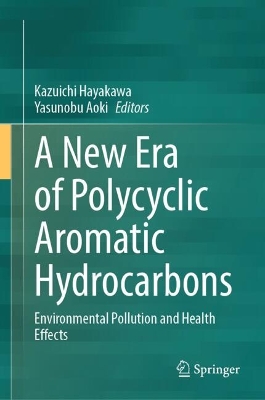
This book explains the latest research on global environmental pollution and health effects caused by polycyclic aromatic hydrocarbons (PAHs) and their derivatives.
The volume editors’ motivation to edit this book is that vehicles are no longer considered the main cause of urban air pollution. This volume consists of five parts to show the facts as follows: the global primary energy consumption pattern is changing from oil and coal to nuclear energy, solar energy, wind energy, and so on. Biomass fuels have also garnered remarkable attention. Additionally, forest fires, exacerbated by global warming, have spread. As a result, global pollution is shifting from developed to developing countries, from urban to suburban areas, and from outdoor to indoor environments. Emerging evidence suggests that health risks caused by PAHs and their oxidative derivatives, including nitro-PAHs (NPAHs), along with fine particles (PM2.5) are related to not only cancer but also to other diseases. This book also reviews methods for biomonitoring and a source contribution analysis.
This book’s main target readers are researchers including administrative, but it shares the most recent and useful information for also graduate students, researchers in industries and undergraduate students.
Southeast Asia (Vietnam): Vegetation/Post harvest burning.- East Asia
(China): Coal burning.- South Asia (India):
Incineration/Cooking/Incineration.- Africa (Rwanda): Vegetation fire/Vehicles.
Kazuichi Hayakawa graduated from the Graduate School of Pharmaceutical Sciences, University of Tokyo and received PhD (1982). His research interest includes environmental pollution caused by polycyclic aromatic hydrocarbons. After retiring from Professor of Kanazawa University, he is now the Professor Emeritus. He published several books, including Polycyclic aromatic hydrocarbons: Behavior and toxicity in East Asia from Springer Nature, and more than 450 original research papers in international journals. He awarded from the Japan Society of Atmospheric Environment, the Japan Society of Analytical Chemistry, the Pharmaceutical Society of Japan and the Commendation for Science and Technology by the Ministry of Education, Culture, Sports, Science and Technology, Japan.
Yasunobu Aoki graduated from the Graduate School of Pharmaceutical Sciences, University of Tokyo and received PhD (1982). His research interest includes mutagenicity of environmental chemicals and their health risk assessment. He was Director of Research Center for Environmental Risk, National Institute for Environmental Studies (NIES) and Visiting Professor, University of Chiba. After retiring from NIES, he is now the Emeritus Researcher, and acts as Associate Editor of Toxicology and Applied Pharmacology. He published 150 original research papers and reviews in the fields of biochemistry and toxicology. He received the Japanese Environmental Mutagen Society Award and Environmental Protection Award from Ministry of the Environment, Japan.

 Lisainfo e-raamatute kohta