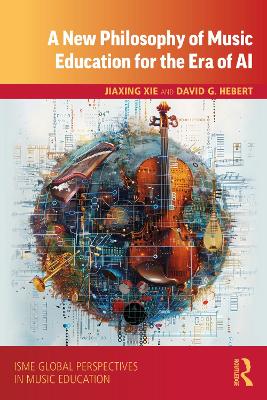
This book outlines a philosophy of music education that is responsive to the age of artificial intelligence. Against the background of AI's challenges to human modes of production, the authors demonstrate how music education can become a tool for self-discovery in this transformative era.
This book outlines a philosophy of music education that is responsive to the age of artificial intelligence. Against the background of AI's challenges to human modes of production, the authors demonstrate how music education can become a tool for self-discovery in this transformative era. Taking the approach of a dialogue between Chinese and Western perspectives, the book addresses the relationships between the social functions of music education and individual development in different historical periods, and envisions the potential role of music education in a new environment shaped by AI. Integrating insights from recent research, it establishes a forward-thinking philosophy of music education that is oriented towards self-discovery and grounded in science. Bringing together philosophical perspectives from Chinese and Western scholars, this book shows how integrating these perspectives can clarify the values that shape music education practices, and enable scholars and educators to better address contemporary issues in the teaching of music.
Overture: A Foreword, by Pamela Burnard, Introduction: What Kind of
Existence Does Humanity Face Today?Dialogue between Chinese and Western
Perspectives,
1. Why Does Music Education Need to Respond to AI, and What Are
the Current Debates in This Field?,
2. What Remains of Humanity?,
3. From
Group Worship to Life Veneration: A Shift in the Existential Function of
Music Education,
4. From Collective Sanctity to Individual Sanctity: Music
Education and the Leap of Human Wisdom in the Age of AI,
5. Beyond Science
Worship: Challenges and Transformations in Music Education,
6. Finding
Yourself in Balance: Music Education in the Age of AI,
7. Conclusion:
Discovering the Self, Awakening the Wisdom of Life, Appendix: Philosophical
Shifts in Music Education in the Age of AI
Jiaxing Xie is Professor of Music Aesthetics and Education at the China Conservatory of Music, former Director of its Institute of Music Research, and a leading figure in Chinese music education. He has served as a Board Member of the International Society for Music Education (ISME), a Member of the International Music Council (IMC), and now as Co-Chair of the ISME Life Membership Committee. He is also General Editor of The History of Chinese Music Disciplines (18 volumes, National Publishing Fund). Author of Music Education Studies (3rd ed., 2025) and The Context of Music: A Hermeneutic View (2005), Xie received the ISME-Gibson Lifetime Achievement Award in 2010. His research integrates aesthetics, philosophy, and complex systems science to explore imagination, non-equilibrium self-organization, and the future of music education in the AI era.
David G. Hebert is a Professor with Western Norway University of Applied Sciences,Bergen. He is also an Honorary Professor with the Education University of Hong Kong and Affiliated Professor with both University of the Faroe Islands and Kyambogo University (Uganda). He is a member of the Executive Committee and Board of the International Society for Music Education, Chair of the Historical Ethnomusicology section of SEM, and has grant-funded projects in Uganda and China. He is Senior Editor of the ISME Routledge Book Series and Co-Editor of the book series Deep Soundings: Critical Studies in Historical Ethnomusicology. With a special interest in Indigenous peoples, he previously worked as Head of Music for a Maori college and is now part of a major research project on Sami music. He is author or editor of 12 books and has contributed to over 35 different journals. Recently, he especially writes about music and AI, decolonization, cultural diplomacy and sustainability.

 Lisainfo e-raamatute kohta