Muutke küpsiste eelistusi
  • Formaat - EPUB+DRM
  • Hind: 72,79 €*
  • * hind on lõplik, st. muud allahindlused enam ei rakendu
  • Lisa ostukorvi
  • Lisa soovinimekirja
  • See e-raamat on mõeldud ainult isiklikuks kasutamiseks. E-raamatuid ei saa tagastada.
  • Formaat: EPUB+DRM
  • Ilmumisaeg: 23-Sep-2024
  • Kirjastus: CRC Press
  • Keel: eng
  • ISBN-13: 9781040118832

DRM piirangud

  • Kopeerimine (copy/paste):

    ei ole lubatud

  • Printimine:

    ei ole lubatud

  • Kasutamine:

    Digitaalõiguste kaitse (DRM)
    Kirjastus on väljastanud selle e-raamatu krüpteeritud kujul, mis tähendab, et selle lugemiseks peate installeerima spetsiaalse tarkvara. Samuti peate looma endale  Adobe ID Rohkem infot siin. E-raamatut saab lugeda 1 kasutaja ning alla laadida kuni 6'de seadmesse (kõik autoriseeritud sama Adobe ID-ga).

    Vajalik tarkvara
    Mobiilsetes seadmetes (telefon või tahvelarvuti) lugemiseks peate installeerima selle tasuta rakenduse: PocketBook Reader (iOS / Android)

    PC või Mac seadmes lugemiseks peate installima Adobe Digital Editionsi (Seeon tasuta rakendus spetsiaalselt e-raamatute lugemiseks. Seda ei tohi segamini ajada Adober Reader'iga, mis tõenäoliselt on juba teie arvutisse installeeritud )

    Seda e-raamatut ei saa lugeda Amazon Kindle's. 

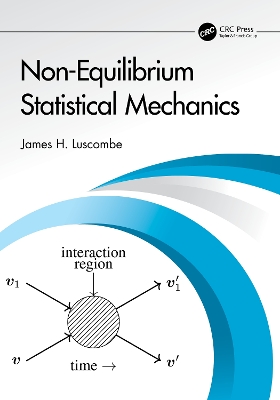
Statistical mechanics provides a framework for relating the properties of macroscopic systems (large collections of atoms, such as in a solid) to the microscopic properties of its parts. However, what happens when macroscopic systems are not in thermal equilibrium, where time is not only a relevant variable, but also essential?

That is the province of nonequilibrium statistical mechanics – there are many ways for systems to be out of equilibrium! The subject is governed by fewer general principles than equilibrium statistical mechanics and consists of a number of different approaches for describing nonequilibrium systems.

Financial markets are analyzed using methods of nonequilibrium statistical physics, such as the Fokker-Planck equation. Any system of sufficient complexity can be analyzed using the methods of nonequilibrium statistical mechanics. The Boltzmann equation is used frequently in the analysis of systems out of thermal equilibrium, from electron transport in semiconductors to modeling the early Universe following the Big Bang.

This book provides an accessible yet very thorough introduction to nonequilibrium statistical mechanics, building on the author's years of teaching experience. Covering a broad range of advanced, extension topics, it can be used to support advanced courses on statistical mechanics, or as a supplementary text for core courses in this field.

Key Features:

· Features a clear, accessible writing style which enables the author to take a sophisticated approach to the subject, but in a way that is suitable for advanced undergraduate students and above.

· Presents foundations of probability theory and stochastic processes and treats principles and basic methods of kinetic theory and time correlation functions.

· Accompanied by separate volumes on thermodynamics and equilibrium statistical mechanics, which can be used in conjunction with this book

James H. Luscombe received the PhD in Physics from the University of Chicago in 1983. After post-doctoral positions at the University of Toronto and Iowa State University, he joined the Research Laboratory of Texas Instruments, where he worked on the development of nanoelectronic devices. In 1994, he joined the Naval Postgraduate School in Monterey, CA, where he is Professor of Physics. He was Chair of the Department of Physics from 2003 – 2009. He teaches a wide variety of topics, including general relativity, statistical mechanics, mathematical methods, and quantum computation. He has published more than 60 research articles, and has given more than 100 conference presentations; he holds 2 patents.


Statistical mechanics provides a framework for relating the properties of macroscopic systems (large collections of atoms, such as in a solid) to the microscopic properties of its parts.

Arvustused

This book provides a thorough introduction to nonequilibrium statistical mechanics, focusing on systems that are not in thermal equilibrium. Luscombe blends classical approaches with modern techniques, exploring time-dependent processes, fluctuations, and irreversible dynamics. Key topics include kinetic theory, stochastic processes, and the fluctuation-dissipation theorem. Designed for those with a background in statistical mechanics, this book serves as an essential resource for advancing understanding in thermodynamics, plasma physics, and cosmologyWe highly recommend Non-Equilibrium Statistical Mechanics by James H. Luscombe to readers interested in understanding the complexities of nonequilibrium systems in physics. This book bridges theoretical foundations with practical applications, covering essential topics such as kinetic theory, stochastic processes, and the fluctuation-dissipation theorem. With clear explanations, supported by robust theoretical insights and relevant examples, it is an invaluable resource for academics, researchers, and advanced students in physics and applied sciences. Whether youre deepening your knowledge of statistical mechanics or exploring nonequilibrium dynamics in various fields, this book offers a comprehensive and accessible approach."

Oktaviyani Daswati (IPB University) and Yunia Hasnataeni ((IPB University) in Technometrics, Volume 68, 2026 - Issue 1 (https://doi.org/10.1080/00401706.2025.2565971)

Chapter 1: Irreversibility, Entropy, and Fluctuations.
Chapter 2: Fluctuations as Stochastic Processes.
Chapter 3: Brownian Mtion and Stochastic Dynamics.
Chapter 4: Kinetic Theory: Boltzmann's Approach to Irreversibility.
Chapter 5: Weakly Coupled Systems: Landau-Vlasov Theories.
Chapter 6: Dissipation, Fluctuations, and Correlations. Appendix A: Statistical Mechanics. Appendix B: Probability Theory. Appendix C: Elastic Collisions. Appendix D: Integral Equations and Resolvents. Appendix E: Dynamical Representations in Quantum Mechanics. Appendix F: Causality and Analyticity. Bibliography. Index.
James H. Luscombe received a PhD in Physics from the University of Chicago in 1983. After post-doctoral positions at the University of Toronto and Iowa State University, he joined the Research Laboratory of Texas Instruments, where he worked on the development of nanoelectronic devices. In 1994, he joined the Naval Postgraduate School in Monterey, CA, where he is a professor of Physics. He was Chair of the Department of Physics from 2003 2009. He teaches a wide variety of topics, including general relativity, statistical mechanics, mathematical methods, and quantum computation. He has published more than 60 research articles, and has given more than 100 conference presentations; he holds 2 patents.