Muutke küpsiste eelistusi

E-raamat: Observed Correction: How We Can All Respond to Misinformation on Social Media

(Don and Carole Larson Professor in Health Communication, University of Minnesota's Hubbard School of Journalism and Mass Communication), (Professor in the Communication, Culture, and Technology program, Georgetown University)
  • Formaat - EPUB+DRM
  • Hind: 21,59 €*
  • * hind on lõplik, st. muud allahindlused enam ei rakendu
  • Lisa ostukorvi
  • Lisa soovinimekirja
  • See e-raamat on mõeldud ainult isiklikuks kasutamiseks. E-raamatuid ei saa tagastada.

DRM piirangud

  • Kopeerimine (copy/paste):

    ei ole lubatud

  • Printimine:

    ei ole lubatud

  • Kasutamine:

    Digitaalõiguste kaitse (DRM)
    Kirjastus on väljastanud selle e-raamatu krüpteeritud kujul, mis tähendab, et selle lugemiseks peate installeerima spetsiaalse tarkvara. Samuti peate looma endale  Adobe ID Rohkem infot siin. E-raamatut saab lugeda 1 kasutaja ning alla laadida kuni 6'de seadmesse (kõik autoriseeritud sama Adobe ID-ga).

    Vajalik tarkvara
    Mobiilsetes seadmetes (telefon või tahvelarvuti) lugemiseks peate installeerima selle tasuta rakenduse: PocketBook Reader (iOS / Android)

    PC või Mac seadmes lugemiseks peate installima Adobe Digital Editionsi (Seeon tasuta rakendus spetsiaalselt e-raamatute lugemiseks. Seda ei tohi segamini ajada Adober Reader'iga, mis tõenäoliselt on juba teie arvutisse installeeritud )

    Seda e-raamatut ei saa lugeda Amazon Kindle's. 

While many solutions have been proposed to combat misinformation on social media, most are either ineffective, expensive, or do not work at scale. What if social media users could help mitigate the misinformation they're also responsible for proliferating?

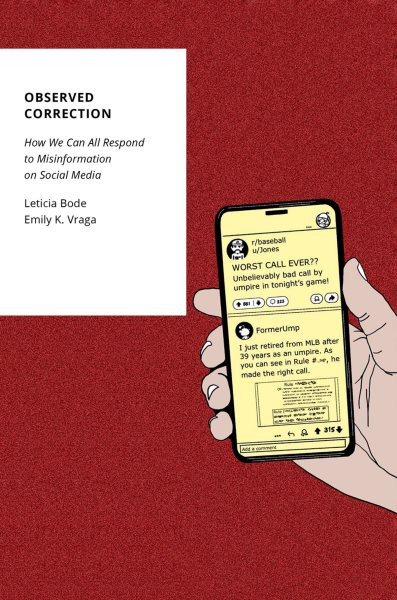
In Observed Correction, Leticia Bode and Emily K. Vraga consider both the power of and the barriers to "observed correction"--users witnessing other users correct misinformation on social media. Bode and Vraga argue that when people view others directly and publicly correct misinformation on social media, their understanding of the topic becomes more accurate. Yet, while many members of the public value correction, Bode and Vraga find that they are often reluctant to correct misinformation they see on social media. This same reluctance to correct is seen among expert fact checkers and health communicators, compounded by the constraints of limited resources and competing priorities. To empower people to respond to misinformation, Bode and Vraga offer a set of practical recommendations for how observational correction can be implemented. In some cases, simple messages addressing concerns can increase users' willingness to respond to misinformation. In other cases, they argue that platforms will need to promote corrections and protect the correctors while experts can contribute by creating accessible curated evidence (ACE) to facilitate user corrections and build social norms around responding to misinformation.

Including analysis of eleven experiments, seven surveys, and dozens of interviews with social media users, health professionals, fact checkers, and platform employees about their efforts to curb misinformation online, Bode and Vraga make the case that observed correction is an effective and scalable tool in the fight against bad content on the Internet.

In Observed Correction, Leticia Bode and Emily K. Vraga consider both the power of and the barriers to "observed correction"--users witnessing other users correct misinformation on social media. Bode and Vraga argue that when people view others directly and publicly correcting misinformation on social media, their understanding of the topic becomes more accurate. Drawing on experiments, surveys, and interviews with social media users, health professionals, fact checkers, and platform employees, Bode and Vraga offer a set of practical recommendations for how observational correction can be implemented.

Arvustused

Observed Correction is excellent at empowering all users to combat online misinformation. * T. Manolovitz, CHOICE *

Chapter 1: Introduction
Chapter 2: The Theory of Observed Correction
Chapter 3: Observed Correction Increases Accuracy
Chapter 4: Correction
Recall
Chapter 5: Perception of Correction
Chapter 6: Conflicted Correctors
Chapter 7: Motivating Correction
Chapter 8: Constrained Experts
Chapter 9:
Accessible Curated Evidence
Chapter 10: Conclusions Notes References Index
Leticia Bode is a Professor in the Communication, Culture, and Technology program at Georgetown University, and the inaugural Research Director of the Knight-Georgetown Institute. She researches the intersection of communication, technology, attitudes, and behavior, emphasizing the role communication technologies may play in the acquisition, use, effects, and implications of both information and misinformation.

Emily K. Vraga is the Don and Carole Larson Professor in Health Communication at the University of Minnesota's Hubbard School of Journalism and Mass Communication. Her research tests methods to identify and correct misinformation on social media, to improve audience resiliency through news literacy training, and to encourage attention to more diverse content.