Muutke küpsiste eelistusi

E-raamat: Opera de salon: Parisian Societies and Spaces in the Second Empire

(Professor of Music, Department of Music, University of Southampton)
  • Formaat: PDF+DRM
  • Ilmumisaeg: 24-Jun-2025
  • Kirjastus: Oxford University Press Inc
  • Keel: eng
  • ISBN-13: 9780197695203
  • Formaat - PDF+DRM
  • Hind: 72,80 €*
  • * hind on lõplik, st. muud allahindlused enam ei rakendu
  • Lisa ostukorvi
  • Lisa soovinimekirja
  • See e-raamat on mõeldud ainult isiklikuks kasutamiseks. E-raamatuid ei saa tagastada.
  • Formaat: PDF+DRM
  • Ilmumisaeg: 24-Jun-2025
  • Kirjastus: Oxford University Press Inc
  • Keel: eng
  • ISBN-13: 9780197695203

DRM piirangud

  • Kopeerimine (copy/paste):

    ei ole lubatud

  • Printimine:

    ei ole lubatud

  • Kasutamine:

    Digitaalõiguste kaitse (DRM)
    Kirjastus on väljastanud selle e-raamatu krüpteeritud kujul, mis tähendab, et selle lugemiseks peate installeerima spetsiaalse tarkvara. Samuti peate looma endale  Adobe ID Rohkem infot siin. E-raamatut saab lugeda 1 kasutaja ning alla laadida kuni 6'de seadmesse (kõik autoriseeritud sama Adobe ID-ga).

    Vajalik tarkvara
    Mobiilsetes seadmetes (telefon või tahvelarvuti) lugemiseks peate installeerima selle tasuta rakenduse: PocketBook Reader (iOS / Android)

    PC või Mac seadmes lugemiseks peate installima Adobe Digital Editionsi (Seeon tasuta rakendus spetsiaalselt e-raamatute lugemiseks. Seda ei tohi segamini ajada Adober Reader'iga, mis tõenäoliselt on juba teie arvutisse installeeritud )

    Seda e-raamatut ei saa lugeda Amazon Kindle's. 

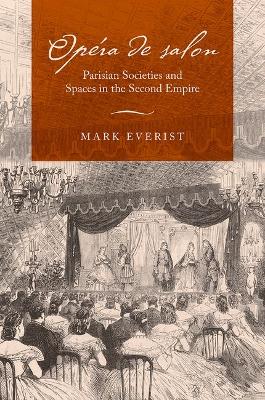
Opéra de salon emerged in the early 1850s out of a much longer tradition of théâtre de société: the cultivation of performing plays in aristocratic town houses and châteaux which continued into the Second Empire of the 1850s and 1860s, and beyond. It consisted of a one-act opérette with between six and nine musical compositions separated by spoken dialogue that carried the action in the same way as opéra-comique or opérette itself. Opéra de salon was separated from opérette and related genres by its performance context: never shared with the regulated theatre, opéra de salon was cultivated in domestic living spaces that were repurposed in ways that ranged from simply pushing back the furniture to building a fully-fledged theatre in one's own home. Opéra de salon furthermore found its way into the concert culture hosted by Parisian piano manufacturers Herz, Erard, Pleyel, and others.

In Opéra de salon: Parisian Societies and Salons in the Second Empire, author Mark Everist brings to light a genre and a set of cultural practices that have long been obscured. Approximately 130 opéras de salon were composed and performed up to ca. 1875, and, as Everist demonstrates, they represent a significant generic trajectory in the history of nineteenth century music and theatre. Produced by major composers and librettists of the day, these works play into questions of gender, age, and urban topography in ways unlike other musical and theatrical genres of the day. Everist's focus is on the salon--the domestic, the private--but he also shows how opéra de salon moves effortlessly between intimate familial space, the more public salon, to the public and largely commercial concert hall in ways that prompt reflection on the status of all these critical categories. Ultimately, Everist challenges the hermetic discipline of 'opera studies' by opening up massive repertories that are still unknown, and by developing critical practices that go beyond traditional categories of theatres, institutions, consumers, and creators.
Illustrations
Music Examples
Tables
Acknowledgements
Introduction
1. Opéra de salon
Opéra - Salon
Opéra de salon
Patterns of Publication
2. Performers and the Improvised Stage
Casts, Scoring and Instrumentation
Vocal Artists
The Improvised Stage
3. Performance and Places: The Bourgeois and the
Aristocrat
Spaces and Patrons
Spaces and Patrons 1: The Medical Profession
Spaces and Patrons 2: Entrepreneurs and the Haute-Bourgeoisie
Spaces and Patrons 3: Government and Aristocracy
4. Performance and Places:
Music and Letters
Spaces and Patrons 4: Artists and Men of Letters
Spaces and Patrons 5: Professional Musicians
Spaces and Patrons 6: Public Spaces
5. Contexts and cultivation
Contexts for creation
Salons - Concerts
Théâtre de société
Charade
Proverbe
Opéra de salon and the Regulated Theatre
Salon, Song and Séance
6. Performance in the Parloir
Women, the Parloir and Opéra de salon
Women Composers and Librettists
7. Locating Opéra de salon
Time and Space
Spatialité
Geolocation
Multiplicities of Power
Opéra de salon in the Provinces and Abroad Conclusion
Appendix
Bibliography
Index
Mark Everist is Professor of Music at the University of Southampton. His research focuses on the music of western Europe from 1150-1330, music for the stage in nineteenth-century France, Mozart, reception theory, and historiography. He is the author of six monographs, the most recent of which are Genealogies of Music and Memory and The Empire at the Opera, editor of three volumes of the Magnus Liber Organi, and has published over 80 articles in peer-reviewed journals and collections of essays. The recipient of the Solie (2010) and Slim (2011) awards of the American Musicological Society, he was elected a fellow of the Academia Europaea in 2012. Everist was President of the Royal Musical Association from 2011-17 and was elected a corresponding member of the American Musicological Society in 2014. He was visiting professor at the Sorbonne in 2021-22 and was elected to a fellowship at the French

Institute of Advanced Studies from 2023-24. In July 2024, Everist was named Chevalier de l'Ordre des Arts et des Lettres by the French Minister of Culture.