Muutke küpsiste eelistusi

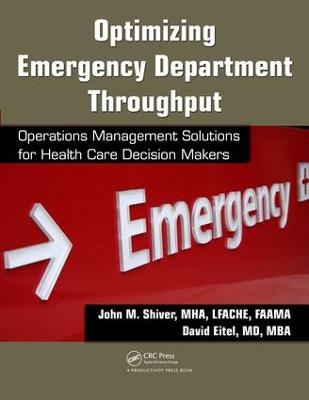
E-raamat: Optimizing Emergency Department Throughput: Operations Management Solutions for Health Care Decision Makers

(College of Health and Human Services, George Mason University, Fairfax, VA, USA)
  • Formaat: PDF+DRM
  • Ilmumisaeg: 26-Jul-2017
  • Kirjastus: Productivity Press
  • Keel: eng
  • ISBN-13: 9781420084979
Teised raamatud teemal:
  • Formaat - PDF+DRM
  • Hind: 94,89 €*
  • * hind on lõplik, st. muud allahindlused enam ei rakendu
  • Lisa ostukorvi
  • Lisa soovinimekirja
  • See e-raamat on mõeldud ainult isiklikuks kasutamiseks. E-raamatuid ei saa tagastada.
  • Formaat: PDF+DRM
  • Ilmumisaeg: 26-Jul-2017
  • Kirjastus: Productivity Press
  • Keel: eng
  • ISBN-13: 9781420084979
Teised raamatud teemal:

DRM piirangud

  • Kopeerimine (copy/paste):

    ei ole lubatud

  • Printimine:

    ei ole lubatud

  • Kasutamine:

    Digitaalõiguste kaitse (DRM)
    Kirjastus on väljastanud selle e-raamatu krüpteeritud kujul, mis tähendab, et selle lugemiseks peate installeerima spetsiaalse tarkvara. Samuti peate looma endale  Adobe ID Rohkem infot siin. E-raamatut saab lugeda 1 kasutaja ning alla laadida kuni 6'de seadmesse (kõik autoriseeritud sama Adobe ID-ga).

    Vajalik tarkvara
    Mobiilsetes seadmetes (telefon või tahvelarvuti) lugemiseks peate installeerima selle tasuta rakenduse: PocketBook Reader (iOS / Android)

    PC või Mac seadmes lugemiseks peate installima Adobe Digital Editionsi (Seeon tasuta rakendus spetsiaalselt e-raamatute lugemiseks. Seda ei tohi segamini ajada Adober Reader'iga, mis tõenäoliselt on juba teie arvutisse installeeritud )

    Seda e-raamatut ei saa lugeda Amazon Kindle's. 

Across the country ambulances are turned away from emergency departments (EDs) and patients are waiting hours and sometimes days to be admitted to a hospital room. Hospitals are finding it hard to get specialist physicians to come to treat emergency patients. Our EDs demand a new way of thinking. They are not at a tipping point; they are at a breaking point. Under current loads and trends they are going to begin to break and these breakdowns will be painful and ultimately dangerous to society.

Recognizing that the ideal in health care is presently beyond our immediate grasp, this book instead focuses on providing health care leaders with the tools they can employ to optimize the performance of EDs and thereby improve service to patients, employees, and communities.

Written by 20 of the most progressive and successful health care reformers in the country, the approaches described can be utilized to quantify improvements, enhance predictability of workflow, and improve staff scheduling. The data derived using these techniques can serve as powerful evidence in support of change. While a common discussion among ED professionals is the perception that many patients are not really emergency patients and could be treated in another setting at another time, that argument is not germane until we as a nation elect to reform the way we chose to deliver healthcare to the underserviced.

In the meantime this book provides invalauable information to help individual hospitals to retool their EDs. It offers new approaches that think outside of the box for all stakeholders. It also provides the statistical evidence that administrators need to make their cases for changes and added resources. It will help you forecast the demand for services and give your center an approach that will allow the ED to become a source of income rather than one that continues to hemorrhage needed limited health care funding.

Arvustused

Much as a surgeon uses a scalpel, retractor, and other tools to operate on a patient, Shiver gives the healthcare manager the tools they need to enhance the function of the Emergency Department, the 'front door' of every communitys health care system. The text is clear, concise and understandable to those lacking a technical background but who still want to apply fairly sophisticated techniques to improving the patient experience and the productivity of ED staff. J. Knox Singleton, President and CEO, Inova Health System

Optimizing Emergency Department Throughput is a breakthrough in creating a framework for ED transformation. It uses state-of-the-art improvement techniques to solve problems bedeviling America: crowding and delays in critical treatment. Shiver and Eitel offer clear, practical approaches that leaders can use to get results. Bruce Siegel MD MPH, Director, Center for Health Care Quality, Department of Health Policy

For those physician leaders and hospital administrators who wonder if there are solutions out there for their frustrating overcrowding and flow issues, this book provides a needed introduction to the science of reengineering your health care delivery system. The authors build on decades of experience together with proven models from the literature that will help you move your organization forward, while improving patient and staff satisfaction. Christopher MB Fernandes, Professor of Emergency Medicine, University of Western Ontario/Chair, Medical Advisory Committee, London Health Sciences Centre

This is a very practical, idea filled book that should be read by any healthcare professional supervising, dependent upon, working in or "sinking" in one of Americas besieged emergency departments. I found myself repeatedly circling, underlining, and writing in the margins throughout the book. In the introduction, Shiver reports that EDs "are not at a tripping point; they are at a breaking point". The "tools" presented in this book can prevent or at least delay your tumble into that seemingly inevitable abyss. Robert J. Cates MS, MD, Chairman of Emergency Medicine, Inova Fairfax Hospital

Because the ED is a major gateway to all hospital services, a public health asset, and an economic driver or millstone, Optimizing Emergency Department Throughput is an essential read for all CNEs, COOs and CEOs. Lawrence L. White, Jr. MHA, FACHE, Research Assistant Professor, School of Public and Community Health Sciences, University of Montana

Introduction: Description of Current Status of Emergency Departments and Hospitals vii
Acknowledgments xi
Fixing the Front End: Why Would an Emergency Department Medical Director or Nursing Supervisor Wish to Install Emergency Severity Index (ESI) Triage?
1(12)
David Eitel
Tom Falvo
Process Mapping and Workflow Diagramming in Health Care
13(12)
Sueanne McKniff
What Is Lean Six Sigma? An Introduction to Lean and Six Sigma for the Health Care Novice
25(6)
David Eitel
Using Lean Six Sigma to Accelerate Emergency Department Results
31(24)
Greg Butler
Chip Caldwell
Shannon Elswick
Queuing Models for Hospital Emergency Departments
55(12)
Yasar A. Ozcan
The Nursing Perspective and Role in Planning a Simulation Modeling Project: Historical, Experiential, and Future Applications of Complex Adaptive Systems Thinking
67(42)
Susan O'Hara
The Physiology of Service Capacity
109(26)
Pierce Story
David Eitel
The Door-to-Doc Toolkit: Planning Emergency Department Capacity for Delivering Safe Care
135(16)
Twila L. Burdick
Jeffery K. Cochran
Richard Andrews
Mary Ellen Bucco
James R. Broyles
Kevin T. Roche
Forecasting the Demand for Emergency Department Services
151(18)
Murray J. Cote
Marlene A. Smith
David R. Eitel
Elif Akcali
Improving Fairness in Nurse Scheduling: Introducing a New Approach Using Auctions and Integer Programming Optimization
169(14)
Melanie L. Degrano
Establishing Engineered Nurse Staffing Requirements in the Emergency Department
183(8)
Frank Overfelt
Patient Safety Organizations: A New Paradigm in Quality Management and Communication Systems in Health Care
191(12)
Douglas B. Dotan
Alternative Emergency Care Settings
203(6)
James Lifton
Appendix: Case Study---Surviving and Thriving in Emergency Department Chaos 209(14)
Index 223(16)
About the Editors 239(2)
About the Contributors 241
College of Health and Human Services, George Mason University, Fairfax, VA, USA