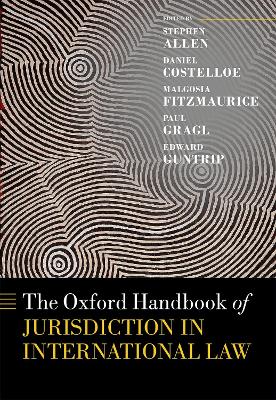
The Oxford Handbook of Jurisdiction in International Law provides an authoritative and comprehensive analysis of the concept of jurisdiction in international law. Jurisdiction plays a fundamental role in international law, limiting the exercise of legal authority over international legal subjects. But despite its importance, the concept has remained, until now, underdeveloped. Discussions of jurisdiction in international law regularly refer to classic heads of jurisdiction based on territoriality or nationality, or use the SS Lotus decision of the Permanent Court of International Justice as a starting point. However, traditional understandings of jurisdiction are facing new challenges. Globalization has increased the need for jurisdiction to be applied extraterritorially, non-State forms of law provide new theoretical challenges and intersections between different forms of jurisdiction have become more intricate.
This Handbook provides a necessary re-examination of the concept of jurisdiction in international law through a thematic analysis of its history, its contemporary application, and how it needs to adapt to encompass future developments in international law. It examines some of the most contentious elements of jurisdiction by considering how the concept is being applied in specific substantive and institutional settings.
Part I: Introduction1. Introduction: Defining State Jurisdiction and Jurisdiction in International Law, Stephen Allen, Daniel Costelloe, Malgosia Fitzmaurice, Paul Gragl, and Edward GuntripPart II: History2. The Beginnings of State Jurisdiction in International Law until 1648, Kaius Tuori3. The Lotus Case in Context - Sovereignty, Westphalia, Vattel, Positivism4. The European Concept of Legal Jurisdiction in the Colonies, Nurfadzilah Yahaya5. Immanuel Kant and Jurisdiction in International Law, Stephan WittichPart III: Theory6. Navigating Diffuse Jurisdictions: An Intra-State Perspective, Helen Quane7. Jurisdictional Pluralism, Paul Schiff Berman8. Deepening the Conversation Between Sociolegal Theory and Legal Scholarship About Jurisdiction, Mariana Valverde9. Critical Approaches to Jurisdiction and International Law, Shaun McVeighPart IV: General International Law10. Cosmopolitan Jurisdiction and the National Interest, Cedric Ryngaert11. Jurisdictional Immunities of the State in International Law, Paul Gragl12. The Establishment, Change, and Expansion of Jurisdiction through Treaties, Dino Kritsiotis13. Territoriality and Globalization, Uta Kohl14. Private law Regulation and Private Interests in Public International Law Jurisdiction, Alex Mills15. Jurisdiction and State Responsibility, Kimberly Trapp16. Enforcing Criminal Jurisdiction in the Clouds and International Law's Enduring Commitment to Territoriality, Stephen AllenPart V: Contextualizing Jurisdiction - Substantive and Institutional Issues17. The 'J' word: Driver or Spoiler of Change in Human Rights Law?, Wouter Vandehole18. International Investment Law, Hybrid Authority and Jurisdiction, Edward Guntrip19. Concepts of State Jurisdiction in the Contentious and Advisory Jurisprudence of the International Court of Justice and the Permanent Court of International Justice, Daniel Costelloe20. The Evolving Nature of the Jurisdiction of the Security Council - a Look at Twenty-First Century Practice, Georg Kerschischnig and Blanca Montejo21. International Criminal Jurisdiction Revisited, Kirsten Schmalenbach22. Jurisdiction and International Territorial Administration, James Summers
Stephen Allen is a Senior Lecturer in Law at Queen Mary, University of London and a barrister with a door tenancy at 5 Essex Court Chambers, London.
Daniel Costelloe is a counsel in the International Arbitration group at Wilmer Cutler Pickering Hale and Dorr LLP in London, where his practice focuses on international disputes and public international law.
Malgosia Fitzmaurice is Professor of Public International Law at Queen Mary, University of London and specializes in international environmental law, the law of treaties, indigenous peoples, and Arctic law.
Paul Gragl is Reader in Public International Law and Theory at Queen Mary, University of London. Besides jurisdiction and state immunity in international law, his research interests include general international law, EU law, and legal theory and philosophy.
Edward Guntrip is a Lecturer in Law at the University of Sussex. His research considers how public international law governs economic activities undertaken in foreign jurisdictions and in areas beyond state jurisdiction.

 Lisainfo e-raamatute kohta