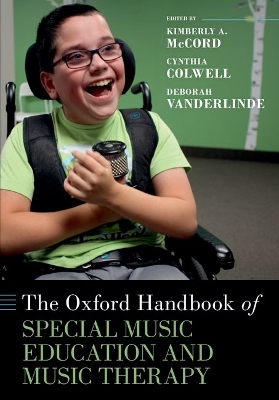
School music teachers have always taught students with (dis)abilities in their classes and ensembles, and occasionally, school music therapists and teachers will collaborate. More often than not, music educators are unaware that their students are receiving music therapy. This handbook addresses this issue in both research and practice by bringing together the complementary fields of Music Therapy and Special Music Education--the latter still a relatively new field but growing in research output and interest. With a focus on school music education (early childhood through grade 12), the twenty-six chapters in this handbook offer a range of discussions by leaders in the fields of music education and music therapy on topics such as theoretical models of disability, ablism in music therapy, intercultural music learning in special education, Universal Design for Learning, music therapy for the whole school community, and more. Many chapters provide descriptions of successful programs in music therapy and special music education around the world.
Taken as a whole, The Oxford Handbook of Special Music Education and Music Therapy is a collaboration between the two fields for the benefit of children of all ages, their teachers, and their music therapists.
This handbook brings together the complementary fields of Music Therapy and Special Music Education--the latter still a relatively new field but growing in research output and interest. With a focus on school music education (early childhood through grade 12), the twenty-six chapters in this handbook offer a range of discussions by leaders in the field of music education and music therapy on topics such as theoretical models of disability, ablism in music therapy, intercultural music learning in special education, Universal Design for Learning, music therapy for the whole school community, and more.
Arvustused
Editors and authors in this important book tenaciously work to increase accessibility and quality of services for children with disabilities. They generously share knowledge on a range of topics to promote creativity and independence in music teachers and music therapists who are preparing children to participate happily and successfully in meaningful life experiences. * Judith A. Jellison, Mary D. Bold Professor Emerita, Center for Music Learning, Butler School of Music, The University of Texas at Austin *
Acknowledgements
Contributors
School Descriptions Introduction
Kimberly McCord, Cynthia Colwell Dunn, and Deborah VanderLinde
Chapter
1. An
Evaluation of Research Methodologies for the Differently Abled: Shifting the
Focus from Deficit-Based to Transformative
Amalia A. Allan
Chapter
2. Dismantling Ableism in Music Therapy for Autistic
Students: Centering Autistic
Colleagues' Vision for the Future
Rebecca West & Mikhaela Ackerman
Chapter
3. Lived Disability Experience:
Bridging Theory, Research, and Practice
Cynthia Bruce
Chapter
4. Using the Social Relational Model of Disability to
Guide Ability-Oriented Music Education
Amanda R. Draper & Sarah J. Bartholomew
Chapter
5. Considering Theoretical
Models of Disability: Practical Implications and Actions for the Music
Educator Erika J. Knapp
Chapter
6. Beyond Performing Inclusion: Lessons
Learned through a Disability Studies-Centric Professional Learning Community
Jesse Rathgeber, Latasha Thomas-Durrell, David A. Stringham, Mary Miller,
Emma Pilmer, Sarah Stelzer, & Grace Templeton
Chapter
7. Music Therapy
Practices in Residential and Therapeutic Day Treatment Schools
CharCarol Fisher
Chapter
8. Making Social, Communicative, and Cognitive
Connections that Count: Integrating Music Therapy Research and Practice to
Support Development
A. Blythe LaGasse & Jaley A. Montgomery
Chapter
9. Exploring Intercultural
Music Learning with Students with Vision Impairment and Intellectual
Disability Takako Haggerty
Chapter
10. Pedagogical Ideas for Teaching d/Deaf
and Hearing Learners in Inclusive Music Classrooms
Katja Sutela
Chapter
11. Adapted Music Curriculum for Students with
Intellectual Disabilities
Marina Wai-Yee Wong
Chapter
12. Adaptive Musical Instruments: Developing an
Organological Framework to Support Disabled Instrumentalists in Mainstream
Ensembles
Anthea Skinner & Aaron Corn
Chapter
13. Assessing the Ability to Relate in
Inclusive Group Music Teaching
Erik Esterbauer, Shirley Salmon & Karin Schumacher
Chapter
14. Confidence
Building Through Co-Teaching and Other Paired Teaching Experiences
Kimberly A. McCord & Abby Gail Means
Chapter
15. DRUM Out Bullying: A
Music-Therapy-Based Socio-Ecological Approach to Address Bullying Lori Fogus
Gooding & Jessica DeKleva
Chapter
16. A Roadmap for Empathy-Based Behaviour
Support in Music Education
Erin Parkes & Jeffery Sabo
Chapter
17. Supporting Music Literacy for All
Learners: Modeling Modes of Representation
Elaine Bernstorf & Amanda M. Vanausdall
Chapter
18. Getting to Know You: Peer
Assisted Learning Strategies for Music Settings
Ellary Draper
Chapter
19. A Student's Perspective on Choral Learning with
Cochlear Implants
Lexy Connelly
Chapter
20. Music Education from the Child's Perspective
Rachel Grimsby
Chapter
21. Centering Perspectives of Disabled Children in
Elementary Music Classrooms
Martina Vasil, Olivia Swedberg Yinger, Alaina Sheridan, Kailey Holmes
Chapter
22. Music Therapists as Team Collaborators in Special Schools
Bronte Arns & Grace Thompson
Chapter
23. Parent Coaching of Music
Interventions for Young Autistic Children: Transforming Research and
Professional Knowledge into Community Practice
Eugenia Hernandez-Ruiz
Chapter
24. Collaborative Music Making: A Model for
Bringing Our Public Schools and Communities Together
Lyn E. Schraer-Joiner & Marguerite Modero
Chapter
25. Sensory Musiking:
Fostering Inclusive Citizenship
Maria Varvarigou
Chapter
26. Cultivating Collaborative Partnerships in
Schools
Melissa Gillespie Index
Kimberly A. McCord is Professor Emerita of Music Education at Illinois State University and Adjunct Professor of Music Education at Teacher's College, Columbia University. Among her books are Oxford publications Teaching the Postsecondary Music Student with Disabilities and Exceptional Pedagogy for Children with Exceptionalities: International Perspectives. She has contributed numerous articles and has served on editorial boards for research journals in jazz education, music technology and music education. She is the founder and director of Just Accessible Music (JAM), an equity-based music school in Connecticut and New York City.
Cynthia Colwell is Professor and Director of Music Therapy at the University of Kansas. Among her publications are a Monograph Series published by the American Music Therapy Association, chapters for Music Therapy: An Introduction to the Profession and Engaging Musical Practices: A Sourcebook for Elementary General Music as well as numerous
research papers. She has served on editorial boards in both music therapy and education and her teaching and research foci are Orff-based music therapy and inclusion in music settings. Currently, she serves as a Visiting Evaluator for the National Association of Schools of Music.
Deborah VanderLinde, Ph.D. is Professor Emerita in Music Education at Oakland University. Her teaching and research focus is the application of constructivist approaches to teaching and learning across music education and special music education contexts. A qualitative researcher, Deborah has contributed several book chapters and has numerous papers published in key journals; in addition, Deborah served as co-editor with Kimberly McCord on the book Exceptional Pedagogy for Children with Exceptionalities: International Perspectives.

 Lisainfo e-raamatute kohta