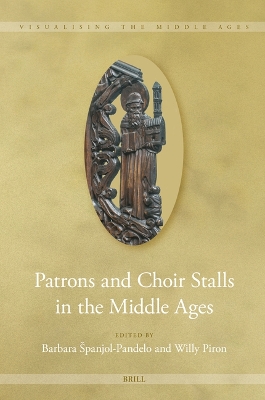
Explore the intricate beauty and historical significance of choir stalls in this groundbreaking collection of essays. Choir stalls were not just functional furnishings but key elements of medieval church interiors, adorned with carvings depicting religious scenes, animals, and symbolic motifs. This volume uniquely examines the role of patronsboth ecclesiastical and secularwho commissioned these masterpieces, highlighting the collaboration between woodcarvers and their sponsors. With a broad geographical and chronological scope, this collection offers fresh insights into the artistry and patronage behind choir stalls, making it essential reading for art historians, medievalists, and anyone fascinated by sacred art and architecture.
Contributors are Joanne Allen, Cécile Meneau d'Anterroches, Frédéric Billiet, Louise Bourdua, Marķa Teresa Chicote Pompanin, Juliana Dresvina, Įngel Fuentes Ortiz, Lorenzo Mascheretti, Willy Piron, Barbara panjol-Pandelo, Maria Dolores Teijeira Pablos, Christel Theunissen, Fernando Villaseńor Sebastiįn , and Ingrid van Woudenberg.
Contents
Acknowledgements
List of Figures
Notes on Contributors
Introduction
Joanne Allen, Juliana Dresvina, Willy Piron, Barbara panjol-Pandelo, and
Christel Theunissen
1 Patrons and Their Projects: Connecting Choir Stalls
Louise Bourdua
2 Corporate, Monastic, and Lay Patronage of Choir Spaces in San Pancrazio in
Florence
Joanne Allen
3 Novus Alexander Macedo, vere magnus, vere pius: the Patronage of
Alessandro Martinengo Colleoni in 16th Century Bergamo
Lorenzo Mascheretti
4 Patrons of the Choir Stalls in the Church of St. Francis in Cres
Barbara panjol-Pandelo
5 Bishop Juan Arias Dįvila and King Henry IV in Segovia Cathedral: a Fake
Stalls Patron?
MŖ Dolores Teijeira Pablos and Fernando Villaseńor Sebastiįn
6 In the Heart of the Church: the Choir(s) of the Cathedral of Cuenca in
Context
Įngel Fuentes Ortiz and Marķa Teresa Chicote Pompanin
7 Lidentité du commanditaire des stalles de Levroux (France): étude dun
indice gravé
Frédéric Billiet
8 George I dAmboise as Patron of the Stalls in Gaillon Castle
Cécile Meneau dAnterroches
9 Margaret of Austria as Regent and Patron: the Choir Stalls of Brou
Ingrid van Woudenberg
10 Choir Stall Patrons in Northwestern Europe
Christel Theunissen
11 Oxford Misericords and Their Patrons, Medieval and Modern: a Brief
History
Juliana Dresvina
12 Moritz von Spiegelberg and His Patent of Nobility on the Choir Stalls in
Emmerich
Willy Piron
Glossary
Index
Barbara panjol-Pandelo, Ph.D. (2014), University of Rijeka, is Associate Professor at the University of Rijeka (Faculty of Humanities and Social Sciences, Department of Art History), and director of the Medieval Adriatic Heritage Research Centre Rijeka (RiMah). Her research focuses on medieval wooden sculpture and the cultural connections between the Veneto region and the eastern Adriatic coast during the late Middle Ages.
Willy Piron studied Art History and Archaeology at the Radboud University Nijmegen. In 2008 he became the manager of the Centre for Art Historical Documentation, Department of Art History, Radboud University Nijmegen. Since 2015 he has been the secretary of Misericordia International. His research interests are late-medieval art and imagery. Among others, his projects include databases on medieval pilgrim badges (Kunera) and choir stalls (Stalla).

 Lisainfo e-raamatute kohta