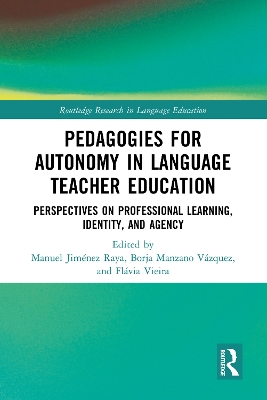
This book aims to challenge established teaching cultures to promote teacher autonomy and autonomy-oriented pedagogies in language teacher education.
This book aims to challenge established teaching cultures to promote teacher autonomy and autonomy-oriented pedagogies in language teacher education.
Offering a set of inspiring case studies that illustrate language teacher education for autonomy as a space of multiple possibilities, the book fuses theory and practice and gives a holistic view of the changing landscape of language teacher education, accounting for the transformative power of educational practices that help teachers think and act in informed, context-specific, and learner-centred ways. It also demonstrates the importance of autonomy in language teacher education contexts, specifically to foster teachers’ professional learning, identity, and agency, as well as in assessing and reshaping teacher education programmes.
This book will be particularly useful to researchers, scholars, and postgraduate students in the fields of teaching and teacher education, modern foreign languages, and teaching and learning language research more broadly. Curriculum designers and language teacher education programme directors may also find the volume of use.
Arvustused
"Why does the nurturing of learner autonomy, essential in an increasingly unpredictable world, remain so elusive in many contexts? This illuminating volume offers a convincing way forward through teacher education case studies demonstrating the links between the theory-practice nexus and teacher autonomy an essential element in pedagogy for autonomy. Inspirational!"
Professor Terry Lamb, University of Westminster, UK
"In this timely addition to Jiménez Rayas & Vieiras previous Routledge (2021) volume, the contributors (all teacher educator-researchers) present a number of experience-based ideas, linking theory and practice... With a particularly insightful focus on teacher education in general and reflective practice specifically, the multi-layered field of language teacher education for autonomy is amply covered from an internationally-diverse set of teaching contexts."
Graeme Porte, Editor, Language Teaching (CUP), Spain
1. Bridging the gap between theory and practice in initial teacher
education for autonomy
2. Teacher education for autonomy: An analysis of
language teacher education initiatives for learner and teacher autonomy
3.
Identity and autonomy development in learning to teach EFL: Making sense of
cognitive/emotional dissonance
4. Linking principle and practice in initial
language teacher education for learner and teacher autonomy: The case for
student teacher case writing
5. Enhancing autonomy through inquiry in
practicum settings: Insights from a narrative of practice in primary English
teaching
6. Language teacher education as a two-way autonomy development
process: Student teachers and teacher educators as learners
7. Developing
collaborative teacher autonomy for learning to teach English to young
learners
8. Autonomous participation in post-observation feedback
discussions: Post-practicum teacher candidates as relative old-timers in an
ELT methods course
9. Becoming a learner again: Implications for autonomy
teacher education
10. From university to schools: Insights from novice
language teachers into teacher autonomy
11. Learning to learn foreign
languages: Empowering pre-service EFL teachers
12. The use of a
self-reflective instrument for pre-service language teachers in Brazil:
Discussions on autonomy, agency, and the use of digital technologies
13.
Language teacher education for autonomy: Critical issues and possible pathways
Manuel Jiménez Raya is Professor of Applied Linguistics at the University of Granada, Spain. He works in the fields of learner and teacher autonomy and language teacher education.
Borja Manzano Vįzquez is Lecturer at the Department of English and German Philology, University of Granada, Spain. He works in the fields of learner and teacher autonomy in language education and language teacher education, and bilingual education.
Flįvia Vieira is Professor at the University of Minho, Portugal. She works in the fields of language teacher education, pedagogy for autonomy, and pedagogy in HE.

 Lisainfo e-raamatute kohta