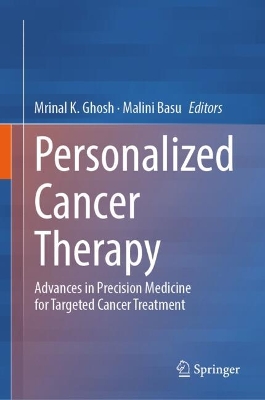
This book offers a definitive and comprehensive exploration of precision medicine, capturing both its foundational principles and cutting-edge innovations. Organized into six sections, it guides readers from the basics of individualized healthcare to the advanced application of genomics, epigenomics, pharmacogenomics, and artificial intelligence in cancer treatment. Through detailed cancer-specific chapterscovering gliomas, head & neck cancers, breast, lung, prostate, colon, pancreatic, and other malignanciesthe book delivers in-depth insights into molecular profiling, diagnosis, and personalized therapy strategies. Beyond scientific advances, it critically addresses the ethical, clinical, and social dimensions of precision medicine, preparing clinicians, researchers, and policymakers to navigate challenges and harness the future opportunities in this transformative field. By blending scientific rigor with forward-looking perspectives, this volume positions itself as an authoritative reference for oncology researchers, clinicians, bioinformaticians, pharmaceutical scientists, and graduate students seeking to understand and contribute to the future of personalized healthcare.
Section
1. Introduction to Precision Medicine.
Chapter
1. Basic
principles and Concepts.
Chapter
2. Shift from traditional to personalized
approaches.- Section
2. Genomics, Epigenomics and Pharmacogenomics.
Chapter
3. Genomics and key alterations.
Chapter
4. Cancer Epigenomics in Precision
medicine.
Chapter
5. Pharmacogenomics in personalized treatment.
Chapter
6.
Precision Cancer Medicine and Clinical Trial Design.
Chapter
7. Clinical
implementation and outcome.- Section
3. Cancer Specific Molecular Profiling,
Diagnosis and Treatment.
Chapter
8. Advanced personalized treatment
strategies in Glioblastoma.
Chapter
9. Personalized treatment options in
Head and Neck Cancer.
Chapter
10. Breast Cancer: Neoantigen vaccines and
targeted therapies.
Chapter
11. Personalized therapy in Non-Small Cell Lung
Cancer.
Chapter
12. Personalized medicines and prospects in Prostate
Cancer.
Chapter
13. Breakthroughs in personalized treatment of Colorectal
Cancer.
Chapter
14. Innovative approaches in Pancreatic Cancer treatment.-
Chapter
15. Advancements in Hematopoietic Cancers treatment.- Section
4.
Nanotherapeutics in Personalized Medicine.
Chapter
16. Targeted delivery for
cancer therapy and real-time monitoring using nanotherapeutics.
Chapter
17.
Biomarker identification using nanoparticles.- Section
5. Challenges,
Limitations and Social considerations.
Chapter
18. Technical and clinical
challenges.
Chapter
19. Social issues and Benefits.
Chapter
20. Role of
health workers in personalized medicine.- Section
6. Novel Innovations and
Future Perspectives.
Chapter
21. Emerging technologies and approaches.-
Chapter
22. Application of bioinformatics and computational biology.
Chapter
23. Artificial intelligence (AI) and machine learning (ML) in personalized
medicine.
Chapter
24. Potential breakthroughs and future research directions.
Dr. Mrinal K Ghosh is a Chief Scientist, In-Charge of CSIR-IICB (TRUE), Salt Lake Campus and Head (2019-2025) of the Cancer Biology and Inflammatory Disorder Division at CSIR-IICB, Kolkata, India; Chairman of management council at CSIR-IICB (TRUE) and a Professor at the Academy of Scientific and Innovative Research (AcSIR), India. He completed his Ph.D. from the University of Calcutta and Post-doctoral research (1997 2005) from Lerner Research Institute, Cleveland Clinic Foundation, OHIO, USA. Dr. Ghoshs research interests include signal transduction in cancer focusing on the regulation of various oncogenes and tumor suppressor proteins, and developing nanotechnology-based targeted drug delivery systems to the targets (identified molecular vulnerabilities) in brain, breast, and colon cancers. He has published 81 papers in peer-reviewed international journals, Edited one book, and authored several book chapters. Dr. Ghosh delivered numerous lectures, and is a reviewer of various national and international journals and research project proposals of World Cancer Research, Ireland Research Board, ICMR, DBT, DST. Dr. Ghosh is a lifetime member of the Indian Society of Translational Research (ISTR), the Chemical Biology Society (CBS), the Indian Association of Cancer Research (IACR), the Society of Biological Chemistry (SBC), and the Indian Science Congress Association (ISCA), India.
Dr. Malini Basu is an Assistant Professor and Head, Department of Microbiology, Dhruba Chand Halder College, University of Calcutta, Kolkata, India. She completed her Ph.D. from the University of Calcutta and Post-doctoral research from Case Western Reserve University (CWRU), USA in collaboration with Rainbow Babies and Children Hospital, Ohio, USA. Dr. Basus research interests include heavy metals, microbial bioremediation and bioindicators, unique virulence, pathogenicity, and host-immune response of Helicobacter pylori in gastric cancer. She has published several papers in peer-reviewed national and international journals and some book chapters. Dr. Basu is a lifetime member of the Microbiologists Society India (MBSI), the Association of Microbiologists of India (AMI), ISCA and ISNA. She is also the state vice-president of the Microbiologists Society of India.

 Lisainfo e-raamatute kohta