Muutke küpsiste eelistusi

E-raamat: Perverse Memory and the Holocaust: A Psychoanalytic Understanding of Polish Bystanders

(University of Warsaw, Poland)
  • Formaat - PDF+DRM
  • Hind: 59,79 €*
  • * hind on lõplik, st. muud allahindlused enam ei rakendu
  • Lisa ostukorvi
  • Lisa soovinimekirja
  • See e-raamat on mõeldud ainult isiklikuks kasutamiseks. E-raamatuid ei saa tagastada.

DRM piirangud

  • Kopeerimine (copy/paste):

    ei ole lubatud

  • Printimine:

    ei ole lubatud

  • Kasutamine:

    Digitaalõiguste kaitse (DRM)
    Kirjastus on väljastanud selle e-raamatu krüpteeritud kujul, mis tähendab, et selle lugemiseks peate installeerima spetsiaalse tarkvara. Samuti peate looma endale  Adobe ID Rohkem infot siin. E-raamatut saab lugeda 1 kasutaja ning alla laadida kuni 6'de seadmesse (kõik autoriseeritud sama Adobe ID-ga).

    Vajalik tarkvara
    Mobiilsetes seadmetes (telefon või tahvelarvuti) lugemiseks peate installeerima selle tasuta rakenduse: PocketBook Reader (iOS / Android)

    PC või Mac seadmes lugemiseks peate installima Adobe Digital Editionsi (Seeon tasuta rakendus spetsiaalselt e-raamatute lugemiseks. Seda ei tohi segamini ajada Adober Reader'iga, mis tõenäoliselt on juba teie arvutisse installeeritud )

    Seda e-raamatut ei saa lugeda Amazon Kindle's. 
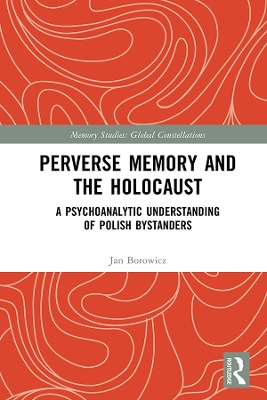
Perverse Memory and the Holocaust presents a new theoretical approach to the study of Polish memory bystanders of the Holocaust. Drawing on psychoanalytic theory, it examines representations of the Holocaust in order to explore the perverse mechanisms of memory at work.


Perverse Memory and the Holocaust presents a new theoretical approach to the study of Polish memory bystanders of the Holocaust. Drawing on psychoanalytic theory, it examines representations of the Holocaust in order to explore the perverse mechanisms of memory at work, in which surface a series of phenomena difficult to remember: the pleasure derived from witnessing scenes of violence, identification with the German perpetrators of violence, the powerful fear of revenge at the hands of Jewish victims, and the adoption of the position of genocide victims.

Moving away from the focus of previous psychoanalytic studies of memory on questions of mourning, melancholy, repressed memory, and loss, this volume considers the transformation of the collective identity of those who remained in the space of past Holocaust events: bystanders, who partook in the events and benefited from the extermination of the Jews. A critique of ‘perverse memory’ that hampers attempts to work through what is remembered, this book will be of interest to scholars across the social sciences working in the fields of Holocaust studies, memory studies, psychoanalytic studies, and cultural studies.

Arvustused

"Whereas perpetrators and victims of the Holocaust are well defined subjects, bystanders remain ambiguous and difficult to understand. Although often described as indifferent to the witnessed violence, in his brilliant study Perverse Memory and the Holocaust, Jan Borowicz assumes that the bystander position must also evoke extreme emotions, which he qualifies as "perverse". In this context "perverse" is a defense structure that prevents the examination of reality and that allows the bystander to freely live in contradiction and to avoid responsibility, guilt, and suffering. He has totally convinced me that only a psychoanalytic approach can do justice to and understand the ambiguity of the perverse emotions bystanders felt." Ernst van Alphen, Professor Emeritus of Literary Studies, Leiden University, the Netherlands

"Bystanders are not uninvolved, Jan Borowicz shows this aspect in many facets. Courageously and uncompromisingly, Jan Borowicz shows us the dirty secret of Poland: confidants and bystanders not only saw the crimes of the Nazis, they also felt something about them. The aspect of excitement and satisfaction, the triumph over the murder of millions of people can no longer be hidden after reading the book, the perverse memory can no longer be glossed over or whitewashed by reinterpreting it. It continues to have an unconscious and preconscious effect in the following generations. The courageous psychoanalytical study of Jan Borowicz can be understood as an interpretation to uncovering the denial in the Polish memory." Elisabeth Brainin and Samy Teicher, Vienna Psychoanalytic Society (IPA), Austria

Introduction: The Blurred and the Overlooked
1. Voyeurism: The Polish
Bystander Looks with One Eye
2. Fetishism: The Nazi in a Uniform
3.
Masochism: Competitive Victimization
4. Sadism: Drastic Returns of the Dead
5. Perverse (Post)Memory Conclusion
Jan Borowicz is a member of the Holocaust Remembrance Research Team at the Institute of Polish Culture at the University of Warsaw, Poland. A cultural studies scholar, he has published two books in Polish on the Holocaust history and memory. He is also a certified psychotherapist, a member of Polish Society for Psychoanalytic Psychotherapy, and a candidate of the Polish Psychoanalytical Society (IPA).