Muutke küpsiste eelistusi

E-raamat: Political Science Research in Practice

Edited by , Edited by (Furman University, USA)
  • Formaat: EPUB+DRM
  • Ilmumisaeg: 03-Sep-2018
  • Kirjastus: Routledge
  • Keel: eng
  • ISBN-13: 9781351401890
  • Formaat - EPUB+DRM
  • Hind: 77,99 €*
  • * hind on lõplik, st. muud allahindlused enam ei rakendu
  • Lisa ostukorvi
  • Lisa soovinimekirja
  • See e-raamat on mõeldud ainult isiklikuks kasutamiseks. E-raamatuid ei saa tagastada.
  • Formaat: EPUB+DRM
  • Ilmumisaeg: 03-Sep-2018
  • Kirjastus: Routledge
  • Keel: eng
  • ISBN-13: 9781351401890

DRM piirangud

  • Kopeerimine (copy/paste):

    ei ole lubatud

  • Printimine:

    ei ole lubatud

  • Kasutamine:

    Digitaalõiguste kaitse (DRM)
    Kirjastus on väljastanud selle e-raamatu krüpteeritud kujul, mis tähendab, et selle lugemiseks peate installeerima spetsiaalse tarkvara. Samuti peate looma endale  Adobe ID Rohkem infot siin. E-raamatut saab lugeda 1 kasutaja ning alla laadida kuni 6'de seadmesse (kõik autoriseeritud sama Adobe ID-ga).

    Vajalik tarkvara
    Mobiilsetes seadmetes (telefon või tahvelarvuti) lugemiseks peate installeerima selle tasuta rakenduse: PocketBook Reader (iOS / Android)

    PC või Mac seadmes lugemiseks peate installima Adobe Digital Editionsi (Seeon tasuta rakendus spetsiaalselt e-raamatute lugemiseks. Seda ei tohi segamini ajada Adober Reader'iga, mis tõenäoliselt on juba teie arvutisse installeeritud )

    Seda e-raamatut ei saa lugeda Amazon Kindle's. 

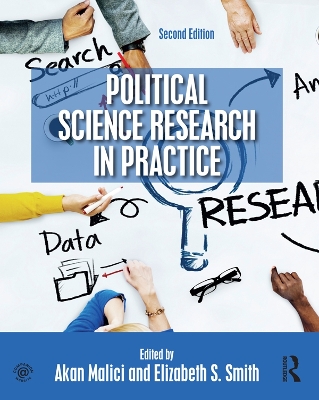
Nothing rings truer to those teaching political science research methods: students hate taking this course. Tackle the challenge and turn the standard research methods teaching model on its head with Political Science Research in Practice. Akan Malici and Elizabeth S. Smith engage students first with pressing political questions and then demonstrate how a researcher has gone about answering them, walking them through real political science research that contributors have conducted. Through the exemplary use of a comparative case study, field research, interviews, textual and interpretive research, statistical research, survey research, public policy and program evaluation, content analysis, and field experiments, each chapter introduces students to a method of empirical inquiry through a specific topic that will spark their interest and curiosity. Each chapter shows the process of developing a research question, how and why a particular method was used, and the rewards and challenges discovered along the way. Students can better appreciate why we need a science of politicswhy methods matterwith these first-hand, issue-based discussions.

The second edition now includes:


Two completely new chapters on field experiments and a chapter on the textual/interpretative method.


New topics, ranging from the Arab Spring to political torture to politically sensitive research in China to social networking and voter turnout.


Revised and updated "Exercises and Discussion Questions" sections.


Revised and updated "Interested to Know More" and "Recommended Resources" sections.

Arvustused

'Most methodology books focus on the dry nuts and bolts of empirical inquiry, and often fail to provide an engaging pedagogical context for undergraduates. This book is different. By embedding methodological discussions within the context of important substantive questions, this volume conveys the science of politics in action. I only wish that such a book were available when I was a student.'Howard Lavine, Arleen C. Carlson Professor of Political Science, University of Minnesota

'Malici and Smith do two things we rarely see in research methods texts: they cover the rich, broad spectrum of empirical approaches in the discipline and they convey these techniques through first-hand examples. The result is a book that is engaging, accessible, and uniquely valuable to political science students and instructors.'Francis Neely, Associate Professor, San Francisco State University

The timely update of Malici and Smith's book helps students understand how political scientists investigate real-world problems using a full spectrum of methodological tool set. It continued the previous edition's one-of-a-kind storytelling approach that makes political science research approachable, relevant, and even fun. It will be welcomed by both teachers and students of political science research methods alike. Yi Edward Yang, Professor of Political Science, James Madison University

List of Illustrations
vii
Notes on Contributors ix
Preface xiii
Acknowledgments xv
1 Why Do We Need A Science Of Politics?
1(13)
Elizabeth S. Smith
Akan Malici
2 How Do We Get A Science Of Politics?
14(14)
Akan Malici
Elizabeth S. Smith
3 The Comparative Case Study Method: "Uncivil Society" In The Arab Uprisings
28(19)
Zaid Eyadat
4 Field Research: Navigating Politically Sensitive Research In China
47(16)
Katherine Palmer Kaup
5 Interviewing In Political Science Research: Who Resists Injustice?
63(19)
Kristina Thalhammer
6 Critical And Interpretive Research: Understanding Torture's Popularity In The United States
82(18)
Brent J. Steele
7 Statistical Research: Lack Of Citizenship, The Achilles' Heel Of Latino Political Power
100(17)
Adrian D. Pantoja
Sarah Allen Gershon
8 Survey Research: Religion And Electoral Behavior In The United States, 1936--2016
117(20)
Lyman A. Kellstedt
James L. Guth
9 Public Policy And Program Evaluation: Does High School Type Affect College Success?
137(19)
David J. Fleming
Joshua M. Cowen
Deven Carlson
10 Content Analysis: Congressional Communication Through Broadcast And New Media
156(16)
C. Danielle Vinson
11 Field Experiments: Wired To Mobilize: The Effect Of Social Networking Messages On Voter Turnout
172(21)
Holly Teresi
Melissa R. Michelson
12 Normative And Ethical Considerations Of Political Science Research
193(15)
Elizabeth S. Smith
Akan Malici
Glossary 208(6)
Index 214
Akan Malici is Professor of Politics and International Affairs at Furman University. He authored When Leaders Learn and When They Don't (SUNY, 2008) and The Search for a Common European Foreign and Security Policy (Palgrave, 2008). He co-authored U.S. Presidents and Foreign Policy Mistakes (Stanford, 2011) and Role Theory and Role Conflict in U.S.-Iran Relations (Routledge, 2016) and co-edited of Re-thinking Foreign Policy Analysis (Routledge, 2011). He teaches classes in International Politics and Research Methodology.

Elizabeth S. Smith is Professor of Politics and International Affairs at Furman University. She received her Ph.D. in American politics with a minor in political psychology from the University of Minnesota. She has taught research methodology for many years. Her work appears in The Journal of Political Science Education, Polity, Political Psychology, The Handbook for Teaching Social Issues, the American Education Research Journal and in Competition in Theory and Practice (Sense Publishers 2009).