Muutke küpsiste eelistusi

E-raamat: Politics of Social Change: From the Sixties to the Present Through the Eyes of a Generation

  • Formaat: EPUB+DRM
  • Ilmumisaeg: 23-Mar-2026
  • Kirjastus: University of Chicago Press
  • Keel: eng
  • ISBN-13: 9780226845241
Teised raamatud teemal:
  • Formaat - EPUB+DRM
  • Hind: 26,51 €*
  • * hind on lõplik, st. muud allahindlused enam ei rakendu
  • Lisa ostukorvi
  • Lisa soovinimekirja
  • See e-raamat on mõeldud ainult isiklikuks kasutamiseks. E-raamatuid ei saa tagastada.
  • Formaat: EPUB+DRM
  • Ilmumisaeg: 23-Mar-2026
  • Kirjastus: University of Chicago Press
  • Keel: eng
  • ISBN-13: 9780226845241
Teised raamatud teemal:

DRM piirangud

  • Kopeerimine (copy/paste):

    ei ole lubatud

  • Printimine:

    ei ole lubatud

  • Kasutamine:

    Digitaalõiguste kaitse (DRM)
    Kirjastus on väljastanud selle e-raamatu krüpteeritud kujul, mis tähendab, et selle lugemiseks peate installeerima spetsiaalse tarkvara. Samuti peate looma endale  Adobe ID Rohkem infot siin. E-raamatut saab lugeda 1 kasutaja ning alla laadida kuni 6'de seadmesse (kõik autoriseeritud sama Adobe ID-ga).

    Vajalik tarkvara
    Mobiilsetes seadmetes (telefon või tahvelarvuti) lugemiseks peate installeerima selle tasuta rakenduse: PocketBook Reader (iOS / Android)

    PC või Mac seadmes lugemiseks peate installima Adobe Digital Editionsi (Seeon tasuta rakendus spetsiaalselt e-raamatute lugemiseks. Seda ei tohi segamini ajada Adober Reader'iga, mis tõenäoliselt on juba teie arvutisse installeeritud )

    Seda e-raamatut ei saa lugeda Amazon Kindle's. 
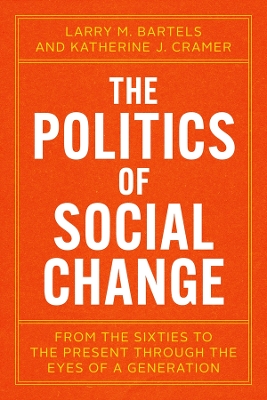
How did we get to this point in American politics? Drawing on insights from an unprecedented decades-long study of ordinary Americans’ political lives, this book tells the story of how, why, and when our politics fractured.

Few time periods have been as defined by waves of monumental social change as the United States during the 1960s. Even today, almost sixty years later, the era is often depicted as a triumph of social progress. Yet, as Larry M. Bartels and Katherine J. Cramer show in The Politics of Social Change, it was Americans’ diverse reactions to the milestone events of the time—from the welcoming, to the fiercely resistant, to the largely oblivious—that planted the seeds of our current political turmoil.

Their masterful analysis draws on a unique historical resource: the longest-running systematic tracking of individual Americans’ political attitudes and behavior ever attempted. The study began in 1965 when researchers interviewed hundreds of high school students across the country and then periodically reinterviewed them over the next three decades. Bartels and Cramer supplement this historical record with in-depth interviews with dozens of the original students, painting a detailed picture of the generation’s individual and collective political development. By tracing the responses of the Class of ’65 to major events of their political lifetimes—including the Civil Rights and Women’s Rights movements, the Vietnam War, the shifting role of religion, escalating economic inequality, immigration, and the rise of Donald Trump—Bartels and Cramer shed new light on the evolution of public opinion and the unsteady progress of American democracy.

Arvustused

Larry Bartels and Katherine Cramer are a dream team at the top of their game in both quantitative and qualitative analysis. Capitalizing on one of the most remarkable long-term survey research projects ever mounted, they have produced a rich and uniquely valuable perspective on more than six decades of social and political change. Seen through the eyes of Americas high school seniors of 1965, the sophisticated, twisting tale that Bartels and Cramer tell leads tragically to todays angry, unequal, dispirited, and polarized America. -- Robert D. Putnam | author of "Bowling Alone" and "The Upswing" How do the circumstances into which people are born and raised, and the political events underway as they come of age, shape their political attitudes decades later? Larry Bartels and Katherine Cramer examine this by studying Americans in the high school Class of 1965. They analyze surveys conducted across these individuals lifespans along with fresh and in-depth interviews Bartels and Cramer themselves conducted recently, in respondents own homes all over the United States. The result is a fascinating exploration that sheds light, not least, on why many children of 1960s became, a half-century later, supporters of President Donald Trump. A must-read for anyone who wants to understand how our place in history shapes our views, and how we, in turn, shape politics. -- Suzanne Mettler | Cornell University

1. Past and Present
2. Life Chances
3. A Stormy Passage: The Impact of the Sixties
4. The Lessons of Vietnam
5. The Struggle(s) for Equality
6. The Political Impact of Economic Change
7. Work and Welfare
8. The Rise of the Religious Right
9. Civic Life and Political Engagement
10. Partisan Change
11. How Long Will It Take? The Politics of Social Change

Acknowledgments
Bibliography
Index
Larry M. Bartels is University Distinguished Professor of Political Science and the Law and May Werthan Shayne Chair of Public Policy and Social Science at Vanderbilt University. His books include Unequal Democracy: The Political Economy of the New Gilded Age and (with Christopher H. Achen) Democracy for Realists: Why Elections Do Not Produce Responsive Government. Katherine J. Cramer is the Natalie C. Holton Chair of Letters & Science and the Virginia Sapiro Professor of Political Science at the University of Wisconsin-Madison. She is the author or coauthor of several books, including The Politics of Resentment: Rural Consciousness in Wisconsin and the Rise of Scott Walker.