Muutke küpsiste eelistusi

E-raamat: Power of Mammon: The Market, Secularization, and New York Baptists, 1790-1922

  • Formaat: PDF+DRM
  • Sari: America's Baptists
  • Ilmumisaeg: 18-Aug-2023
  • Kirjastus: University of Tennessee Press
  • Keel: eng
  • ISBN-13: 9781621906926
  • Formaat - PDF+DRM
  • Hind: 31,81 €*
  • * hind on lõplik, st. muud allahindlused enam ei rakendu
  • Lisa ostukorvi
  • Lisa soovinimekirja
  • See e-raamat on mõeldud ainult isiklikuks kasutamiseks. E-raamatuid ei saa tagastada.
  • Formaat: PDF+DRM
  • Sari: America's Baptists
  • Ilmumisaeg: 18-Aug-2023
  • Kirjastus: University of Tennessee Press
  • Keel: eng
  • ISBN-13: 9781621906926

DRM piirangud

  • Kopeerimine (copy/paste):

    ei ole lubatud

  • Printimine:

    ei ole lubatud

  • Kasutamine:

    Digitaalõiguste kaitse (DRM)
    Kirjastus on väljastanud selle e-raamatu krüpteeritud kujul, mis tähendab, et selle lugemiseks peate installeerima spetsiaalse tarkvara. Samuti peate looma endale  Adobe ID Rohkem infot siin. E-raamatut saab lugeda 1 kasutaja ning alla laadida kuni 6'de seadmesse (kõik autoriseeritud sama Adobe ID-ga).

    Vajalik tarkvara
    Mobiilsetes seadmetes (telefon või tahvelarvuti) lugemiseks peate installeerima selle tasuta rakenduse: PocketBook Reader (iOS / Android)

    PC või Mac seadmes lugemiseks peate installima Adobe Digital Editionsi (Seeon tasuta rakendus spetsiaalselt e-raamatute lugemiseks. Seda ei tohi segamini ajada Adober Reader'iga, mis tõenäoliselt on juba teie arvutisse installeeritud )

    Seda e-raamatut ei saa lugeda Amazon Kindle's. 

"Curtis D. Johnson argues that the values and attractions of the market revolution triggered changes in congregational life that secularized New York State Baptist congregations in the nineteenth and early twentieth centuries. The market and associated forces, such as media, politics, individualism, and consumerism, affected Baptist belief and behavior so that, after a century of change, Baptist congregations were far weaker institutions than they had been earlier. The Baptist experience suggests that the seeds of religion's fading influence in contemporary America were actually sown two hundred years ago"--

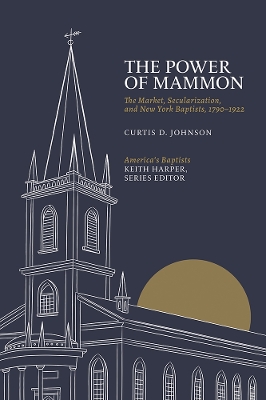
In The Power of Mammon, Curtis D. Johnson describes how the market economy and market-related forces, such as the media, politics, individualism, and consumerism, radically changed the nature of Baptist congregational life in New York State during three centuries. Collectively, these forces emphasized the importance of material wealth over everything else, and these values penetrated the thinking of Baptist ministers and laypeople alike. Beginning in the 1820s, the pastorate turned into a profession, the laity&;s influence diminished, closeknit religious fellowships evolved into voluntary associations, and evangelism became far less effective. Men, being the most engaged in the market, secularized the more quickly and became less involved in church affairs. By the 1870s, male disengagement opened the door to increased female participation in church governance. While scientific advances and religious pluralism also played a role, the market and its related distractions were the primary forces behind the secularization of Baptist life.

The Power of Mammon is history from the ground up. Unlike many denominational histories, this book emphasizes congregational life and the importance of the laity. This focus allows the reader to hear the voices of ordinary Baptists who argued over a host of issues. Johnson deftly connects large social trends with exhaustive attention to archival material, including numerous well-chosen records preserved by forty-two New York churches. These records include details related to membership, discipline, finance, and institutional history. Utilizing statistical analysis to achieve even greater clarity, Johnson effectively bridges the gap between the particularity of church records and the broader history of New York&;s Baptist churches.

Johnson&;s narrative of Baptist history in New York will serve as a model for other regional studies and adds to our understanding of secularization and its impact on American religion.

Arvustused

Curtis D. Johnsons sweeping, detailed, and convincing narrative of Baptist history in New York makes an important contribution to Baptist history. Because New York was a major center of Baptist life during the period of Johnsons study, his book promises to be required reading for anyone interested in Baptist history in the northern United States.- Amanda Porterfield, author of Corporate Spirit: Religion and the Rise of the Modern Corporation

Foreword ix
Keith Harper Acknowledgments xi
Introduction xiii
Part 1 Covenanted Communities, 1790-1820
1 People's Churches
3(14)
2 A Place for (Some) Women
17(8)
3 On Revivals and Awakenings
25(8)
Part 2 The Market Revolution, 1820-1845
4 The Transforming Market
33(12)
5 Ministers and the Market
45(10)
6 Women Lose Their Place
55(10)
7 Constricting Liberty
65(16)
8 The Protracted Meeting Myth
81(16)
9 Apocalypse
97(8)
Part 3 The Process of Secularization, 1835-1860
10 Individualism Triumphant
105(18)
11 Something Old, Something New
123(11)
Part 4 Baptists and the Commercial Establishment, 1860-1922
12 The Market Enshrined
134(13)
13 Women to the Rescue
147(14)
14 Divided Baptists
161(16)
15 Evangelism in a Secular Age
177(8)
Afterword 185(4)
Notes 189(44)
Bibliography 233(16)
Index 249
Curtis D. Johnson is professor of history at Mount St. Marys University, Emmitsburg, Maryland. He is the author of Islands of Holiness: Rural Religion in Upstate New York, 17901860 and Redeeming America: Evangelicals and the Road to Civil War.