Muutke küpsiste eelistusi

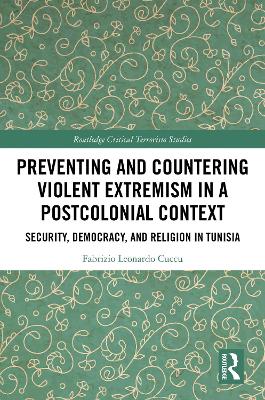
E-raamat: Preventing and Countering Violent Extremism in a Postcolonial Context: Security, Democracy, and Religion in Tunisia

  • Formaat - PDF+DRM
  • Hind: 59,79 €*
  • * hind on lõplik, st. muud allahindlused enam ei rakendu
  • Lisa ostukorvi
  • Lisa soovinimekirja
  • See e-raamat on mõeldud ainult isiklikuks kasutamiseks. E-raamatuid ei saa tagastada.
  • Raamatukogudele

DRM piirangud

  • Kopeerimine (copy/paste):

    ei ole lubatud

  • Printimine:

    ei ole lubatud

  • Kasutamine:

    Digitaalõiguste kaitse (DRM)
    Kirjastus on väljastanud selle e-raamatu krüpteeritud kujul, mis tähendab, et selle lugemiseks peate installeerima spetsiaalse tarkvara. Samuti peate looma endale  Adobe ID Rohkem infot siin. E-raamatut saab lugeda 1 kasutaja ning alla laadida kuni 6'de seadmesse (kõik autoriseeritud sama Adobe ID-ga).

    Vajalik tarkvara
    Mobiilsetes seadmetes (telefon või tahvelarvuti) lugemiseks peate installeerima selle tasuta rakenduse: PocketBook Reader (iOS / Android)

    PC või Mac seadmes lugemiseks peate installima Adobe Digital Editionsi (Seeon tasuta rakendus spetsiaalselt e-raamatute lugemiseks. Seda ei tohi segamini ajada Adober Reader'iga, mis tõenäoliselt on juba teie arvutisse installeeritud )

    Seda e-raamatut ei saa lugeda Amazon Kindle's. 

This book examines how global policies designed to prevent extremism have shaped religious and security governance in Tunisia in recent years, focusing on local programs for training imams.


This book examines how global policies designed to prevent extremism have shaped religious and security governance in Tunisia in recent years, focusing on local programs for training imams.

By tracing the evolution of security measures in Tunisia from the colonial era to today, the book highlights how transnational security policies—particularly those promoted after 2011—have reinforced state control over religion. While many studies explore religion’s role in politics, this work shows how international security agendas influence religious institutions and discourse locally. Through interviews with religious leaders and civil society organizations, the book uncovers how Tunisian institutions have strategically used international counter-extremism frameworks to justify increased security measures. It also sheds light on the evolving role of imams as security actors. By linking past and present, the book challenges the idea that counter-extremism policies are ‘neutral’, showing instead how they often echo colonial-era policing.

This book will be of interest to students of countering violent extremism, securitization, African studies, and International Relations in general.

Arvustused

"This important new book traces the development of P/CVE measures in Tunisia, highlighting the agency of local actors and situating counter-radicalisation initiatives in wider social and political contexts. With an enviable combination of historical nuance, original empirical findings, and cutting-edge conceptual insight, Preventing and Countering Violent Extremism in a Postcolonial Context will be essential reading to anyone interested in the complex contemporary intersections between security, religion, and politics. It deserves the widest possible audience."

Lee Jarvis, Professor of Security and Society, Adelaide University, Australia

"In Preventing and Countering Extremism in a Postcolonial Context, Fabrizio Leonardo Cuccu delivers the first significant and book-length study of how counter-extremism moves from International Organisations to the postcolonial space. The text explores the unique refraction of P/CVE norms through the power structures of Tunisian politics and society, as well as the role played by Imams in highlighting and silencing parts of the P/CVE canon for the local environment. Cuccu's book teaches us that security is never simple; it is refracted through layers of history as well as geography, directed according to the interests of those who wield power, in any context."

Charlotte Heath-Kelly, Professor of Politics and International Studies, University of Warwick, United Kingdom

Introduction
Chapter 1: Security in Postcolonial Settings: The
Transnational Management of Dangerous Populations
Chapter 2: Reproducing
Colonial Logics: International Actors and the Assessment of Transnational
Threats
Chapter 3: Between International and National Discourses: Managing
Islam in Postcolonial Tunisia
Chapter 4: International Development and
Violent Extremism: Multiple Actors in Local Programmes
Chapter 5:
Vernacular Security, Religion and Local Imams Conclusions: International
P/CVE Programmes and the Continuation of Colonial Policing
Fabrizio Leonardo Cuccu is Alumni Research Fellow at the Merian Centre for Advanced Studies in the Maghreb (MECAM), University of Tunis, Tunisia, and Research Assistant in the School of Law and Government, Dublin City University, Ireland. His research focuses on security, development, and migration policies in postcolonial settings. His work has been published in the Cambridge Review of International Affairs, LAnnée du Maghreb and Surveillance & Society.