Muutke küpsiste eelistusi

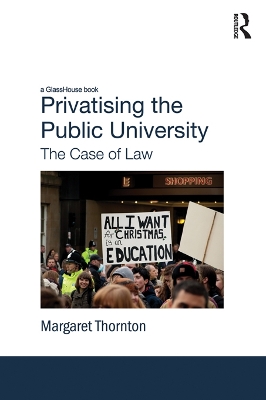
E-raamat: Privatising the Public University: The Case of Law

(Australian National Univeristy, Australia)
  • Formaat: EPUB+DRM
  • Ilmumisaeg: 12-Sep-2011
  • Kirjastus: Routledge
  • Keel: eng
  • ISBN-13: 9781136641299
  • Formaat - EPUB+DRM
  • Hind: 54,59 €*
  • * hind on lõplik, st. muud allahindlused enam ei rakendu
  • Lisa ostukorvi
  • Lisa soovinimekirja
  • See e-raamat on mõeldud ainult isiklikuks kasutamiseks. E-raamatuid ei saa tagastada.
  • Formaat: EPUB+DRM
  • Ilmumisaeg: 12-Sep-2011
  • Kirjastus: Routledge
  • Keel: eng
  • ISBN-13: 9781136641299

DRM piirangud

  • Kopeerimine (copy/paste):

    ei ole lubatud

  • Printimine:

    ei ole lubatud

  • Kasutamine:

    Digitaalõiguste kaitse (DRM)
    Kirjastus on väljastanud selle e-raamatu krüpteeritud kujul, mis tähendab, et selle lugemiseks peate installeerima spetsiaalse tarkvara. Samuti peate looma endale  Adobe ID Rohkem infot siin. E-raamatut saab lugeda 1 kasutaja ning alla laadida kuni 6'de seadmesse (kõik autoriseeritud sama Adobe ID-ga).

    Vajalik tarkvara
    Mobiilsetes seadmetes (telefon või tahvelarvuti) lugemiseks peate installeerima selle tasuta rakenduse: PocketBook Reader (iOS / Android)

    PC või Mac seadmes lugemiseks peate installima Adobe Digital Editionsi (Seeon tasuta rakendus spetsiaalselt e-raamatute lugemiseks. Seda ei tohi segamini ajada Adober Reader'iga, mis tõenäoliselt on juba teie arvutisse installeeritud )

    Seda e-raamatut ei saa lugeda Amazon Kindle's. 

"Privatising the Public University: The Case of Law is the first full-length critical study examining the impact of the dramatic reforms that have swept through universities over the last two decades. Drawing on extensive research and interviews in Australia, New Zealand, the UK and Canada, Margaret Thornton considers the impact of the market on students, academics and law schools, documenting how both the curriculum and pedagogical methods have changed. If the passing of the idea of the university is rued, concern usually focuses on the humanities and the natural sciences. In this respect, law has been regarded as privileged because of the virtually unstoppable demand for law places and the willingness of students to pay high fees. And, as this book shows, it is commercial and instrumental forms of legal training that are now favoured, whilst the humanistic, critical, theoretical and social justice aspects of legal knowledge have now been corroded. Privatising the Public University will be of considerable interest to legal academics; but it will also be invaluable work for anyone interested in the future of higher education"--

Privatising the Public University: The Case of Law is the first full-length critical study examining the impact of the dramatic reforms that have swept through universities over the last two decades. Drawing on extensive research and interviews in Australia, New Zealand, the UK and Canada, Margaret Thornton considers the impact of the market on students, academics and law schools, documenting how both the curriculum and pedagogical methods have changed. If the passing of the idea of the university is rued, concern usually focuses on the humanities and the natural sciences. In this respect, law has been regarded as privileged because of the virtually unstoppable demand for law places and the willingness of students to pay high fees. And, as this book shows, it is commercial and instrumental forms of legal training that are now favoured, whilst the humanistic, critical, theoretical and social justice aspects of legal knowledge have been corroded. Privatising the Public University will be of considerable interest to legal academics; but it will also be invaluable work for anyone interested in the future of higher education, or, more generally, in the corporatization of culture.

Foreword x
Preface xii
Acknowledgements xviii
List of abbreviations
xx
1 The political economy of higher education
1(26)
The neoliberal turn
1(4)
The New Knowledge Economy
5(3)
The legacy of Hayek and Friedman
8(4)
The privatising imperative
12(4)
The corporate university
16(3)
Risky business
19(4)
Conclusion: Kerr's folly
23(4)
2 The market comes to law school
27(32)
From elite to mass
27(4)
The market embrace
31(6)
Sameness and difference
37(6)
Studentlcustomers
43(2)
Graduate destinations
45(5)
Looking a gift horse in the mouth
50(6)
Conclusion: throwing good money after bad
56(3)
3 Jettisoning the critical
59(51)
Towards new knowledge
59(8)
Sloughing off the social
67(14)
Vocationalising the curriculum
70(2)
Wrestling with theory
72(4)
Feminism and diversity
76(5)
Adding in skills
81(3)
Pedagogical practices
84(10)
Transmitting frozen knowledge
85(6)
Flexible delivery
91(1)
Intensive mode
91(1)
Online
92(2)
Assessment
94(6)
`Dumbing down'
100(4)
A culture of complaint
104(3)
Conclusion: back to the future
107(3)
4 Governance and academic life
110(55)
Managerialism
110(5)
Mega-faculties
115(9)
Law deans as subalterns
124(7)
The corrosion of collegiality
131(4)
The new contractualism
135(9)
Appointments
135(3)
Promotions
138(3)
Precarious work
141(3)
Workloads
144(6)
Re-gendering the academy
150(8)
Conclusion: seeking a balanced life
158(7)
5 Research in the corporatised university
165(42)
Contested knowledge
165(7)
The new environment
172(4)
Research entrepreneurialism
176(17)
Publish or perish
179(2)
Applied research
181(4)
Auditing performance
185(8)
Academic freedom
193(2)
Higher degrees
195(7)
By research
195(2)
By coursework
197(5)
Conclusion: teaching or research?
202(5)
6 Conclusion
207(23)
The market metanarrative
207(3)
Doughnuts in the legal academy
210(2)
Academic morale
212(6)
Aspirations
218(3)
Law school futures
221(9)
Appendix: approach 230(4)
Bibliography 234(24)
Index 258
Margaret Thornton is Professor of Law at the Australian National University. She is a graduate of Sydney, New South Wales and Yale Universities, a Fellow of the Academy of Social Sciences in Australia and a Foundation Fellow of the Australian Academy of Law