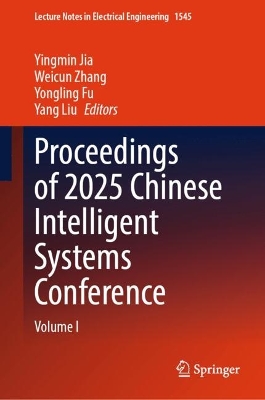
This book collects papers presented at the 21st Chinese Intelligent Systems Conference, CISC 2025, held in Beijing, China, from October 2526, 2025. It focuses on new theoretical results and techniques in the field of intelligent systems and control. This is achieved by providing in-depth studies of a number of important topics such as multi-agent systems, complex networks, intelligent robots, complex systems theory and swarm behaviour, event-driven and data-driven control, robust and adaptive control, big data and brain science, process control, intelligent sensors and detection technology, deep learning and learning control, navigation and control of flying vehicles, and so on. The book is particularly suitable for readers interested in learning intelligent systems and control and artificial intelligence. It can benefit researchers, engineers and graduate students.
Yingmin Jia (Senior Member, IEEE) received the B.S. degree in control theory from Shandong University, Jinan, China, in 1982, and the M.S. and Ph.D. degrees both in control theory and applications from Beihang University, Beijing, China, in 1990 and 1993, respectively. In 1993, he joined the Seventh Research Division, Beihang University, where he is currently a professor with the School of Automation Science and Electrical Engineering. His research interests include robust control, intelligent control, and their applications in robot systems and aerospace systems.
Weicun Zhang is an associate professor of the School of Automation and Electrical Engineering, University of Science and Technology Beijing. He earned his Ph. D degree from Tsinghua University in the field of control theory. His research interests include: self-tuning adaptive control, multiple model adaptive control/estimation of both linear and nonlinear systems. As representative research work, he established a Virtual Equivalent System (VES) theory for unified analysis of adaptive control systems, which is independent of specific control strategy and parameter estimation algorithm.
Yongling Fu (Member of ICAS) received the B.S. degree in Engineering Equipment from the Institute of Hebei Construction Engineering, Zhangjiakou, China, in 1987, and the M.S. and Ph.D. degrees both in Fluid Transmission and control from the Harbin Institute of Technology, Harbin, China, in 1990 and 1993, respectively. In 1993, he joined the Automation Control Department, Beihang University, where he is currently a professor with the School of Mechanical Engineering and Automation. His research interests include mechtronics engineering, special robots and intelligent control. He focuses on their applications in industrial systems and aerospace systems.
Yang Liu received the B.S. degree in mathematics and the Ph.D. degree in control theory and applications both from Beihang University (BUAA), Beijing, China, in 2005 and 2010, respectively. She joined the Seventh Research Division, Beihang University since 2010, where she is currently an associate professor with the School of Automation Science and Electrical Engineering. Her research interests include multi-agent system, robust control and intelligent control.

 Lisainfo e-raamatute kohta