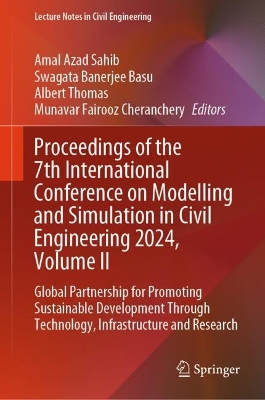
This book offers a comprehensive exploration of the critical issues surrounding SDGs 9, 11 and 12, delving into the multifaceted challenges and innovative solutions that define these vital fields. Civil engineering plays a pivotal role in achieving sustainable development goals (SDGs) by providing the foundational infrastructure necessary for sustainable development across various sectors. From designing resilient transportation systems to constructing eco-friendly buildings, civil engineers are at the forefront of creating solutions that promote economic growth, social equity, and environmental sustainability. One of the primary goals of civil engineering in the context of sustainable development is to ensure access to safe and reliable infrastructure for all, which aligns with SDG 9: Industry, Innovation, and Infrastructure. This involves designing and constructing roads, bridges, railways, airports, and ports that not only facilitate economic activities but also minimize environmental impact and enhance social inclusivity. For instance, civil engineers are increasingly incorporating green infrastructure techniques such as permeable pavements, green roofs, and rain gardens to manage stormwater runoff, mitigate urban heat island effects, and improve air quality in urban areas, contributing to SDG 11: Sustainable Cities and Communities.
Moreover, civil engineers play a crucial role in addressing global challenges such as climate change and resource depletion, which are central to several SDGs. By integrating principles of sustainability into their designs and practices, civil engineers contribute to SDG 12: Responsible Consumption and Production. This includes implementing renewable energy systems, and promoting circular economy, sustainable materials and construction techniques, recycled materials, waste to resource techniques, lean construction, etc. to reduce carbon emissions and minimize resource consumption throughout the life cycle of infrastructure projects.
Performance evaluation of self-compacting concrete incorporating
dimensional limestone waste: mechanical and impact resistance properties for
sustainable construction.- Assessing the performance of mechanical and
durability properties of internally cured blended concrete using Robo sand as
fine aggregate.- Mechanical and durability properties of self-curing concrete
by 100% replacement of fine aggregate with Robo sand.- Durability evaluation
of fiber reinforced concrete with treatment of different curing compounds.- A
study on alkali- activated paver blocks using red gypsum and phosphoric acid
as admixtures.- Manufacturing of light weight kerbstone by utilizing the
waste milk cover.- Study on effect of water and air curing on the properties
of geopolymer.- Transfer learning model for multi-class concrete surface
crack detection.- Effect of cut-out on natural frequency of laminated
composite cylindrical shells.- Analysis of porous sandwich plate for
non-linear bending subjected to non-uniform loadings.- Thermo structural
analysis of voided flat slabs using ANSYS.- Seismic control of benchmark
highway bridge using modified viscous mass Damper.- Seismic control of
seismically excited benchmark building using rotational viscous mass damper
(VMD).- Investigation of dynamic behaviour of FRP reinforced concrete
structures under seismic loading.- Experimental investigation on structural
behaviour of self-compacting concrete beam column joint incorporated with
steel fibres.- Analysis of porous beam for non-linear bending under different
non-uniform loadings A numerical study.
Dr. Amal Azad Sahib is an associate professor in the Department of Civil Engineering, TKM College of Engineering Kollam, Kerala, India. An academician and researcher since 2007, she has been a popular teacher for UG and PG courses like engineering mechanics, mechanics of solids, fluid mechanics, geotechnical engineering, geoenvironmental engineering, advanced foundation engineering, geotechnical investigation, personnel management, life skills, and universal human values. She completed her Ph.D. in Geotechnical Engineering from IIT Madras, India, in 2020 under the Quality Improvement Programme scheme of Govt. of India. Her research interests include soft clay characterization, ground improvement, geoenvironmental engineering, geotechnical and pavement applications of C & D waste. She has 16 publications in various journals, conferences, and book chapters to her credit.
Dr. Swagata Banerjee Basu is a professor in the Department of Civil Engineering at the Indian Institute of Technology Bombay (IITB), India. She earned her doctoral degree from the University of California, Irvine (UCI), USA. Prior to joining IITB in 2015, she was appointed as an assistant professor in the Department of Civil and Environmental Engineering at the Pennsylvania State University (Penn State), USA, since 2009. Her primary research interest lies in the areas of earthquake engineering, bridge engineering, life cycle risk, reliability, and resilience analysis, structural performance assessment under multiple natural hazards, and the use of advanced structural materials for retrofit purposes. As the sole investigator, she received multiple research awards from the National Science Foundation (NSF) in the USA and Science and Engineering Research Board (SERB) in India. Her research has so far yielded thirty-four articles in peer-reviewed journals and several papers in referred international conference proceedings.
Dr. Albert Thomas is an associate professor at the construction technology and management (CTaM) group of civil engineering at IIT Bombay. Dr. Thomas obtained his Ph.D. from the University of Michigan, Ann Arbor, USA, and M-Tech in construction technology and management from IIT Madras. During his years as a graduate research assistant, he was involved in several projects aimed at incorporating sustainability and life cycle-based thinking in various infrastructure and built facilities. His research articles are published in various peer-reviewed and highly rated international journals and conference proceedings totalling to more than fifty in number. Dr. Thomas and his research group (Sustainable Infrastructure Modelling Group- IIT Bombay) is the recipient of several awards for research excellence such as best paper award, best poster award, fellowships from national and international funding bodies and industries.
Dr. Munavar Fairooz Cheranchery is an assistant professor in the Civil Engineering Department at NIT Calicut. He completed his Masters and Ph.D. at the Indian Institute of Technology Kharagpur and was awarded the prestigious DAAD fellowship for conducting his masters thesis at the Technical University of Darmstadt, Germany. Dr. Fairooz has secured research funding exceeding 2 crores and has extensive consultancy experience in Traffic Engineering and Transportation Planning. He is currently the investigator of four sponsored research projects. Dr. Fairooz has published over 16 papers in esteemed international journals such as the Transportation Research Record, Transport Policy, and the Journal of Transportation Engineering Part A: Systems. He has also presented his work at more than 10 international conferences. In 2016, he received a Travel Grant to present at the Transportation Research Board Conference in Washington, D.C., USA.

 Lisainfo e-raamatute kohta