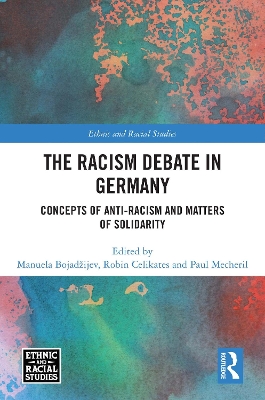
This book traces the current debates on critical theory of racism in Germany and emphasizes its contribution to the global discourse on racism and anti-racism. It provides a comprehensive examination of the key debates, blind spots, and pitfalls of this theory while exploring the relationship between anti-Semitism and racism.
This book traces current debates on the critical theory of racism in Germany and emphasizes its contribution to the global discourse on racism and anti-racism. It provides a comprehensive examination of the key debates, blind spots, and pitfalls of this theory while exploring the politicization of discussions surrounding the relationship between anti-semitism and racism. The contributions shed light on the current state and weaknesses of anti-racism in Germany, including government measures, while offering alternative understandings of difference and highlighting the importance of solidarity in combating racism.
The concept of ‘structural racism’ is presented as central to political conflicts, showing how this term is used in anti-racist movements and the barriers to its discussion. This book examines the link between state violence, restrictive migration policies, police practices, and the moral panic surrounding ‘clan crime’ through the lens of ‘carceral racism.’ It also analyses the crucial role of language in creating racist distinctions, focusing on how the German language can function as a marker of difference and a ‘linguistic hiding place for race.’ The discussion extends to the methodological challenges of integrating critical theories of racism with quantitative methods.
This book is an essential read for scholars, students, and activists interested in critical race theory, German studies, migration studies, and global anti-racist movements. It offers valuable insights for anyone seeking to understand how Germany’s specific historical and social context shapes contemporary debates on racism within a broader international framework.
The chapters in this book were originally published as a special issue of Ethnic and Racial Studies.
Introduction: The racism debate in Germany: concepts of anti-racism and
matters of solidarity: introduction to the special issue
1. Racism or
racisms? Rethinking differentiation and the significance of solidarity
2.
From Xenophobia to structural racism, and back? Epistemic obstacles,
conceptual struggles, and the role of critical theory
3. Counting racism:
quantitative methods and the challenges of structural analysis in Germany
4.
Sprich Deutsch. A race critical reading of discourses on language and
citizenship in twenty-first century Germany
5. Policing the surplus crisis,
carceral racism and abolitionist resistance in Germany
6. Antisemitism and
racism revisited: historical genealogies and current research debates
Manuela Bojadijev is Professor at the Institute of European Ethnology at Humboldt University Berlin and the Berlin Institute for Migration Research, Germany. She is a permanent fellow at the Centre for Social Critique Berlin, Germany, and the Institute for Social Research in Frankfurt, Germany. Her work examines racism and migration from global perspectives, focusing on how social change manifests through representations of migration. Through collaborative projects, she investigates mobility transformations in relation to digitalization and logistics, particularly in urban spaces. Her research bridges conceptual questions of migration with lived experiences in migration societies.
Robin Celikates is Professor of Social Philosophy at Freie Universität Berlin, and Co-director of the Centre for Social Critique Berlin, Germany. He is a permanent fellow at the Institute for Social Research in Frankfurt, Germany, and co-directs the Transforming Solidarities research project. Previously at the University of Amsterdam, Netherlands, and the Institute for Advanced Study in Princeton, USA, his research focuses on critical theory, civil disobedience, democratic theory, migration, and racism.
Paul Mecheril is Professor of Educational Science with a focus on Migration at Bielefeld University, Germany. With a background in psychology and philosophy, his academic journey includes positions at the universities of Innsbruck and Oldenburg, where he specialized in learning and education in migration societies. His work examines the intersection between education, belonging and subject formation in the context of migration and racism.

 Lisainfo e-raamatute kohta