"
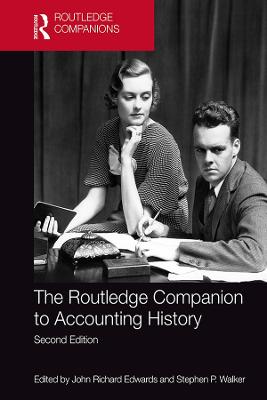
The Routledge Companion to Accounting History
presents a single-volume synthesis of research in this expanding field, exploring and analysing accounting from ancient civilisations to the modern day.
No longer perceived as the narrow study of how a mysterious technique was used in past, the scope of accounting history has widened substantially. This revised and updated volume moves beyond the history of accounting technologies, accounting theories and practices and the accountants who applied them. Expert contributors from around the world explore the interfaces between accounting and the economy, society, culture and the polity. Accounting history is shown to offer important insights into such disparate phenomena as the evolution of capitalism, control of labour, gender and family relationships, racial exploitation, the operation of religious organisations, and the functioning of the state.
Illuminating the foundation and development of accounting systems, this updated, classic book opens the field to a new generation of accounting scholars and historians around the world.
Arvustused
'Vast in scope and unparalleled in the depth of its contributions, this new edition is an indispensable up-to-date source for aspiring and established accounting historians, and all those interested in this vibrant and foundational sub-discipline of accounting.' -- Rob Bryer, Emeritus Professor of Accounting, Warwick University, UK
Introduction: Synthesis and engagement.
1. Structures, territories and
tribes.
2. Historiography.
3. Subjects, sources and dissemination.
4. Ancient
accounting.
5. Bookkeeping.
6. Mechanisation, computerisation and information
systems.
7. Financial accounting theory.
8. Financial accounting practice.
9.
Management accounting: theory and practice.
10. Auditing.
11.
Professionalisation.
12. Practitioners, work and organisations.
13.
Education.
14. Regulation.
15. Agriculture.
16. Mercantilism.
17. Capitalism.
18. Railroads .
19. National accounting.
20. Scandals.
21. Gender.
22. Race
and ethnicity.
23. Colonialism and indigenous peoples.
24. Emancipation.
25.
Religion.
26. Creative arts.
27. The state.
28. Military .
29. Taxation
John Richard Edwards is Professor of Accounting at Cardiff University, UK
Stephen Walker is Professor of Accounting at the University of Edinburgh, UK

 Lisainfo e-raamatute kohta