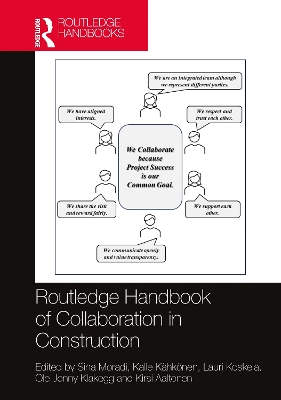
This innovative Handbook aims to look at the logic, various dimensions, and implications of collaboration in construction. It opens with a conceptualization of collaboration and its accompanying terms (i.e., cooperation and coordination) and continues with chapters in Part I which discuss the theoretical grounds of collaboration between individuals and organizations from the viewpoints of an impressive variety of relevant disciplines including organizational science; anthropology; law; economics; design; and production.
This is followed by discussions of the essence and value of collaboration in construction in Part II through explaining the role of collaborative project delivery methods and their benefits in advancing collaboration, describing the competency profile of project managers for collaborative construction, explaining key drivers and barriers of collaboration in construction, and explaining practices as well as challenges of measuring collaboration in construction.
Then, in Part III, case projects are employed to explain the benefits of collaboration in different levels of team, project, and business, to discuss the role and impact of collaboration on site and bridging the divide between construction and facility management, to discuss the role of digitalization in facilitating and advancing collaboration, to explain collaboration in decision making, to present examples of collaborative visual management, and to outline the implications of stakeholders' early involvement and collaboration for project success. Finally, consideration is given to the future of collaboration in construction to conclude the book.
This Handbook is key reading for a broad ranging audience within the fields of construction, project, infrastructure and engineering management, organisational science, economics, and business management.
This innovative Handbook aims to look at the various dimensions and implications of collaboration in construction. It is key reading within the fields of construction, project, infrastructure and engineering management, organisational sciences, economics, business management and sociology.
List of Tables and Figures
Introduction
Chapter
1. Basis for Collaborative Practices in Construction: Definition of
Collaboration, Cooperation, and Coordination
Part I- Collaboration in Theory. Explaining Collaboration between Individuals
and Organizations from the Viewpoints of Relevant Disciplines.
Chapter
2. An Organization Science Perspective on Collaboration in
Construction Projects: Implications of Practice Theory
Chapter
3. Anthropological Perspectives on Collaboration in Construction
Chapter
4. Collaborative Contract and Contract Theory
Chapter
5. The Construction Commons: A New Institutional Economics
Perspective on Collaborative Project Resources
Chapter
6. Building Design Collaboration: Why, What, and How
Chapter
7. Collaboration in Production
Part II- Collaboration in Construction. Discussing Essence and Value of
Collaboration in Construction.
Chapter
8. Collaborative Delivery Models
Chapter
9. Competency Profile of Project Managers for Collaborative
Construction
Chapter
10. Key Drivers for Collaboration in Construction
Chapter
11. Barriers to Collaboration A Multi-level Perspective
Chapter
12. Measuring Collaboration in Inter-organizational Construction
Projects: Practices and Challenges in the Real World
Part III- Construction Collaboration in Practice. Discussing the Benefits of
Collaboration in Case Projects.
Chapter
13. Creation of an Innovation Ecosystem Automating the Reporting of
CO2 Emissions in the Built Environment
Chapter
14. The Dynamics of Formal and Relational Collaborative Practices in
Inter-Organizational Construction Projects
Chapter
15. Bridging the Great Divide: Towards Collaboration Between Design
and Operation
Chapter
16. Towards Collaboration on Site Multidisciplinary Teams through a
Supply Chain Approach
Chapter
17. Collaboration in Decision Making
Chapter
18. Managing Complex Collaboration in Construction Projects
Chapter
19. Digital Platforms: Empowering and Transforming Collaborations
Chapter
20. Awareness and Ability to Act
Chapter
21. Visual Management in Collaboration
Chapter
22. Early Involvement and Integration on the Project front end:
Implications for Clients Collaborative Actions
Final Remarks - Future of Collaboration in Construction
Sina Moradi (0000-0002-2990-3671) is currently a Postdoctoral Researcher of Construction Management at Tampere University in Finland, where he completed his PhD in August 2021. Dr. Moradi has been involved in academia and industry altogether for twelve years, and as a result he has gained experience of working both in construction projects (as supervisor and scheduling expert) and in academia (as researcher and lecturer). In the recent five years, the focus of his research activities and publications has been on collaborative project delivery, lean construction, project success, sustainability in building contruction, and project managers' competencies.
Kalle Kähkönen (0000-0002-8986-7721) is Professor of Construction Management and Economics at Tampere University in Finland. His former employer was VTT Technical Research Centre of Finland. Prof. Kähkönens main research interests and activities are presently addressing collaborative construction operations and digitalization in the built environment sector. He has acted as supervisor, pre-examiner, or opponent for over 30 doctoral dissertations in Finland and abroad.
Lauri Koskela (0000-0003-4449-2281) is Adjunct Professor at Tallinn University of Technology. Previously he worked at the University of Huddersfield as Professor of Construction and Project Management and at the University of Salford as Professor of Lean, Theory-Based Project, and Production Management. Since 1991, Lauri has been involved in research on lean construction. His research has focused especially on the theory of production management underlying lean construction.
Ole Jonny Klakegg (0000-0002-1767-0911) is Professor of Project Management at NTNU Department of Civil and Environmental Engineering, focusing on project delivery models. Throughout his career, Ole Jonny Klakegg has alternated between teaching and research at the university and working as a consultant in project management. This way he has built substantial experience including theoretical and practical perspectives. He has 30 years of experience in research, teaching, and consulting within project management, including 15 years of experience as manager and consultant in the private sector.
Kirsi Aaltonen is Associate Professor of Project Management at University of Oulu, Finland, where she heads the Project Business Research Team in the Industrial Engineering and Management Research Unit. She has published widely on project stakeholder management and engagement in Scandinavian Journal of Management, International Journal of Project Management, Industrial Marketing Management, and International Journal of Managing Projects in Business. Her current research interests are in the areas of stakeholder management in complex projects, integrated project deliveries, and institutional change in project-based industries.


 Lisainfo e-raamatute kohta