Muutke küpsiste eelistusi

E-raamat: Routledge Handbook of Contemporary Sri Lanka

Edited by (Centre for Humanitarian Diplomacy, Sarajevo, Bosnia and Herzegovina), Edited by (University of Gothenburg, Sweden)
  • Formaat: PDF+DRM
  • Ilmumisaeg: 18-Jul-2024
  • Kirjastus: Routledge
  • Keel: eng
  • ISBN-13: 9781040043509
  • Formaat - PDF+DRM
  • Hind: 4,47 €*
  • * hind on lõplik, st. muud allahindlused enam ei rakendu
  • Lisa ostukorvi
  • Lisa soovinimekirja
  • See e-raamat on mõeldud ainult isiklikuks kasutamiseks. E-raamatuid ei saa tagastada.
  • Formaat: PDF+DRM
  • Ilmumisaeg: 18-Jul-2024
  • Kirjastus: Routledge
  • Keel: eng
  • ISBN-13: 9781040043509

DRM piirangud

  • Kopeerimine (copy/paste):

    ei ole lubatud

  • Printimine:

    ei ole lubatud

  • Kasutamine:

    Digitaalõiguste kaitse (DRM)
    Kirjastus on väljastanud selle e-raamatu krüpteeritud kujul, mis tähendab, et selle lugemiseks peate installeerima spetsiaalse tarkvara. Samuti peate looma endale  Adobe ID Rohkem infot siin. E-raamatut saab lugeda 1 kasutaja ning alla laadida kuni 6'de seadmesse (kõik autoriseeritud sama Adobe ID-ga).

    Vajalik tarkvara
    Mobiilsetes seadmetes (telefon või tahvelarvuti) lugemiseks peate installeerima selle tasuta rakenduse: PocketBook Reader (iOS / Android)

    PC või Mac seadmes lugemiseks peate installima Adobe Digital Editionsi (Seeon tasuta rakendus spetsiaalselt e-raamatute lugemiseks. Seda ei tohi segamini ajada Adober Reader'iga, mis tõenäoliselt on juba teie arvutisse installeeritud )

    Seda e-raamatut ei saa lugeda Amazon Kindle's. 

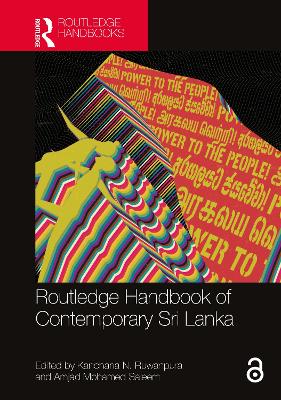
The Routledge Handbook of Contemporary Sri Lanka offers a comprehensive overview on issues facing the island country and an overview delineating some key moments in the country’s contemporary polity, economy, and sociality.

This book outlines aspects and influences foundational to understanding a country defined by its economic and political turmoil, and rift with public distrust in today’s shifting geopolitics. Chapters by various established scholars highlight this book’s pivotal contribution in situating Sri Lanka’s turmoil and deprivation in this current conjuncture.

The handbook is structured in seven sections:

• Nations and Nationalism

• Politics, State and Institutions

• Economy and Political Economy

• Work and Life

• Environment and Environmental Politics

• Society, Social Systems and Culture

• Moment of flux, looking ahead

Each section includes on average six chapters covering the social sciences and humanities to survey emerging and cutting-edge areas of the study of Sri Lanka. Multi-disciplinary in focus, the book also includes an introductory and concluding section, which creates the space and platform for senior, mid-ranking and junior academics to engage in dynamic conversation with each other on the subject of contemporary Sri Lanka. Including scholarship from Sri Lankan experts, the handbook creates academic output, which chimes with broader calls in academia on decolonizing the academic landscape.

An important reference work, this handbook will be of interest to scholars and students from wide-ranging academic disciplines and a focus on Sri Lanka, Asia and South Asian Studies, sociology, environmental politics, development, labour, management, political economy and anthropology.


This handbook offers a comprehensive overview on issues facing Sri Lanka and an overview delineating some key moments in the country’s contemporary polity, economy, and sociality.

Arvustused

Sri Lanka is at the cross-roads on many fronts. The Routledge Handbook of Contemporary Sri Lanka comes at as a boon to researchers on these different fronts by identifying issues involved in the many problems that confront Sri Lanka. The problems of Sri Lanka reflect the conditions in many developing countries. It is befuddled with economic crises resulting from inability to service sovereign debts, unresolved ethnic crises fomented by chauvinist leaders, heavy corruption that depletes the national treasury, a political shift towards authoritarianism, environmental depletion, drug problems, pervasive criminal violence and other situations of social disruption. These different areas are covered by leading experts. This superbly written research handbook serves as a tool to study not only Sri Lanka but to compare its problems with other developing states with similar problems. It serves as an introduction to scholars new to the field and as a book that provides fresh insights into different aspects of social and economic life in the island to the established researchers. It will remain the best guide to research on aspects of socio-economic issues in Sri Lanka.

Muthucumaraswamy Sornarajah, Emeritus Professor of Law, National University of Singapore

This excellent and important volume brings together a broad range of contemporary scholars in a hard-hitting, multi-disciplinary analysis of Sri Lankas current political and economic malaise. Thirty-five original chapters carefully and critically delineate the multiple factors which converged in the 2022 anti-government struggle (aragalaya) and its subsequent repression, and cautiously point the way forward to greater political, economic, social and environmental justice in Sri Lanka. This unique collection will be valuable to everyone who wants to understand Sri Lankas contemporary situation, and indispensable both to scholars who study it and to policy-makers who attempt to redress it.

Jonathan S. Walters, Professor of Religion and George Hudson Ball Endowed Chair of Humanities, Whitman College, USA

This is a valuable reference book on a country that defies easy readings. Sri Lanka is today in flux navigating political turmoil, environmental degradation, ethnic tensions, and economic hardships due to an unprecedented collapse of the economy. This volume of 35 essays and reflections captures this moment in all its unevenness, shedding light on the ambiguities that lace Sri Lankan society. The book moves from chapters dissecting nationalism, politics, and institutions to more specific topics on the economy and political economy, labour, environmental tensions and social and cultural formations. The contributions are sharp, well researched, theoretically informed and seamlessly connected. While different approaches and positions are represented, they share a commitment to an equitable, just, and ecologically sensitive country to be forged in the future. This is an inspiring volume and a reliable source for anyone interested in Sri Lanka today.

Nira Wickramasinghe, Chair and Professor of Modern South Asian Studies, Leiden University, The Netherlands

[ This book] describes itself as a comprehensive survey of issues facing [ Sri Lanka]. While it certainly does that, evidenced by the multitude of topics discussed by highly qualified authors, to simply call it a handbook is an understatement. The book is not merely here is Sri Lanka and its issues. It is an indictment of the mistakes, spanning decades in some cases, that have led Sri Lanka to where it is today. [ ] The book, spanning many topics, is best suited for readers familiar with the basics of the Sri Lankan context, especially those with a social science, humanities, or political science background. It is strongly critical of colonial influences and the Sinhala-Buddhist, patriarchal status quo in Sri Lanka. Furthermore, it is a summary of academic literature on its various topics, evident in the tendency to cite secondary literature throughout the chapters. [ ] It is a one-stop shop that provides readers with a clear picture of current academic thinking on a diverse set of topics. From there, they can delve further into the subjects with the rich lists of sources in the references. Considering the dire situation in which Sri Lanka finds itself, it needs its citizens to have greater literacy in its affairs, both past and current. The Routledge Handbook is a fine step in that direction.

G.A. Abayaratna, University of Colombo Review (Series III), Vol.5, No.2, 2024

Once among the most promising societies in the Global South, Sri Lanka has been beset by daunting problems for decades. Readers interested in social scientific studies describing its current situation will find value in the many contributions on economic, environmental, and health policy in this collection. Essays detailing the sovereign debt crisis, agricultural labor conditions, multiple social inequalities, wetlands governance, health care provision, and urban development are particularly good. Chapters examining politics directly focus on the development of constitutional authority and issues of national and minority identities.

J. C. Hickman, Berry College, USA

List of Illustrations xi List of Contributors xiii Acknowledgements
xviii PART I Introduction 1 If I was President 3 Sarah Kabir Slivers of Sri
Lanka: Sways, Stability, and System Change? 7 Kanchana N. Ruwanpura and Amjad
Mohamed Saleem PART II Nations and Nationalism 31 1 Island Imaginaries:
Insularity, Repetition, and the Spatial Politics of the National 33 Tariq
Jazeel 2 Authoritarian Politics and Gender in Sri Lanka: A Survey 43 Rajni
Gamage 3 Nationalism, Conflict, and Power-Sharing 55 Bart Klem 4 Centring
Conflict: Contemporary Sri Lanka in Perspective 68 Shamara Wettimuny PART III
Politics, State, and Institutions 81 5 Defining Sri Lankas Identity:
Reflections on Key Constitutional and the Legal Moments 83 Bhavani Fonseka
and Luwie Niranjan Ganeshathasan 6 Imagining the Nation: A Critical Overview
of Sinhala Nationalism and Its Cultural Coordinates 94 Harshana Rambukwella 7
Eastern Muslims of Sri Lanka: Developing an Identity Consciousness 106
Aboobacker Rameez and Mohamed Anifa Mohamed Fowsar 8 Transitional Justice:
State of Play in Sri Lanka 118 Farah Mihlar 9 Contemporary Gender Activism:
Engaging the Law and the State 130 Kaushalya Ariyarathne and Kiran Grewal
PART IV Economy and Political Economy 145 10 Sri Lankas Foreign Debt Crisis:
Deep Roots? 147 Umesh Moramudali 11 The Sri Lankan Economy: Hope, Despair,
and Prospects 162 Prema-chandra Athukorala 12 Gender Equality in Sri Lankas
Economy: Persistent Challenges 176 Dileni Gunewardena 13 Unveiling the
Margins: Women, Caste, Class, and Post-War Development in Sri Lankas North
and East 194 Narayani Sritharan 14 Higher Education in Contemporary Sri
Lanka: Key Topics 207 Kaushalya Perera PART V Work and Life 219 15
Informality, Masculinity, and Agglomeration Imaginaries 221 Nipesh Palat
Narayanan 16 The Work and Lives of Agricultural Workers 231 Cynthia M. Caron
17 The Gendered Political Economy of Work in Post-War Sri Lanka 242 Jayanthi
Thiyaga Lingham 18 Work and Life of Sri Lankan Garment Factory Workers: A
Gendered Perspective 253 Shyamain Wickramasingha 19 Microfinance, Debt and
Indebtedness of Rural Sector Workers in Sri Lanka 264 Nedha de Silva and
Amali Wedagedara PART VI Environment and Environmental Politics 275 20
Following Currents: Oceanic and Littoral Sri Lanka 277 Rapti Siriwardane-de
Zoysa 21 A Political Ecology of Sri Lankas Urban and Regional Wetlands 288
Missaka Hettiarachchi 22 Sri Lankas Energy Transition: One Step Forward, Two
Steps Back 300 Gz. MeeNilankco Theiventhran 23 Environmental Protection in
Sri Lanka: A Critical Legal Approach 314 Kalana Senaratane 24 Ecological
States: Nature, Militarization, and Nationalism in Sri Lanka 325 Vivian Y.
Choi 25 Sri Lankas Environmental History 335 Sujit Sivasundaram PART VII
Society, Social Systems, and Culture 347 26 Public Health System of Sri
Lanka: Past, Present, and Future 349 Shashika Bandara 27 Politicizing the
Virtual: Examining the Internet on the Intersections of Gender and Sexuality
in Sri Lanka 361 Senel Wanniarachchi and Zahrah Rizwan 28 Feminist Pathways
and Political Possibilities in Sri Lankan Plantation Studies 372 Mythri
Jegathesan 29 Caste in Contemporary Sri Lanka 383 Dominic Esler 30 Dynamics
of Low-Income Settlements in Colombo, Sri Lanka 396 Mohideen M. Alikhan PART
VIII Moment of Flux, Looking Ahead 407 31 COVID-19: Sri Lankas Moral Test
409 Santhushya Fernando 32 People in the Palace 416 Dinesha Samararatne 33
After Aragalaya: Moving beyond the Status Quo? 420 Oliver Walton 34
Consolidating a Dangerous Consensus: The Failure of Sri Lankas Public Policy
Complex in 2019 423 Kusum Wijetilleke 35 The Dreary Pillage of Privacy,
Talking Economics in Colombos Tower Blocks 430 Michael Collyer Index 434
Kanchana N. Ruwanpura is a Professor of Development Geography, the University of Gothenburg, Sweden, and an Honorary Fellow at CSAS, at the University of Edinburgh, Scotland.

Amjad Mohamed Saleem currently works at the International Federation of Red Cross and Red Crescent Societies in Geneva, Switzerland.