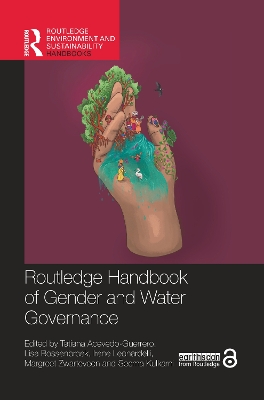
This handbook provides a comprehensive overview of the field of gender and water governance, exploring how the use, management and knowledge of water resources, services and the water environment are deeply gendered.
In water there is a recognized gender gap between water responsibilities and water rights and bridging this gap is likely to help achieve not just goals of equity, but also those of sustainability. Building on a rich legacy of feminist water scholarship, the Routledge Handbook of Gender and Water Governance is a collection of reflections and studies that can be used as a prismatic lens into a thriving and ever proliferating array of feminist water studies. It provides a clear testimony of how hydrofeminism has evolved from rather instrumental gender-and-water studies to scholarship that uses feminist tools to pry open, critically reflect on and formulate alternatives to water development-as-usual. The book also show how the community of feminists interested in studying water has diversified and expanded, from often white female scholars studying projects, and gender relations, in the so-called Global South to a varied mix of scholars and activists theorizing from diverse geographical and political locations – prominently including the body. It is organised into five interconnected parts:
• Part I: Positionality and Embodied Waters
• Part II: Revisiting Water Debates: Diplomacy, Security, Justice, and Heritage
• Part III: Sanitation Stories
• Part IV: Precarious Livelihoods
• Part V: New Feminist Futures
Each of these parts brings out the gendered nature of water, shedding light on the often-neglected care and unpaid labour of women and its relationship with extractivism and socioeconomic inequalities. The overall aim of the handbook is to apply social science insights to water governance challenges, creating synergies and linkages between different disciplines and scientific domains.
The Routledge Handbook of Gender and Water Governance is essential reading for students, scholars and professionals interested in water governance, water security, health and sanitation, gender studies and sustainable development more broadly.
This handbook provides an overview of the field of gender and water governance, exploring how the use, management and knowledge of water resources and the water environment are gendered. It is essential reading for students, scholars and professionals interested in water governance, water security, health and sanitation, and gender studies.
Introduction: A Carrier Bag For Gender And Feminist Water Research -
Tatiana Acevedo-Guerrero, Lisa Bossenbroek, Irene Leonardelli, Margreet
Zwarteveen, and Seema Kulkarni
Part 1: Positionality and embodied waters
1. Womens Anti-Hydropower Activism In Turkey: Water, Environmental Struggles
And Bodily Experiences - Özge Yaka
2. Making Engineers Tell Their Stories? Masculinity, Whiteness And
Heteronormativity At Work In Life History Interviews In Irrigation In Nepal
Janwillem Liebrand
3. Gendering Groundwater Salinity: A Study Of Lodhva, Gujarat, India-
Maitreyi Koduganti Venkata and Gabriela Cuadrado-Quesada
4. Mapping Water Care Practices: The Case Of Ennore-Pulicat Wetlands In
Chennai, India Qurratul Ain Contractor
5. Women's bodily experiences: accessing and treating water in the Colombian
Caribbean Silvia Corredor-Rodrķguez
6. Embodying the Urban Political Ecology of Water: Three Analytical
Approaches to Urban Water Insecurity - Yaffa Truelove
7. The Temporal Fragility Of Water Infrastructure: Conceptualizing The
Gendered, Affective Labor Of Maintenance And Repair Kathleen O'Reilly,
Kavita Ramakrishnan, and Jessica Budds
Part 2: Revisiting water debates: diplomacy, security, justice, and heritage
8. Household Water Security Experiences Of Women And Girls In Rural Ghana
Benjamin Dosu, Mohammed Abubakari, Maura Hanrahan, and Tom Johnston
9. Toxic Homes, Toxic Water: Housing, Segregation, and Gendered
Responsibilities for Household Water Insecurity in the American Rust Belt
Cara Jacob, Lucero Radonic, and Priyanka Jayakodi
10. Poverty, Water Security, and Womens Activism in Liberia Chantal
Victoria Bright
11. Gender, Human Rights and Water Governance in Indonesia - Stroma Cole,
Paula Skye Tallman, Gabriela Salmon-Mulanovich, Binahayati Rusyidi, and
Yesaya Sandang
12. Peace, Power, Participation: Transboundary Water Cooperation through a
Gender Lens Rozemarijn ter Horst
13. New Spaces for Water Justice? Groundwater Extraction and Changing
Gendered Subjectivities in Morocco's Saļss Region Lisa Bossenbroek and
Margreet Zwarteveen
14. Liquid Heritage: Can Water Museums Facilitate A New Gendered Water
Ethics? Sara Ahmed
Part 3: Sanitation stories
15. The Contentious Path Of Menstrual Health: Reflections On The Past And
Provocations For The Future Of The Water Sanitation And Hygiene Sector
Jacqueline Gaybor Tobar
16. The Many Meanings Of Menstruation: Practices, Imaginaries and Access to
Water and Sanitation Infrastructure In Lusaka, Zambia Amie Jammeh and
Tatiana Acevedo-Guerrero
17. Access To Water, Sanitation And Hygiene For All: Focusing On Transgender
Experiences In India Durba Biswas
18. Harvest Of Uterus: Poor Sanitation, Water Scarcity And The Political
Economy Of Sugarcane In Maharashtra, India Seema Kulkarni and Abhay Shukla
19. Care-Full Sanitation For Shared Water Futures - Kelly Dombrowski
Part 4: Precarious livelihoods
20. Water Reuse Irrigation, Gender, and Poverty Inequalities in Kafr El
Sheikh, Egypt Deepa Joshi, Amina Dessouki, and Alexandra Schindler
21. Altering Water Flows In The Draa Valley, Morocco: A Feminist Analysis -
Lisa Bossenbroek and Hind Ftouhi
22. Water, Women and Fishing Livelihoods in South and Southeast Asia - Holly
M. Hapke, Nikita Gopal, Kyoko Kusakabe, and Gayathri Lokuge
23. Wetsuweten Women Leading The Defense Of Rivers And Water From Abuses
Committed In Connection With Megaprojects. The Persistent Legacies Of The
Past In Canada Nancy R. Tapias Torrado
24. Domesticity, Masculinities and Femininities: Complicating Gender And
Dealing With Water In Pemba, Mozambique Sandra Manuel, Margarida Paulo,
Tatiana Acevedo-Guerrero, Danķcia Munguambe, and Amanda Matabele
Part 5: New feminist futures
25. How Water Changes (Every)Things: A Feminist Study Of How Water Worlds
Shape Processes Of Rural Agrarian Transformations In Maharashtra, India
Arianna Tozzi and Irene Leonardelli
26. Beyond Water Justice And Water Security: Debates On Water, Women, And
Climate Change In Latin America Catalina Quiroga and Anyi Castelblanco
27. Beyond Material Dimensions Of Water Insecurity: Gendered Subjectivities,
Senses Of Community, And Renewed Political Possibilities - Evelyn Arriagada,
Leila M. Harris, and Dacotah-Victoria Splichalova
28. Semį:th X_ó:tsa: Fringe Natures as Decolonial Feminist-Queer-Trans Water
Imaginaries - Madeline Donald and Astrida Neimanis
Concluding Reflections - Future Directions For Feminist Water Research
Tatiana Acevedo-Guerrero is Assistant Professor at the Copernicus Institute for Sustainable Development, Utrecht University, the Netherlands. She leads the ERC project titled Homescapes make the world we live in, that takes water as an entry point of an investigation into the homes of the urban South.
Lisa Bossenbroek is a researcher at the iES, Institute of Environmental Sciences, University of Kaiserslautern-Landau, Germany.
Irene Leonardelli is a postdoctoral researcher at the University of Calabria, Italy. She holds a PhD from the IHE-Delft Institute for Water Education, the Netherlands, where she worked at IHE Delft for more than four years as a junior researcher.
Margreet Zwarteveen is Professor of Water Governance at the IHE-Delft Institute for Water Education and the University of Amsterdam, the Netherlands. She is the co-editor of Drip Irrigation for Agriculture (Routledge, 2017).
Seema Kulkarni is a senior fellow at the Society for Promoting Participative Ecosystem Management (SOPPECOM).

 Lisainfo e-raamatute kohta