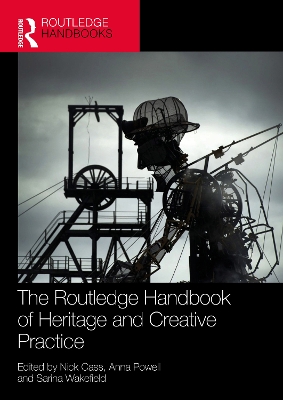
The Routledge Handbook of Heritage and Creative Practice interrogates creativity as a tool for a critical engagement with heritage and provides a comprehensive study of ways in which heritage and creative practice intersect, in research and in practice, in a transnational context.
This book introduces researchers, students, creative and heritage practitioners to contemporary practices from a breadth of perspectives. The transnational nature of its scope is key to the interrogation of how ‘heritage’ and ‘creativity’ are ever evolving, conceived of differently in different contexts, and intersect in interesting ways through the work of creative practitioners. The volume argues that heritage itself is a creative practice, such that the ‘creative’ work that occurs in these projects is not singular and distinct. Rather the symbiotic reciprocity between heritage and creativity is intersectional and embedded within best practice. The international array of authors and differing approaches from around the world, including case studies from Africa, Brazil and the Caribbean, Bahrain, China, Hong Kong, Iraq, Japan, and Saudi Arabia, provide a truly global approach to the subject, while the diverse range of topics covered, including urban renewal, the coronavirus pandemic, memorial culture, public art, and colonial heritage, allows readers to gain insight into the richness of practices across a diversity of disciplines and heritage contexts.
This volume offers a significant and new contribution to heritage studies that will be of interest to scholars and students in heritage and museum studies, as well those in the fields of art, architecture, anthropology, design, digital and curatorial studies. It also provides a valuable resource for artists, arts professionals, architects and museums and heritage practitioners.
The Routledge Handbook of Heritage and Creative Practice interrogates creativity as a tool for a critical engagement with heritage and provides a comprehensive study of ways in which heritage and creative practice intersect, in research and in practice, in a transnational context.
List of Contributors; List of Figures; Introduction; Part 1 Different
Possibilities
1. Towards a Metamodern Practice of Heritage;
2. Art, Ethics,
and Cultural Resilience: Rethinking Curatorial Practices Through Kamėntį
Ontology and Knowledge;
3. REAL FAKES: creating (remote) immersive sensory
experiences that unify the material, the virtual and the social;
4. Heritages
Remain as Theatrical Experiments in Mexico: Performing Palimpsest Bodies;
5.
Creativity at the Core: thoughts on creativity in museums, galleries and
schools;
6. Creative Programming in the Literary Heritage Sector amidst the
Covid-19 Pandemic: Before, During and After?;
7. Following the rove:
intangible cultural heritage and creative writing practice; Part 2 Creative
Heritage
8. Recycling Love: Creative responses to the mass removal of
love-locks;
9. Rachel Scales Autograph Cloth;
10. Deep Mapping- intersecting
engagements with a creative mentalité;
11. Introducing Heritage Scenography:
A creative, place-based research methodology;
12. Cultural Representation and
Artistic Presentation in the Public Art of The Gulf Policy, strategy, public
access;
13. Creativity as a Critical Tool for Meaningful Heritage Production
and Cultural Engagement in Bahrain;
14. Creative practitioners and heritage:
a vital ingredient to a cocktail of creativity;
15. Heritage and creative
practices for global challenges: case studies and lessons learnt from the
UKs Global Challenges Research Fund and Newton research portfolios Part 3
Thresholds;16. Parading Myths and Legends in Community Climate;
17. How have
carnivals affected black cultural manifestations past abolition: Focusing on
Brazil and Caribbean carnivals;
18. Pokfulam Village, the Aunties Studio and
the Fire Dragon: Community, art, and heritage preservation;
19. Endurance:
Creativity through crisis;
20. Heritage ownership: preservation by affect,
form-of-life, and creative practice;
21. Four Gateways to Bahrain Bab al
Bahrain and Belgrave's Modern Monument;
22. Re/re/re: Appropriating and
Re-assembling Morris Reproductions in a Post-Digital Age;
23. Brass Arts
this voice; this life; this procession: a sojourn through the home and
writings of Virginia Woolf with LiDAR and Kinect as extended practices of
light;
24. Doors of perception into borderland worlds: Contemporary audio
walking practice in a Victorian garden cemetery; Index.
Nick Cass is Associate Professor in the School of Fine Art, History of Art and Cultural Studies at the University of Leeds. His research focuses on the relationship between heritage and contemporary art practice. This interest brings together his background as an artist and his experience working in museums.
Anna Powell is Senior Lecturer in Art and Design at the University of Huddersfield. She has an MA in Museum Studies and PhD in History of Art from the University of Leeds. Her research and teaching spans history, theory and practice in contemporary art, graphic design, museums and heritage studies.
Sarina Wakefield is Lecturer in Museum Studies and Dean of Internationalisation at the University of Leicester. Her research focuses on the politics of transnational museology. She has over 20 years of experience working on the cultural heritage and museology of the Arabian Peninsula.


 Lisainfo e-raamatute kohta