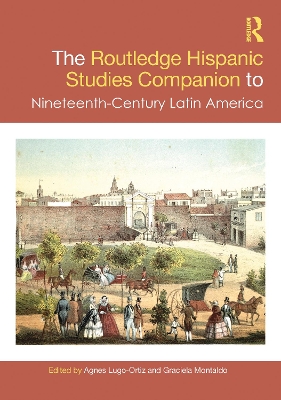
"The Routledge Hispanic Studies Companion to Nineteenth-Century Latin America provides a unique, comprehensive, and critical overview of Latin American studies in the nineteenth century, including the major regions and subfield. The essays in this collection offer a complex, yet accessible transdisciplinary overview of the heterogeneous and asynchronous historical, political, and cultural processes that account for the becoming of Latin America in the nineteenth century--from Mexico and the Caribbean Basin to the Southern Cone. The thematic division of the book into six parts allows for a better understanding of the ways in which different themes are interrelated and affords readers the opportunity to draw their own connections among subfields. The volume assembles a robust sample of recent and innovative scholarship on the subject, reformulating from fresh perspectives commonly held views on the issues that characterized the era. Additionally, it provides an overarching analysis of the field and introduces cutting-edge concepts all within one expansive volume, opening the dialogue about topics that share common denominators and modelling how those topics can be approached from a variety of perspectives. The innovative volume will be of interest to students and scholars of Latin American studies and Spanish studies. Readers unfamiliar with the period will acquire a comprehensive view of its complexities while specialists will discover new interpretations and archives"--
The Routledge Hispanic Studies Companion to Nineteenth-Century Latin America provides a unique, comprehensive, and critical overview of Latin American studies in the nineteenth century, including the major regions and subfield.
The essays in this collection offer a complex, yet accessible transdisciplinary overview of the heterogeneous and asynchronous historical, political, and cultural processes that account for the becoming of Latin America in the nineteenth century—from Mexico and the Caribbean Basin to the Southern Cone. The thematic division of the book into six parts allows for a better understanding of the ways in which different themes are interrelated and affords readers the opportunity to draw their own connections among subfields. The volume assembles a robust sample of recent and innovative scholarship on the subject, reformulating from fresh perspectives commonly held views on the issues that characterized the era. Additionally, it provides an overarching analysis of the field and introduces cutting-edge concepts all within one expansive volume, opening the dialogue about topics that share common denominators and modelling how those topics can be approached from a variety of perspectives.
The innovative volume will be of interest to students and scholars of Latin American studies and Spanish studies. Readers unfamiliar with the period will acquire a comprehensive view of its complexities while specialists will discover new interpretations and archives.
The Routledge Hispanic Studies Companion to Nineteenth-Century Latin America provides a unique, comprehensive, and critical overview of Latin American studies in the nineteenth century, including the major regions and subfield.
Introduction
On Nineteenth-Century Latin America: Coordinates for a Companion
Part
1. The Invention of Latin America in the Nineteenth Century
Introduction
1. The Idea of Latin America in the Nineteenth Century
Part
2. Sovereignties in Dispute
Introduction
2. The Haitian Revolution and Independence in Latin America
3. Cultural and Political Debates on Independence and Sovereignty in the
Early Nineteenth Century
4. Frontier Crossroads: US Expansionist Wars, Territorial Anxieties, and
Nineteenth-Century Latin America
5. Sovereignty, Finances, and the Novel
6. The Body of the Nation: Images of Sovereignty in Times of War in
Nineteenth-Century Brazil
Part
3. Wars, Violence, Social Strife
Introduction
7. Caudillismo: Definitions, Histories, Representations
8. Caudillismo and Banditry
9. Engendering War Writing in Nineteenth-Century Latin America
10. Radical Genealogies: The Beginnings of Anarchism in Nineteenth-Century
Latin America, 1860-1890
Part
4. Re-Drawing Territories
Introduction
11. Tropical Seas: Scenes of the Caribbean in Nineteenth-Century Travel
Narratives
12. Transpacific Relations and Chinese Labor in the Americas
13. Hemispheric Literary Networks and José Martķs Charleston Earthquake
14. Civic Festivals, Popular Spectacles, and the Art of Drawing Republics
Part
5. Bodies and Citizenship
Introduction
15. Citizenships and Cultural Politics
16. Citizenship, Visual Culture, Costumbrismo
17. Tuning the Indian: Creole Discourse, Citizenship, and Aurality in
(Post)colonial Latin America
18. Slavery, Emancipation, and the History of Racial Silence in the Americas
19. Fictions of Jewishness
20. Obscenity, Obscene Humor, Syphilis, and Popular Music in
Turn-of-the-Century Spanish America: A Case Study
21. Necropolitics of Affect: Sentimentality, Race, and Gender in
Nineteenth-Century Peru
Part
6. Knowledges
Introduction
22. Science, (Not-)Knowing, and Periodical Cultures
23. Work and the Intellectual: From Simón Rodrķguez (1769-1854) to Clorinda
Matto de Turner (1852-1909)
24. Literary Crimes: Turn-of-the-Century Authorship
25. Thinking through Performance Practices in Nineteenth-Century Latin
America
26. Museums and Archives: Symbolic Extractivism, Nationhood, and
Secularization
27. Art Makers and the Making of Art: Latin America, ca. 1780-1880
Agnes Lugo-Ortiz is Associate Professor of Hispanic and Luso-Brazilian Studies at the University of Chicago in Chicago, Illinois, USA, where she also co-coordinates the Working Group on Slavery and Visual Culture. Her publications include Identidades imaginadas: biografķa y nacionalidad en el horizonte de la guerra (Cuba 18601898) and the collection Slave Portraiture in the Atlantic World (co-edited with Angela Rosenthal).
Graciela Montaldo is Professor at Columbia University in New York, USA. Her research explores Latin American cultural history, focusing on the production and circulation of cultural practices as they intersect with politics. She is the author of Museum of Consumption: Archives of Mass Culture in Argentina and co-editor of The Argentina Reader: History, Culture, Politics, among other publications.


 Lisainfo e-raamatute kohta