"Rwanda's Gacaca Courts provide an innovative response to the genocide of 1994. Incorporating elements of both African dispute resolution and of Western-style criminal courts, Gacaca courts are in line with recent trends to revive traditional grassroots mechanisms as a way of addressing a violent past. Having been devised as a holistic approach to prosecution and punishment as well as to healing and repairing, they also reflect the increasing importance of victim participation in international criminal justice. This book critically examines the Gacaca courts' achievements as a mechanism of criminal justice and as a tool for healing, repairing, and reconciling the shattered communities. Having prosecuted over one million people suspected of crimes during the 1994 genocide, the courts have been both praised for their efficiency and condemned for their lack of due process. Drawing upon extensive observations of trial proceedings, this book is the first to provide a detailed analysis of the Gacaca legislation and its practical implementation. It discusses the Gacaca courts within the framework of transitional and international criminal justice and argues that, despite the trend towards local, tailor-made solutions to the challenges of political transition, there is a common set of principles to be respected in addressing the past. Evaluating the Gacaca courts against the backdrop of existing or emerging principles, such as the duties to investigate and prosecute, and the right to the truth, the book providesa sophisticated critique of Rwanda's reconciliation policy. In doing so, it contributes to the development and the clarification of these principles. It concludes that Gacaca courts have achieved a great deal in stimulating a basic discourse on the genocide, but they have also contributed to assigning collective responsibility and may thus end up deepening the divides within Rwandan society"--Provided by publisher.
Rwanda's Gacaca Courts provide an innovative response to the genocide of 1994. Incorporating elements of both African dispute resolution and of Western-style criminal courts, Gacaca courts are in line with recent trends to revive traditional grassroots mechanisms as a way of addressing a violent past. Having been devised as a holistic approach to prosecution and punishment as well as to healing and repairing, they also reflect the increasing importance of victim participation in international criminal justice.
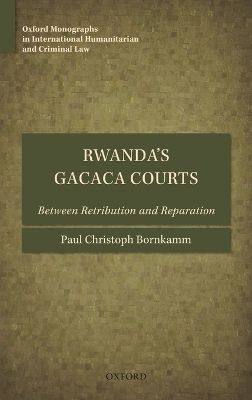
This book critically examines the Gacaca courts' achievements as a mechanism of criminal justice and as a tool for healing, repairing, and reconciling the shattered communities. Having prosecuted over one million people suspected of crimes during the 1994 genocide, the courts have been both praised for their efficiency and condemned for their lack of due process. Drawing upon extensive observations of trial proceedings, this book is the first to provide a detailed analysis of the Gacaca legislation and its practical implementation. It discusses the Gacaca courts within the framework of transitional and international criminal justice and argues that, despite the trend towards local, tailor-made solutions to the challenges of political transition, there is a common set of principles to be respected in addressing the past. Evaluating the Gacaca courts against the backdrop of existing or emerging principles, such as the duties to investigate and prosecute, and the right to the truth, the book provides a sophisticated critique of Rwanda's reconciliation policy. In doing so, it contributes to the development and the clarification of these principles. It concludes that Gacaca courts have achieved a great deal in stimulating a basic discourse on the genocide, but they have also contributed to assigning collective responsibility and may thus end up deepening the divides within Rwandan society.


 Lisainfo e-raamatute kohta