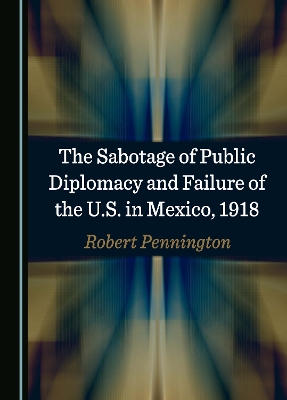
Public diplomacy is a relatively new practice in international political relations, developed during World War I due to the recognition that public opinion cannot be ignored in the formation of government policies. The practice grew out of propaganda campaigns as a means to influence foreign groups while avoiding the negative attributes associated with propaganda: lies, deception, and totalitarian power converting individuals to psychological commitment. But like propaganda in international political relations, public diplomacy is directed across an international border to a mass audience, using various techniques of persuasion with the goal of affecting or effecting policy. In the earliest attempts by the United States government, public diplomacy failed because of conflict between public idealism and private, self-interested pragmatism. This book evaluates the pioneering public diplomacy campaign directed at the Mexican people by the United States government in 1918.
Robert Pennington, PhD (University of Wisconsin-Madison, 1991) Professor Emeritus at Fo Guang University, Taiwan, has held faculty positions at several universities in the USA and Taiwan in departments of communication, management, foreign languages and cultures, and in graduate institutes of international communication studies, technology and innovation management, and e-commerce. He has also lectured at universities in South Korea. The primary focus of his research is mass media as an expression of cultural theory. His writing has appeared in publications with a global readership, and has covered topics such as cultural development implications of communication technology, and consumption and marketing communication as cultural processes for satisfying basic human needs. He also has written about marketing communication development, advertising and brands within consumer culture, the meanings of consumer brands and psycho-linguistic methodology. His research extensively develops a theory of culture as a system of symbolic forms, utilizing methodology that selects influential literature from a range of disciplines to form a synthesis of seemingly diverse perspectives.

 Lisainfo e-raamatute kohta