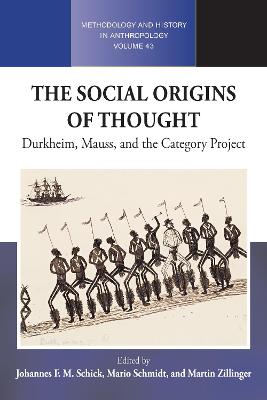
By studying how different societies understand categories such as time and causality, the Durkheimians decentered Western epistemology. With contributions from philosophy, sociology, anthropology, media studies, and sinology, this volume illustrates the interdisciplinarity and intellectual rigor of the “category project” which did not only stir controversies among contemporary scholars but paved the way for other theories exploring how the thoughts of individuals are prefigured by society and vice versa.
Arvustused
It makes a clear contribution to its field by a group of scholars with a coherent nucleus in Germany, many of whom have been researching this topic for years, if not decades it represents the culmination, at least for the time being, of work on these issues (the Durkheimians and the categories). Robert Parkin, University of Oxford
This is a collective book from international scholars assessing the legacy of the Durkheim school of sociology through the epistemological question of the origins of categories of thought This is a significant contribution to the historical epistemology in France. Frédéric Keck, Director of Research at the Laboratory of Social Anthropology (CNRS-Collčge de France-EHESS).
List of Figures
Introduction: The Durkheim Schools "Category Project": A Collaborative
Experiment Unfolds
Johannes F.M. Schick, Mario Schmidt, and Martin Zillinger
Part I: Silenced Influences and Hidden Texts
Chapter
1. Kantian Categories and the Relativist Turn: A Comparison of Three
Routes
Gregory Schrempp
Chapter
2. Hidden Durkheim and Hidden Mauss: An Empirical Rereading of the
Hidden Analogical Work Made Necessary by the Creation of a New Science
Nicolas Sembel
Chapter
3. Mana in Context: From Max Müller to Marcel Mauss
Nicolas Meylan
Chapter
4. Durkheim, the Question of the Categories and the Concept of
Labor
Susan Stedman Jones
Chapter
5. Inequality Is a Scientific Issue When the Technologies of
Practice That Create Social Categories Become Dependent on Justice in
Modernity
Anne Warfield Rawls
Chapter
6. Experimenting with Social Matter: Claude Bernard's Influence on
the Durkheim School's Understanding of Categories
Mario Schmidt
Part II: Lateral Links and Ambivalent Antagonists
Chapter
7. Freedom, Food, and the Total Social Fact. Some Terminological
Details of the Category Project in "Le Don" by Marcel Mauss
Erhard Schüttpelz
Chapter
8. Durkheimian Thinking and the Category of Totality
Nick J. Allen
Chapter
9. Durkheimian Creative Effervescence, Bergson and the Ethology of
Animal and Human Societies
William Watts Miller
Chapter
10. "It is not my time that is thus arranged": Bergson, the
'Category Project', and the Structuralist Turn
Heike Delitz
Chapter
11. "Let Us Dare a Little Bit of Metaphysics": Marcel Mauss, Henri
Hubert and Louis Weber on Causality, Time, and Technology
Johannes F. M. Schick
Part III: Forgotten Allies and Secret Students
Chapter
12. The Rhythm of Space: Stefan Czarnowski's Relational Theory of
the Sacred
Martin Zillinger
Chapter
13. La Pensée Catégorique: Marcel Granet's Grand Sinological Project
at the Heart of the "L'Année Sociologique" Tradition
Robert André LaFleur
Chapter
14. Drawing a Line: On Hertz' Hands
Ulrich van Loyen
Chapter
15. Between Claude Lévi-Strauss, Pierre Bourdieu and Michel
Foucault, or: What Is the Meaning of Mauss' "Total Social Fact"?
Jean-Franēois Bert
Chapter
16. From Durkheim to Halbwachs: Rebuilding the Theory of Collective
Representations
Jean-Christoph Marcel
Chapter
17. Durkheims Quest: Philosophy beyond the Classroom and the
Libraries
Wendy James
Index
Johannes F.M. Schick is a Postdoctoral Fellow at the a.r.t.e.s. Graduate School for the Humanities (University of Cologne). He was the head of the DFG-research Project Action, Operation, Gesture: Technology as Interdisciplinary Anthropology.
Mario Schmidt is a Postdoctoral Fellow at the a.r.t.e.s. Graduate School of the Humanities at the University of Cologne. He has published in distinguished academic journals such as Africa, Journal of Eastern African Studies, Ethnohistory, and Journal of Cultural Economy.
Martin Zillinger is Professor of Social and Cultural Anthropology at the University of Cologne. His major field research has been in Morocco on trance, ritual, and new media.

 Lisainfo e-raamatute kohta