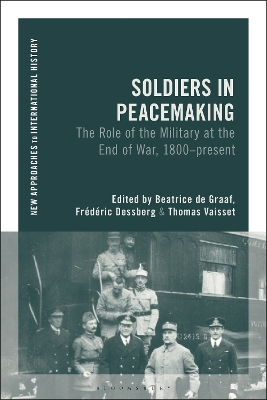
What is the role of a soldier at the end of war, when either victory or defeat is inevitable? This book delves into that question, exploring how the military and soldiers on the ground have contributed to the transition to peace. With case studies from 1800 to the present day, Soldiers in Peace-making offers a historical overview of the part military men and women have played in the aftermath of war.
From UN peacekeeping in Cambodia to military observers in former Yugoslavia, the post-Cold War US Army and more, the essays in this collection map the strategy, politics and practicalities involved in the transition from war to postwar. Analyzing the legitimacy of each 'peace' and the military's approach to them, the chapters explore how soldiers have engaged with politics and political leaders, interacted with civil populations, and called upon their own expertise to enable the peace-making process. In exploring the hybrid role of military men and women as diplomats, peacemakers, negotiators and fighters this book reveals the crucial part they have played as conflicts come to a close.
Arvustused
The volume ... opens up a research field that has not yet been examined in sufficient detail and thereby offers genuine scholarly added value. * H-Soz-Kult * This edited volume raises interesting questions regarding the influence and roles played by military actors on the international scene, which goes well beyond the traditional narratives of combatants. * Canadian Military History * The questions this collection raises should produce much spirited discussion in many staff colleges and graduate seminars. * Social History *
Muu info
Exploring the role of the military at the end of war, this volume of case studies investigates how soldiers have contributed to the transition to peace throughout the 19th and 20th centuries.
Introduction, Beatrice De Graaf, Frédéric Dessberg & Thomas Vaisset,
(University of Utrecht, Netherlands, University Paris 1 Panthéon-Sorbonne,
France, and Le Havre Normandy University, France)
Part I : Politico-Military Relationships
1. Peace-making and Civil-military Relations, 1918-1923, Hew Strachan
(University of St. Andrews, UK)
2. The Post-Cold War United States Army and Debates over Peacekeeping
Operations, David Fitzgerald (University College Cork, Ireland)
3. Soldier or Diplomat? The Grey Area of UN Peacekeeping in Cambodia,
Wietse Stam (Leiden University, Netherlands)
4. United Nations Military Observers in Former Yugoslavia: Strategic
Influencers or Sitting Ducks?, Dion Landstra and Thomas Wijnaendts van
Resandt (Leiden University, Netherlands)
Part II: Civil Populations and The Military
5. Turning Enemies into Friends: The Role of the Military in
Peace-Making in France after Napoleon (1815-1818), Christine Haynes
(University of North Carolina at Charlotte, USA)
6. War Against War: The Antimilitarist Activities of Greek War
Veterans (19221925), Alexandros Makris (University of Patras, Greece)
7. Building Insecurity? Military and Paramilitary Forces in Postwar
Czechoslovak Borderlands (1945-1948), Paul Lenormand (Sciences Po Paris,
France)
Part III: Military Expertise
8. General of the Russian Army Alexei Orlov: Military Figure in the
Service of Diplomacy, Elena Linkova (Peoples' Friendship University of
Russia)
9. The Naval Officer, a Peacekeeper in Europe (1815-1848)? Keeping
European Peace Overseas and Consolidating French Naval Power, Hélčne Vencent,
(Panthéon-Sorbonne, France)
10. Soldiers Versus Veterans. Peacemaking in Britain after Napoleon, Evan
Wilson, (US Naval War College, USA)
11. The Price of Disobedience: The Eastern French Army in Albania
(1916-1925), Renaud Dorlhiac, (EHESS Paris, France)
Bibliography
Notes
Beatrice de Graaf is Professor of History at University of Utrecht, Netherlands. A historian in the field of security and terrorism, her research focuses on security-related themes in the 19th century and on modern and contemporary cases of conflict and terrorism. She was awarded with the Stevin Prize in 2018 for her work.
Frédéric Dessberg is Senior Lecturer of Modern History at the University Paris 1 Panthéon-Sorbonne, France, and is head of the European Defence and Security research department at Saint-Cyr Research Center. He also holds the Jean Monnet European Chair for European Defence and Security. His work primarily explores French policy in Eastern Europe during the interwar period.
Thomas Vaisset is Lecturer in Contemporary History at Le Havre Normandy University, France. His research focuses on the history of the French Navy between 1870 and 1945, and the history of French external resistance during WWII.

 Lisainfo e-raamatute kohta