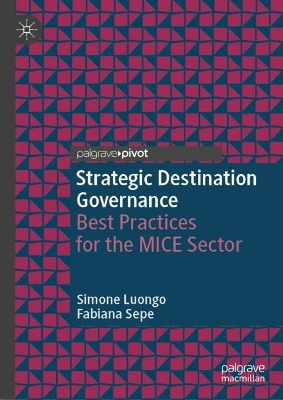
This book offers a comprehensive exploration of the intersection between destination management and the meetings, incentives, conferences and events (MICE) sector.
Fragmented approaches to destination management often hinder the industry, especially amid evolving market demands and the need for sustainable economic benefits for local communities. Strengthening governance and fostering strategic collaboration among stakeholders can significantly enhance destination competitiveness.
To this end, the book introduces the principles of destination governance, examines the operational dynamics of Convention Bureaus and applies the “6 A’s” framework—access, accommodation, attractions, amenities, assemblage and ancillary services—to create integrated and appealing offerings.
Drawing on case studies, it demonstrates how destinations can leverage their unique characteristics and adapt governance strategies to drive sustainable economic growth and long-term success.
This is an essential guide for readers seeking to understand and navigate the evolving landscape of business tourism.
Chapter
1. Introduction to the topic and definition of research
hypotheses.
Chapter
2. Theoretical framework.
Chapter
3. From governance to
destination governance.
Chapter
4. Destination management and the actors in
mice industry.
Chapter
5. Territorial governance in the mice industry: a
source of competitive advantage for tourist destinations.
Simone Luongo is Research Fellow at the University of Naples Federico II, Italy. His research explores tourism management, with a particular focus on destination governance, resilience and digital innovation. He investigates how strategies and technologies can foster sustainable tourism development, strengthen community engagement and enhance visitor experiences. Through his publications and international conference contributions, he provides knowledge and practical insights for tourism professionals, policymakers and destination managers.
Fabiana Sepe is Assistant Professor at the University of Naples Federico II, Italy. Her multidisciplinary research spans management, tourism studies and the agri-food sector. She investigates how emerging technologies, sustainable practices and collaborative innovation foster competitiveness and regional development. With publications in international journals and conference contributions, she bridges academic research with practical applications, supporting both local economies and knowledge-intensive services in a global context.

 Lisainfo e-raamatute kohta