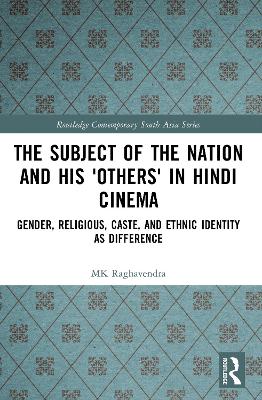
This book analyses the representations of the subjects of Hindi cinema as a way of gaining insights into the hegemony of the upper-caste Hindu male in narratives of nationhood.
Given that Hindi cinema has narrativised the nation after 1947, the book examines how these subjects were chosen and argues that they were upper-caste, Hindu and predominantly male. The author's analysis shows asymmetries in the constitution of the ‘imagined nation’ in the public consciousness. Women, the marginalised categories and minorities were presented as ‘others’ with separate stories for the issues dealing with them - but distinct from that of the nation. Stories centered on women primarily highlight their position within society. In this context, the book argues that it is the male protagonist whose story mirrors that of the nation as allegory.
A novel contribution to the field of Bollywood Studies, this insightful work will be of interest to those studying Hindi Cinema and Film Studies, Political Science and History as well as Gender Studies.
This book analyses the representations of the subjects of Hindi cinema as a way of gaining insights into the hegemony of the upper-caste Hindu male in narratives of nationhood.
Introduction
Chapter 1: Film Form and Ideology
Chapter 2: The Trajectory of the Hero in Bollywood
Chapter 3: Representing Women
Chapter 4: The Portrayal of Muslims as Religious Minorities
Chapter 5: Caste Identity and Conflict
Chapter 6: Ethnicities and Hindi Cinema
Chapter 7: Representing the Social Other
Chapter 8: Pakistan as the National Other
Afterword: Asymmetric Nationhood
MK Raghavendra is an independent scholar of culture, literature and politics, specializing in film, particularly its political aspects. He won the National Award for Best Film Critic in 1997 and received a Homi Bhabha Fellowship to research popular film narrative. Since then he has authored six volumes of academic film scholarship from international publishers including Routledge. Apart from these, he has authored three academic works on literature, culture and politics. He has published in national and international anthologies and journals on the above subjects, and his writing has been translated into French, Polish and Russian and published.


 Lisainfo e-raamatute kohta