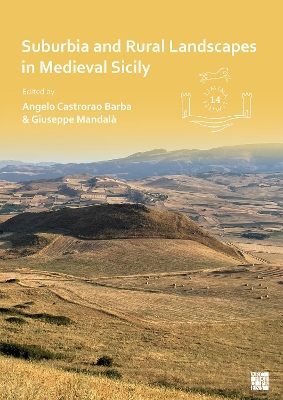
Suburbia and Rural Landscapes in Medieval Sicily presents the results of the main ongoing archaeological and historical research focusing on medieval suburbia and rural sites in Sicily. It is thus intended to update traditional views regarding the evolution of this territory from Late Antiquity to the Middle Ages by bringing into the picture new data from archaeological excavations undertaken at several sites across Sicily, new information from surveys of written sources, and new reflections based on the analysis of both material and documentary sources. The volume is divided into thematic areas: Urbanscapes, suburbia, hinterlands; Inland and mountainous landscapes; Changes in rural settlement patterns; and Defence and control of the territory. The essays underline the fundamental contribution of archaeological research in Sicily to the debate on the formation of early medieval landscapes at the crossroads between the Byzantine and Islamic worlds. A comparison with other research areas and constant dialogue with historical sources constitute essential elements for advancing our knowledge of the rural and suburban world of Sicily as a case study illustrating wider Mediterranean dynamics.
Introduction Angelo Castrorao Barba, Giuseppe Mandalą
I - Urbanscapes, Suburbia, Hinterlands
Chapter 1: The Topographical Context of Palermo in the Islamic Age: New
Archaeological Research Stefano Vassallo
Chapter 2: The Kings Hospital in Norman Palermo: San Giovanni dei Lebbrosi
in Context Giuseppe Mandalą, Marķa de los Įngeles Utrero Agudo
Chapter 3: The Process of the Creation and Decline of the Local Religious and
Economic Centres of Medieval Sicily: a Case Study of the Santa Maria di
Campogrosso Monastery Sawomir Modzioch, Barbara Szubert, Ewa Modzioch
Chapter 4: A Pattern of Changes in Southern Sicily: Agrigento and its
Hinterland between the Byzantine and Norman Periods Maria Serena Rizzo
II - Inland and Mountainous Landscapes
Chapter 5: Contessa Entellina: Rural vs. Urban Medieval Landscapes in Inner
Western Sicily Alessandro Corretti, Claudio Filippo Mangiaracina
Chapter 6: The Settlement of Contrada Castro (Corleone, Palermo) between the
Byzantine and Islamic Periods (7th-11th c. AD) Angelo Castrorao Barba,
Roberto Miccichč, Filippo Pisciotta, Claudia Speciale, Carla Aleo Nero,
Pasquale Marino, Giuseppe Bazan
Chapter 7: The Madonie Mountains Area during the Norman Age: from al-Idrs
to Archaeology Rosa Maria Cucco
Chapter 8: Water Management, Territorial Organisation and Settlement in
Calatafimi (Trapani, Western Sicily) José Marķa Martķn Civantos, Rocco
Corselli, Maria Teresa Bonet Garcķa
Chapter 9: Late Antique and Early Medieval Settlement Patterns in the Inland
Landscape of the Erei Upland (Enna, Central Sicily) Francesca Valbruzzi
III - Change in Rural Settlement Patterns
Chapter 10: Historical and Archaeological Data for the Ancient Road Network
in Western Sicily from the Roman Period to the Norman Age Aurelio Burgio,
Alessandra Canale
Chapter 11: The End of Antiquity and the New Point of Departure in the
Medieval Settlement System of Southern and Central Sicily Johannes
Bergemann
Chapter 12: After the Late Roman Villa of Piazza Armerina: the Islamic
Settlement and its Pits Patrizio Pensabene, Paolo Barresi
Chapter 13: Etnas Northwestern Slopes between Late Antiquity and the Middle
Ages Andrea Maria Gennaro
IV Defence and Control
Chapter 14: The Making of the Frontier in the 9th Century. Rocchicella di
Mineo (CT) and Rural Landscapes in Eastern Sicily Lucia Arcifa
Chapter 15: Byzantine and Islamic Villages, Rupestrian Settlements and
Fortifications in Southeastern Sicily: the LAMIS Project Giuseppe
Cacciaguerra
Angelo Castrorao Barba is Postdoctoral Researcher (MSCA COFUND PASIFIC 2022-2024) at the Institute of Archaeology and Ethnology/Centre for Late Antique and Early Medieval Studies of the Polish Academy of Sciences. He is a specialist in rural settlement patterns from the Roman period to Late Antiquity and the Early Middle Ages in the Mediterranean area, particularly in Sicily. He has directed survey and excavations in Sicily and Andalusia and he has published on several topics, including the archaeology of Late Antique, Byzantine and Islamic Sicily, the end of Roman villas and interdisciplinary approaches on landscape archaeology.
Giuseppe Mandalą is Associate Professor of the History of Islamic Countries at the Universitą degli studi di Milano La Statale, where he teaches the cultural history of the Mediterranean. He specializes in intellectual history and the cultural transmission of texts, as well as the study of their processes of production, diffusion, and reception. He has published extensively on medieval transcultural topics, particularly focusing on Sicily and the Mediterranean.

 Lisainfo e-raamatute kohta