Muutke küpsiste eelistusi

E-raamat: Sudden Death: Medicine and Religion in Eighteenth-Century Rome

  • Formaat: EPUB+DRM
  • Ilmumisaeg: 01-Apr-2016
  • Kirjastus: Routledge
  • Keel: eng
  • ISBN-13: 9781317048510
  • Formaat - EPUB+DRM
  • Hind: 54,59 €*
  • * hind on lõplik, st. muud allahindlused enam ei rakendu
  • Lisa ostukorvi
  • Lisa soovinimekirja
  • See e-raamat on mõeldud ainult isiklikuks kasutamiseks. E-raamatuid ei saa tagastada.
  • Formaat: EPUB+DRM
  • Ilmumisaeg: 01-Apr-2016
  • Kirjastus: Routledge
  • Keel: eng
  • ISBN-13: 9781317048510

DRM piirangud

  • Kopeerimine (copy/paste):

    ei ole lubatud

  • Printimine:

    ei ole lubatud

  • Kasutamine:

    Digitaalõiguste kaitse (DRM)
    Kirjastus on väljastanud selle e-raamatu krüpteeritud kujul, mis tähendab, et selle lugemiseks peate installeerima spetsiaalse tarkvara. Samuti peate looma endale  Adobe ID Rohkem infot siin. E-raamatut saab lugeda 1 kasutaja ning alla laadida kuni 6'de seadmesse (kõik autoriseeritud sama Adobe ID-ga).

    Vajalik tarkvara
    Mobiilsetes seadmetes (telefon või tahvelarvuti) lugemiseks peate installeerima selle tasuta rakenduse: PocketBook Reader (iOS / Android)

    PC või Mac seadmes lugemiseks peate installima Adobe Digital Editionsi (Seeon tasuta rakendus spetsiaalselt e-raamatute lugemiseks. Seda ei tohi segamini ajada Adober Reader'iga, mis tõenäoliselt on juba teie arvutisse installeeritud )

    Seda e-raamatut ei saa lugeda Amazon Kindle's. 

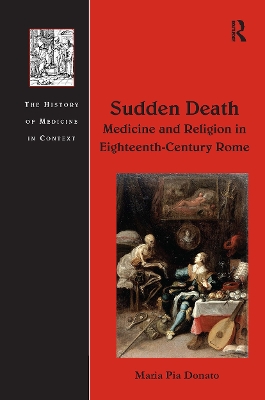
In 1705-1706, during the War of the Spanish Succession and two years after a devastating earthquake, an ’epidemic’ of mysterious sudden deaths terrorized Rome. In early modern society, a sudden death was perceived as a mala mors because it threatened the victim’s salvation by hindering repentance and last confession. Special masses were celebrated to implore God’s clemency and Pope Clement XI ordered his personal physician, Giovanni Maria Lancisi, to perform a series of dissections in the university anatomical theatre in order to discover the 'true causes' of the deadly events. It was the first investigation of this kind ever to take place for a condition which was not contagious. The book that Lancisi published on this topic, De subitaneis mortibus (’On Sudden Deaths’, 1707), is one of the earliest modern scientific investigations of death; it was not only an accomplished example of mechanical philosophy as applied to the life sciences in eighteenth-century Europe, but also heralded a new pathological anatomy (traditionally associated with Giambattista Morgagni). Moreover, Lancisi’s tract and the whole affair of the sudden deaths in Rome marked a significant break in the traditional attitude towards dying, introducing a more active approach that would later develop into the practice of resuscitation medicine. Sudden Death explores how a new scientific interpretation of death and a new attitude towards dying first came into being, breaking free from the Hippocratic tradition, which regarded death as the obvious limit of physician’s capacity, and leading the way to a belief in the 'conquest of death' by medicine which remains in force to this day.

Arvustused

Praise for the Italian edition: '... beautifully written and impeccably structured, with clearly stated research questions and a helpful bibliography of key works, this in-depth study is an intellectual delight.' Alexandra Bamji, Bulletin of the History of Medicine '...an excellent work that combines medical, social, and political history to examine the meaning of illness in early modern culture.' Anita Guerrini, The American Historical Review

Acknowledgements vii
Abbreviations and Translator's Notes ix
Introduction 1(12)
PART I SUDDEN DEATH AND THE PHYSICIAN'S ROLE IN SOCIETY
1 Fears
13(28)
2 The Medico-legal Enquiry on Sudden Death, or: The Truth of the Body and the Public Role of Physicians
41(26)
3 From the Dead to the Living: Medicine and Public Health in the Early Eighteenth Century
67(20)
PART II SUDDEN DEATH IN MEDICAL THEORY AND PRACTICE
4 A New Stance on Death: The Mechanical Medicine of Lancisi's De subitaneis mortibus (1707)
87(24)
5 The Pathological Gaze: The Problematic Status of Post-mortem Evidence in Early Eighteenth-Century Medicine
111(32)
PART III THE LOST AND THE SAVED: SUDDEN DEATH AS AN ETHICAL AND RELIGIOUS ISSUE
6 Death and the Doctors: Scientific Queries and Ethical Dilemmas
143(24)
7 In the Hour of Death
167(20)
8 Looking for a Heavenly Protector: Saint Andrew Avellino, the `Apoplectic Saint'
187(22)
Epilogue: Was there Ever a Sudden Death `Epidemic' in Rome? 209(8)
Index 217
Maria Pia Donato is an associate professor of Early Modern History at the University of Cagliari, Italy, and chargé de recherche at the Centre National de la Recherche Scientifique, Institut dHistoire moderne et contemporaine of Paris, France. She is the author of Accademie romane. Una storia sociale, 1671-1824 (Naples 2000) and numerous essays on the political, social and cultural life of modern Rome, the history of medicine, and the history of science.