Muutke küpsiste eelistusi
  • Formaat - EPUB+DRM
  • Hind: 54,59 €*
  • * hind on lõplik, st. muud allahindlused enam ei rakendu
  • Lisa ostukorvi
  • Lisa soovinimekirja
  • See e-raamat on mõeldud ainult isiklikuks kasutamiseks. E-raamatuid ei saa tagastada.
  • Formaat: EPUB+DRM
  • Sari: Legal Pedagogy
  • Ilmumisaeg: 21-Jul-2020
  • Kirjastus: Routledge
  • Keel: eng
  • ISBN-13: 9781000090949

DRM piirangud

  • Kopeerimine (copy/paste):

    ei ole lubatud

  • Printimine:

    ei ole lubatud

  • Kasutamine:

    Digitaalõiguste kaitse (DRM)
    Kirjastus on väljastanud selle e-raamatu krüpteeritud kujul, mis tähendab, et selle lugemiseks peate installeerima spetsiaalse tarkvara. Samuti peate looma endale  Adobe ID Rohkem infot siin. E-raamatut saab lugeda 1 kasutaja ning alla laadida kuni 6'de seadmesse (kõik autoriseeritud sama Adobe ID-ga).

    Vajalik tarkvara
    Mobiilsetes seadmetes (telefon või tahvelarvuti) lugemiseks peate installeerima selle tasuta rakenduse: PocketBook Reader (iOS / Android)

    PC või Mac seadmes lugemiseks peate installima Adobe Digital Editionsi (Seeon tasuta rakendus spetsiaalselt e-raamatute lugemiseks. Seda ei tohi segamini ajada Adober Reader'iga, mis tõenäoliselt on juba teie arvutisse installeeritud )

    Seda e-raamatut ei saa lugeda Amazon Kindle's. 
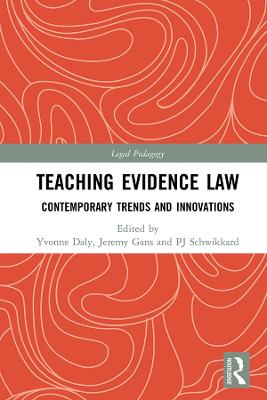
Teaching Evidence Law sets out the contemporary experiences of evidence teachers in a range of common law countries across four continents: Australia, Canada, Hong Kong, Ireland, New Zealand, South Africa, the United Kingdom and the United States. It addresses key themes and places these in the context of academic literature on the teaching of evidence, proof and fact-finding.

This book focuses on the methods used to teach a mix of abstract and practical rules, as well as the underlying skills of fact-analysis, that students need to apply the law in practice, to research it in the future and to debate its appropriateness. The chapters describe innovative ways of overcoming the many challenges of this field, addressing the expanding fields of evidence law, how to reach and accommodate new audiences with an interest in evidence, and the tools devised to meet old and new pedagogical problems in this area.

Part of Routledges series on Legal Pedagogy, this book will be of great interest to academics, post-graduate students, teachers and researchers of evidence law, as well as those with a wider interest in legal pedagogy or legal practice.
INTRODUCTION: Taking Evidence Teaching Seriously. PART ONE: NEW TOOLS.
1. Learning Evidence with an Uncasebook.
2. Teaching Evidence Law in a
Flipped Classroom.
3. Using True Crime to Teach Evidence.
4. Using Mock Voir
Dires to Assess the Law of Evidence.
5. Using Deductive Reasoning to Teach
the Application of a Heightened Relevance Standard to Sexual History
Evidence.
6. Using International Criminal Law to Teach Evidence. PART TWO:
NEW AUDIENCES.
7. The Influences of Decolonisation on an Evidence
Curriculum.
8. Undergraduate Learning in Evidence: Complexities, Challenges
and Opportunities.
9. Bridging the Law and Forensic Science Divide.
10.
Teaching Evidence Law in Hong Kong after
1997. PART THREE: NEW FIELDS.
11. A
Blended Learning Approach to Teaching Electronic Evidence.
12. Introducing
Science and Technology Studies into the Expert Evidence Course.
13. Teaching
Legal Ethics in a Course on Evidence. CONCLUSION: The Horizon of Evidence Law
Teaching
Yvonne Daly is Associate Professor of Law at Dublin City University, Ireland.

Jeremy Gans is Professor of Law at the University of Melbourne, Australia.

PJ Schwikkard is Professor of Public Law at the University of Cape Town, South Africa.