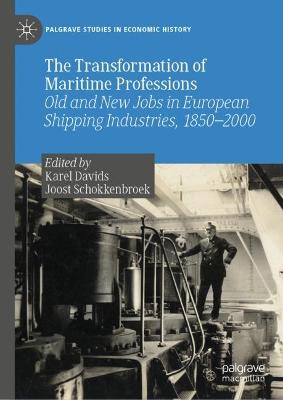
This book deals with the economic impact of technological changes and the rise of passenger shipping on social relations on board and ashore in European shipping industries between c.1850 and 2000. The changes in motive power, communication techniques and positioning technologies and the rise of passenger shipping went together with the creation of new tasks and functions and the marginalization or disappearance of traditional jobs and skills. This book presents case-studies on changes in different maritime professions between the middle of the nineteenth century and the end of the twentieth century, covering the shipping industries of a variety of seafaring countries in Europe. The subjects include changes in maritime labour at large, changes in specific groups of deck, catering or engine room personnel, such as captains, cooks, catering personnel, engineers, or radio-operators. A number of chapters employ a prosopographical or micro-historical approach, while others apply a spatial perspective, analyze business records, materials from professional associations or distil information from large sets of quantitative data. This book will be of interest to academics and students of economic history, maritime and labour history.
Chapter 1: Introduction.- Part I: Changes in maritime labour:
Institutional, technological and spatial contexts.
Chapter 2: The human
element in power-driven merchant ship propulsion since 1850: The British
case.
Chapter 3: Technological change, institutions, and maritime labour:
International reforms and their reception in Sweden and Finland,
c.1850-1939.
Chapter 4: Changes in maritime labour in Greece during the
transition from sail to steam, c. 1850-1917.
Chapter 5: Seamen in the city.
Origins, residence and standard of living of Le Havre seamen from c. 1800 to
the First Wold War.
Chapter 6: Reading shipboard space: the plans of ships
serving the Netherlands East Indies, c.1850-1914.- Part II: Case studies of
old maritime jobs.
Chapter 7: Reconfiguring authority at sea: Steamships and
their captains in a Danish context, c.1850-1950.
Chapter 8: Feeding the
fleet: Cooks in the Belgian merchant marine, c.1850-1930.- Part III: Case
studies of new maritime jobs.
Chapter 9: Elbowing their way: Engineers in
the Spanish merchant marine, c.1850-1950.
Chapter 10: From the captains
tiger to the chief steward. Career patterns of the catering personnel on
British passenger liners, 18601938.
Chapter 11: Surfing the waves. The rise
and decline of radio operators in the Dutch mercantile marine in the
twentieth century.
Chapter 12: Conclusion.
Karel Davids is Professor Emeritus of Economic and Social History at the Vrije Universiteit Amsterdam, the Netherlands. He has published and taught on economic and social history, maritime history, the history of technology and global history.
Joost Schokkenbroek has been Executive Director of the Vancouver Maritime Museum since July 2017. Prior to this he was affiliated with The Kendall Whaling Museum in the USA (1988-1990) and Het Scheepvaartmuseum (The Dutch National Maritime Museum) in Amsterdam (1991-2017), where he worked as Chief Curator, in combination with a Professorship of Maritime History and Maritime Heritage at Vrije Universiteit in Amsterdam.

 Lisainfo e-raamatute kohta