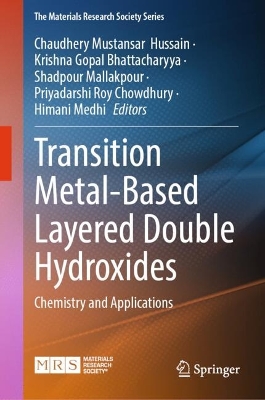
This contributed volume provides a comprehensive and consolidated resource on transition metal-based layered double hydroxides (LDHs). The book bridges the existing knowledge gap by offering an authoritative reference encompassing the latest research, developments, and applications of LDHs. It addresses specific challenges faced by researchers, including the complexities of designing LDHs for various applications, the dispersion of information across multiple sources, and the limited accessibility to up-to-date research. The book explores synthetic methods and functionalization strategies of LDHs while also discussing their various applications in areas such as catalysis, absorption, green chemistry, and/or tissue engineering, among others. It is a valuable resource for graduate students, researchers, and professionals working in the field of transition metal-based layered double hydroxides and materials science.
PART I: FUNDAMENTALS.- Introduction to transition metal based layered
double hydroxides.- Layered double hydroxide-derived catalysts: rehydration,
reconstitution, exfoliation, and supporting for catalytic applications.- PART
II: MULTIFACETED APPLICATIONS.- Metal organic framework incorporated
transition metal based layered double hydroxides for supercapacitors.- Defect
and interface engineering of transition metal layered double hydroxides for
metal-air batteries.- Transition metal based layered double hydroxides for
sample preparation.- Transition metal-based layered double hydroxides for
enhanced photocatalysis and adsorption.- Transition metal based layered
double hydroxides as photocatalysts for water treatment and clean energy
production.- Adsorption with transition metal-based layered double
hydroxides.- Transition Metal Based LDH for efficient Dye-sensitized Solar
Cells.- Multifunctional layered double hydroxides for efficient
photocatalytic applications.- Transition Metal based Layered Double
Hydroxides for Diagnostic Applications.- Transition metal layered double
hydroxides as emerging platforms for biomedical applications.- PART III: CASE
STUDIES.- Recent advances in synthesis and applications of materials obtained
by the immobilization of metalloporphyrins on layered double hydroxides.-
Insights into Reconstruction via Structural Memory Effect of Layered Double
Hydroxides Using X-ray Diffraction.- Future perspectives of transition metal
based layered double hydroxides.
Prof. Dr. Chaudhery Mustansar Hussain is an adjunct Professor and Director of Laboratories in the Department of Chemistry & Environmental Sciences at the New Jersey Institute of Technology (NJIT), Newark, New Jersey, United States. His research is focused on the applications of nanotechnology and advanced materials, environmental management, analytical chemistry, and various other industries. Dr. Hussain is the author of numerous papers in peer-reviewed journals as well as a prolific author and editor of around one hundred and fifty (150) books, including scientific monographs and handbooks in his research areas.
Prof. Dr. Krishna G. Bhattacharyya obtained his PhD and DIC from Imperial College of Science, Technology and Medicine, London. He joined the department of Chemistry, Gauhati University in 1975, held the positions of Dean, Faculty of Science and Director UGC Human Resource Development Centre, Gauhati University for a significant period of time, and retired from his service at Gauhati University as Professor in April 2016. His research interests are in the fields of water, air, and soil chemistry, heterogeneous catalysis, and environmental chemistry. Professor Dr. Bhattacharyya has more than 230 publications in several high-quality research papers, reviews, and thought-provoking perspectives with ELSEVIER, the American Chemical Society, the Royal Society of Chemistry, John Wiley & Sons, Springer, Taylor & Francis, etc. His research documents more than 14626 citations, with an h-index of 49 and an i-10 index of 103. He had successfully completed several major research projects from the World Bank, the Department of Science and Technology, the Department of Biotechnology, the Ministry of Environment and Forests, ISRO, DRDO, and other organizations. Professor Dr. Bhattacharyya is also a prolific author of several chemistry and environmental science textbooks, scientific monographs, and handbooks on cross-cutting topics in his research areas that played a critical role in breaking down silos and facilitating cross-fertilization of ideas and methods between researchers from diverse fields, particularly in environmental monitoring and waste management. He has been listed among the 2% of top scientists in the world by Stanford Universitys team of scientists, who meticulously analyzed the works and contributions of over 100,000 scientists in the world and ranked them subject-wise. Professor Bhattacharyya ranks 3rd among Indian scientists and 235th among world scientists in the field of environmental science. The database, created under the leadership of Dr. John PA Ioannidis, was published in a highly respected journalPLOS Biology. Apart from this, Prof Bhattacharyya served as the Chairman of the State Environment Impact Assessment Authority (SEIAA), Assam, India. Presently, he is working as a Professor of Chemistry in Assam Don Bosco University, India, and is actively involved in research.
Professor Dr. Shadpour Mallakpour, an organic polymer chemist, graduated from the chemistry department at the University of Florida (UF), Gainesville, Florida, U.S.A., in 1984. He spent two years as a post-doc at UF. He joined the Department of Chemistry, Isfahan University of Technology (IUT), Iran, in 1986. He held several positions, such as chairman of the Department of Chemistry and Deputy of research, Department of Chemistry at IUT. From 1994 to 1995 he worked as a visiting professor at the University of Mainz, Germany, and from 2003-2004 as visiting professor, at Virginia Tech, Blacksburg, USA. He has published more than 890 journal papers and book chapters and more than 440 conference papers and got more than 40 items of awards. The most important award to him was given for the selection of the first laureate of fundamental research at the 21st Khwarizmi International Award in 2008. He is listed as one of the Top 1% Scientists in Chemistry in ISI Essential Science Indicators since 2003. He was selected as an academic guest of the 59th Meeting of Nobel Prize Winners in Chemistry, 2009, at Lindau, Germany. He presented many lectures as an invited or keynote speaker at different national and international conferences or universities. He was a member of organizing and scientific committees for many national and international conferences. He was also the chairperson of many national and international meetings. In recent year he focused on the preparation and characterization of polymers containing chiral amino acid moieties under green conditions using ionic liquids and microwave irradiation as new technology and bringing these aspects towards nanotechnology for the preparation of novel chiral bio-nanocomposite polymers as well as polymer nanocomposites for hazardous materials removal technologies.
Priyadarshi Roy Chowdhury, Ph.D. is a Senior Research Fellow of Chemistry, at Gauhati University, India, and is presently involved in water quality monitoring in the Public Health Engineering Department, Govt. of Assam, India. His research is focused on LDHs and their applications, nanotechnology and advanced materials, analytical chemistry, environmental management, adsorption, biosorption, photocatalysis, and various other industries. He has a patent on LDH synthesis and photocatalysis. He is the author of numerous papers in reputed peer-reviewed journals and book chapters in his research areas.
Dr. Himani Medhi, is working as an Assistant Professor and Head, Department of Chemistry, Eastern Karbi Anglong College, Assam, India. Her research is focused on adsorption, biosorption, photocatalysis with LDHs, nanotechnology and advanced materials, quantum dots, analytical chemistry, environmental management, etc. She is the author of numerous papers in reputed peer-reviewed journals and book chapters in her research areas.
Professor Dr. Shadpour Mallakpour, an organic polymer chemist, graduated from the chemistry department at the University of Florida (UF), Gainesville, Florida, U.S.A., in 1984. He spent two years as a post-doc at UF. He joined the Department of Chemistry, Isfahan University of Technology (IUT), Iran, in 1986. He held several positions, such as chairman of the Department of Chemistry and Deputy of research, Department of Chemistry at IUT. From 1994 to 1995 he worked as a visiting professor at the University of Mainz, Germany, and from 2003-2004 as visiting professor, at Virginia Tech, Blacksburg, USA. He has published more than 890 journal papers and book chapters and more than 440 conference papers and got more than 40 items of awards. The most important award to him was given for the selection of the first laureate of fundamental research at the 21st Khwarizmi International Award in 2008. He is listed as one of the Top 1% Scientists in Chemistry in ISI Essential Science Indicators since 2003. He was selected as an academic guest of the 59th Meeting of Nobel Prize Winners in Chemistry, 2009, at Lindau, Germany. He presented many lectures as an invited or keynote speaker at different national and international conferences or universities. He was a member of organizing and scientific committees for many national and international conferences. He was also the chairperson of many national and international meetings. In recent year he focused on the preparation and characterization of polymers containing chiral amino acid moieties under green conditions using ionic liquids and microwave irradiation as new technology and bringing these aspects towards nanotechnology for the preparation of novel chiral bio-nanocomposite polymers as well as polymer nanocomposites for hazardous materials removal technologies.
Priyadarshi Roy Chowdhury, Ph.D. is a Senior Research Fellow of Chemistry, at Gauhati University, India, and is presently involved in water quality monitoring in the Public Health Engineering Department, Govt. of Assam, India. His research is focused on LDHs and their applications, nanotechnology and advanced materials, analytical chemistry, environmental management, adsorption, biosorption, photocatalysis, and various other industries. He has a patent on LDH synthesis and photocatalysis. He is the author of numerous papers in reputed peer-reviewed journals and book chapters in his research areas.
Dr. Himani Medhi, is working as an Assistant Professor and Head, Department of Chemistry, Eastern Karbi Anglong College, Assam, India. Her research is focused on adsorption, biosorption, photocatalysis with LDHs, nanotechnology and advanced materials, quantum dots, analytical chemistry, environmental management, etc. She is the author of numerous papers in reputed peer-reviewed journals and book chapters in her research areas.

 Lisainfo e-raamatute kohta