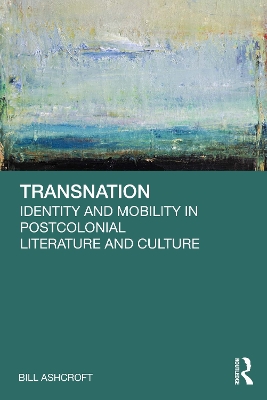
Transnation: Identity and Mobility in Postcolonial Literature and Culture offers a fresh and thought-provoking exploration of transnationalism, focusing on the mobility of populations who may not physically leave their national borders, but whose potential for movement subtly challenges the power and authority of the state. Drawing from postcolonial studies, it examines how marginalized and colonized groups resist and navigate the systems of control imposed by the state – resistance that may be subtle, yet constant and potent. Through the concept of the transnation, Bill Ashcroft reveals how individuals and groups move while avoiding the restrictive practices of borders. It emphasizes the increasing global mobility and how all nations, whether their populations are moving or not, can be seen as transnations. The book provides a radical lens on mobility, showing how deeply it impacts nations and how it might pose a threat to traditional forms of control. The work covers critical themes such as: nations, postnationalism, and the transnation; the space of the transnation; borders and bordering practices; the subjects of the transnation; the transnation and the city; and the porosity of borders in the works of Rushdie and Ghosh. An ideal resource for scholars and students of global movement, migration, literary studies, postcolonial studies, and transnational studies, this book provides a unique perspective on how people move within and across the boundaries of nation-states in an increasingly interconnected world. This book will be of great use to scholars and students investigating the increase in global movement.
Transnation: Identity and Mobility in Postcolonial Literature and Culture offers a fresh and thought-provoking exploration of transnationalism, focusing on the mobility of populations who may not physically leave their national borders, but whose potential for movement subtly challenges the power and authority of the state.
Introduction
Chapter 1 Nation, Transnation, and Belonging
Chapter 2
The Space of the Transnation
Chapter 3 Borders and Bordering
Chapter 4 The
Subjects of the Transnation
Chapter 5 Transnation and the City
Chapter 6
Rushdie, Ghosh, and the Porosity of Borders Afterword
Bill Ashcroft is a renowned critic and theorist, founding exponent of postcolonial theory, and co-author of The Empire Writes Back the first text to offer a systematic examination of the field of postcolonial studies. He is author and co-author of twenty-three books and over two hundred articles and chapters, variously translated into six languages, and he is on the editorial boards of ten international journals. His latest works are Utopianism in Postcolonial Literatures (2016); The Postcolonial Studies Reader (3rd ed., 2025); and Key Concepts in Postcolonial Studies (4th ed., 2025). He is Emeritus Professor at the University of New South Wales, Australia, and is a Fellow of the Australian Academy of the Humanities.

 Lisainfo e-raamatute kohta