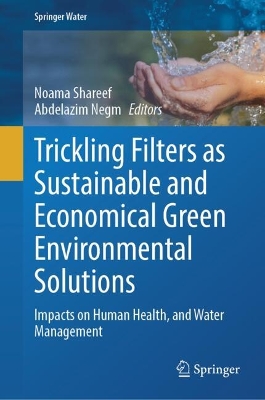
This book offers a clear, authoritative, and practice-oriented guide to modern trickling filter technology as a best practice, positioning it as an ecological, economical, and resilient solution for municipal and industrial wastewater treatment. Bridging more than a century of innovation, the book demonstrates why trickling filters remain a cornerstone of sustainable biological treatment systems worldwide. Through rigorous analysis and applications, the book explains the innovation in fundamental principles of biofilm systems, highlighting their efficiency, robustness, and role in achieving high-performance biological purification under diverse climatic and operational conditions. It critically examines classical and modern design philosophies, operational strategies, and process optimization techniques for modern-generation trickling filter systems.
The book provides in-depth coverage of integrated treatment approaches, combining trickling filter with activated sludge configurations applied worldwide, as well as novel hybrid systems that incorporate adsorption processes and bioaugmentation. Special attention is given to the removal of emerging contaminants and micropollutants, supported by pilot-scale studies and operational performance data Industrial applications are addressed through detailed discussions of biotower systems for food and beverage wastewater, while decentralized, resource-efficient solutions are explored through combinations of trickling filter anaerobic digestion. The book further evaluates design parameters, operational costs, performance indicators, and future development pathways, linking trickling filter technology to circular economy concepts, water reuse strategies, and sustainable development goals, with relevance to the MENA region. By reviewing theoretical models and current research trends, the book connects engineering practice with public health protection and sustainable water governance. It serves as an essential reference for academics, practicing engineers, decision-makers, regulators, and postgraduate students, and is equally valuable for professionals engaged in environmental engineering and water management worldwide.
Part I:Intrucution lays the foundation by tracing the origins,
evolution, and technical principles of trickling filters and biofilm
systems.- A Century of Making Trickling Filter Technology
Evolvement.- Biofilm System Performance in Biological Treatment by Using
Trickling Filter Technologies.- German Process Design Considerations for
Trickling Filter Systems.- Part II:Flixibity Applications of trickling
filters in different treatment concepts and levels.- Better Together Combined
Trickling Filter-activated Sludge Processes in USA.- Innovative Hybrid
Trickling Filters Combining Adsorption and Bioaugmentation for Efficient
Removal of Emerging Contaminants.-Biotower as an Efficient Solution for Food
& Beverage Industrial Wastewater Treatment.- Combining Trickling Filter with
Anaerobic Digestion as a Decentralized Wastewater Treatment System.- Part
II:Economic Aspects and Low Energy Consumption: Implications for Reduced
OPEX.- Design, Cost and development of trickling filter technologies in
wastewater treatment.- Assessing the Performance of Trickling Filters in
Wastewater Treatment.- Biofilm Support in Eliminating Drug Residues in a
Wastewater Treatment Plant Pilot.- Part IV: Summary: Trickling Filters
Evolution, Energy Efficiency, and Key Lessons.- Comprehensive Review of
Philosophical Perspectives and Research Status of Trickling Filter
Technologies.
Dr.-Ing. Noama Shareef is a Senior Water and Environmental Engineering Expert with over 15 years of experience in the German and international water sectors. She holds a Ph.D. in Water Management from University of Rostock, Germany, in addition to Bachelors, Diploma, and masters degrees in civilEnvironmental Engineering. Her expertise covers wastewater and sludge treatment, including WWTP and sludge unit design and evaluation, O&M, process optimization, biofilm systems, nutrient recovery, and reuse of treated water and sludge, supported by strong experience in process engineering, sanitation systems, and technical consultancy. Dr. Shareef has worked extensively across the MENA region with international development programs supported by KfW, USAID, GIZ, SIWI, SIDA, ACWUA, and the Arab League, contributing to water sector reform, infrastructure development, and sludge management strategies. She has led performance assessments of sludge treatment units, developed sludge management and O&M frameworks, and delivered capacity-building programs for utilities and operators. Her experience also includes served as a Water Policy Advisor with a European Water Association (EWA) representing over 1,400 members, strengthening her skills in business planning and strategic development. Dr. Shareef is a licensed Training Trainers (ToT) in wastewater O&M, water quality management, energy efficiency, water integrity, reuse, and decentralized wastewater systems. She is an Editor with Springer, a speaker at high-level international conferences, and a licensed Arbitration Consultant in International Commercial Arbitration.
Prof. Dr. Eng. Abdelazim Negm is a Professor of Hydraulics (and Water Resources) at the Faculty of Engineering, Zagazig University, Egypt, a position he has held since 2004. He previously served as Vice Dean of the Faculty of Engineering at Zagazig University (20082011) and as Head of the Environmental Engineering Department at the Egypt-Japan University of Science and Technology (E-JUST) from 2013 to 2016. Since 2006, he has been actively involved in numerous international and local and international research-funded projects, leading several of them. Prof. Negm has published more than 400 papers in national and international journals and conference proceedings and has contributed to over 50+ book chapters published by Springer. A number of his publications have received best paper awards. He has edited more than 60 books with Springer and has extensive experience in academic publishing and peer review. He has served on the scientific and organizing committees of many international conferences and has participated in more than 105+ conferences worldwide, including delivering several keynote lectures. He is a reviewer for over 50 international scientific journals indexed in Scopus and Web of Science. His editorial roles include Editor-in-Chief of the Egyptian International Journal of Engineering Sciences and Technology (20172020), editor of the Euro-Mediterranean Journal of Environmental Integration (Springer), and associate editor of journals published by Elsevier. He is also a member of the editorial boards of several international journals and an editorial board member of the Springer Handbook of Environmental Chemistry book series since 2019. In addition, he served as Head of the Permanent Scientific Committee on Water Resources at the Supreme Council of Egyptian Universities (cycle 13) and as a member in cycles 12 and 15. He is listed in major international biographical directories, including Marquis Whos Who in the World and the International Biographical Centres Outstanding Intellectuals of the 21st Century.

 Lisainfo e-raamatute kohta