Muutke küpsiste eelistusi

E-raamat: Understanding Greek Religion

(Kent State University, USA)
  • Formaat - PDF+DRM
  • Hind: 59,79 €*
  • * hind on lõplik, st. muud allahindlused enam ei rakendu
  • Lisa ostukorvi
  • Lisa soovinimekirja
  • See e-raamat on mõeldud ainult isiklikuks kasutamiseks. E-raamatuid ei saa tagastada.

DRM piirangud

  • Kopeerimine (copy/paste):

    ei ole lubatud

  • Printimine:

    ei ole lubatud

  • Kasutamine:

    Digitaalõiguste kaitse (DRM)
    Kirjastus on väljastanud selle e-raamatu krüpteeritud kujul, mis tähendab, et selle lugemiseks peate installeerima spetsiaalse tarkvara. Samuti peate looma endale  Adobe ID Rohkem infot siin. E-raamatut saab lugeda 1 kasutaja ning alla laadida kuni 6'de seadmesse (kõik autoriseeritud sama Adobe ID-ga).

    Vajalik tarkvara
    Mobiilsetes seadmetes (telefon või tahvelarvuti) lugemiseks peate installeerima selle tasuta rakenduse: PocketBook Reader (iOS / Android)

    PC või Mac seadmes lugemiseks peate installima Adobe Digital Editionsi (Seeon tasuta rakendus spetsiaalselt e-raamatute lugemiseks. Seda ei tohi segamini ajada Adober Reader'iga, mis tõenäoliselt on juba teie arvutisse installeeritud )

    Seda e-raamatut ei saa lugeda Amazon Kindle's. 

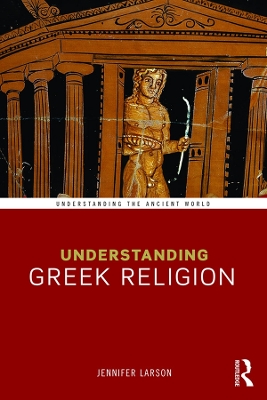
Understanding Greek Religion is one of the first attempts to fully examine any religion from a cognitivist perspective, applying methods and findings from the cognitive science of religion to the ancient Greek world. In this book, Jennifer Larson shows that many of the fundamentals of Greek religion, such as anthropomorphic gods, divinatory procedures, purity beliefs, reciprocity, and sympathetic magic arise naturally as by-products of normal human cognition. Drawing on evidence from across the ancient Greek world, Larson provides detailed coverage of Greek theology and local pantheons, rituals including processions, animal sacrifice and choral dance, and afterlife beliefs as they were expressed through hero worship and mystery cults.Eighteen in-depth essays illustrate the theoretical discussion with primary sources and include case studies of key cult inscriptions from Kyrene, Kos, and Miletos. This volume features maps, tables, and over twenty images to support and expand on the text, and will provide conceptual tools for understanding the actions and beliefs that constitute a religion. Additionally, Larson offers the first detailed discussion of cognition and memory in the transmission of Greek religious beliefs and rituals, as well as a glossary of terms and a bibliographical essay on the cognitive science of religion.Understanding Greek Religion is an essential resource for both undergraduate and postgraduate students of Greek culture and ancient Mediterranean religions.

Arvustused

"Understanding Greek Religion: A Cognitive Approach is the best possible introduction to ancient Greek religion. There is more to the Greek religion than poetic myths and strange rituals. Jennifer Larson starts from the crucial idea that the ancient Greeks were like us, in that they shared the same mental processes and lived in the same world. She shows how this means that there is a lot more that can be said about the role of religion in their lives than simple studies of the ancient texts can reveal. Anyone at all interested in ancient Greek religion should read this book."

- Professor Hugh Bowden, King's College London

"Providing a comprehensive introduction to ancient Greek religion, Larson (classics, Kent State Univ.) examines the customary topicsmyths, rituals, deities, mystery and hero cults, divination, festivals, games, processions, pollution, sacrifice, and so onfrom a thoroughly new perspective: cognitive science ... Larson shows how the dynamics of religious thought and behavior involve agency, dual processing (distinguishing intuitive and reflective processes), and counterintuitive concepts (making concepts memorable) and how mental tools enable humans to construct representations as the basis of religion. The glossary and bibliographical essay will guide students as they explore this new approach to Greek religion. This volume is a model for the study of the ancient world."

- L. J. Alderink, Concordia College

List of illustrations, maps and tables
ix
Preface and acknowledgments xii
Using this book xvii
Abbreviations xviii
1 What is Greek religion?
1(65)
Essay 1.1 Twelve gods, and other ways to limit a pantheon
23(8)
Essay 1.2 Homer's Hera and the Hera(s) of cult
31(9)
Essay 1.3 Reciprocity in Greek religion
40(26)
2 Implicit theology and the (ir)rational
66(61)
Essay 2.1 Epiphanies of Athena
88(7)
Essay 2.2 What do the gods know?
95(7)
Essay 2.3 Myth, ritual and Adonis
102(25)
3 Orthopraxy, identity and society
127(60)
Essay 3.1 The inclusiveness of the Panathenaic festival
142(6)
Essay 3.2 Dancing for the gods
148(8)
Essay 3.3 The Kyrene cathartic law
156(31)
4 Ritual, festival and sacrifice
187(63)
Essay 4.1 Sacrificing to Zeus Polieus on Kos
204(7)
Essay 4.2 Theseus and the Athenian calendar
211(8)
Essay 4.3 Ritual form and the Greek evidence
219(31)
5 Eschatology, mysteries and hero cults
250(60)
Essay 5.1 How mystical were the Eleusinian Mysteries?
268(8)
Essay 5.2 Texts to accompany the dead
276(7)
Essay 5.3 Three heroic founders
283(27)
6 Memory, continuity and change
310(64)
Essay 6.1 Memory and the Molpoi
327(9)
Essay 6.2 Heracles as a Pan-Mediterranean deity
336(9)
Essay 6.3 The origins of Sarapis
345(29)
Glossary 374(5)
The cognitive science of religion: A bibliographical essay 379(6)
Index 385
Jennifer Larson is Professor of Classics at Kent State University. Her research interests include Greek poetry, mythology and religion. She is the author of Greek Nymphs: Myth, Cult, Lore (2001) and Ancient Greek Cults: A Guide (2007).